You're Not Checking Email. Email Is Checking You.
The compulsive inbox loop isn't a time problem — it's an attention architecture problem. And the fix isn't a better email app.
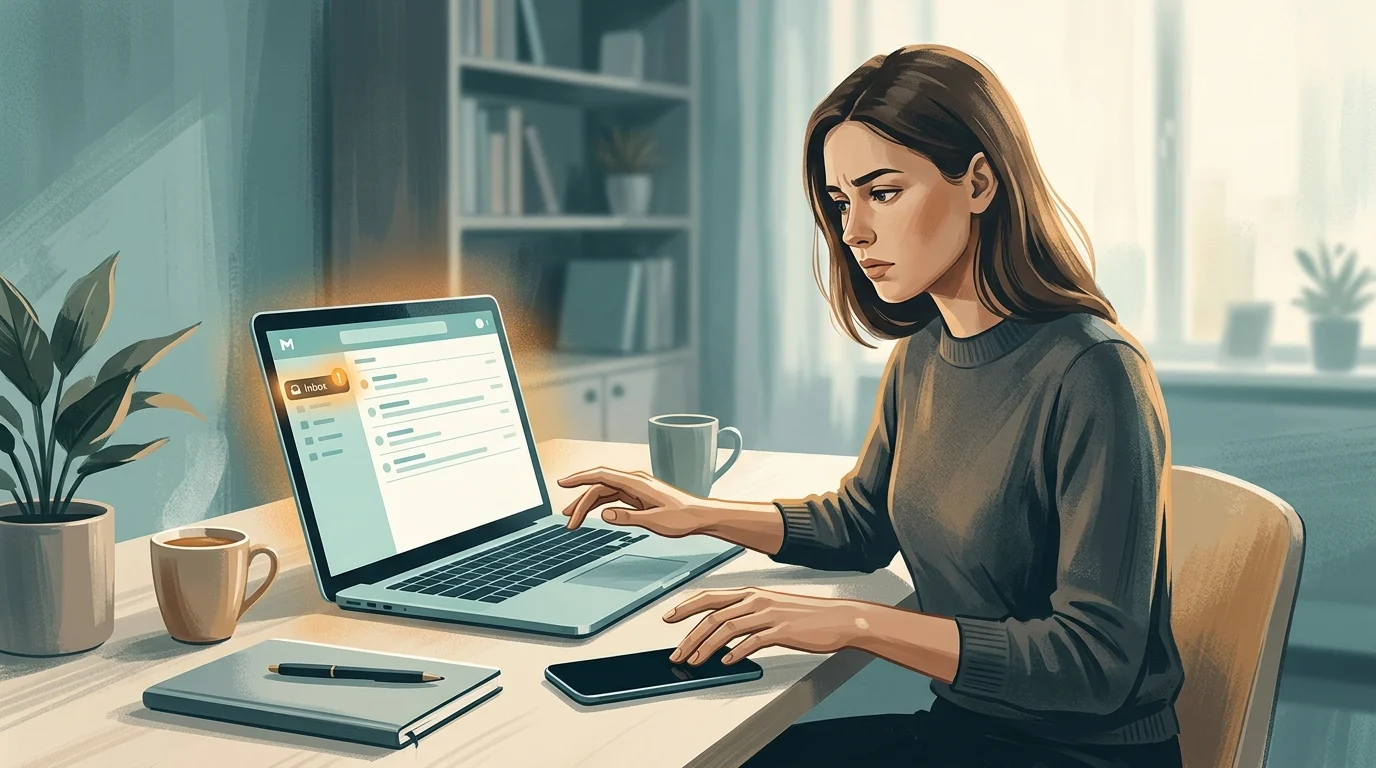
"I'll just check my email real quick." You've said this today. Maybe more than once. The sentence has the feeling of a plan — a contained, bounded action with a beginning and an end. It isn't.
The lie isn't in "email." It's in "just." Because "just" implies you're the one initiating, controlling, and concluding the action. But by the time you're three threads deep, tabs open, composing a reply you didn't plan to write, and now wondering whether you should forward that thing from last Tuesday — you weren't doing a quick check. You were pulled in.
Compulsive email checking is the pattern of opening your inbox more frequently than any real urgency requires — driven not by the needs of incoming messages, but by the discomfort of not knowing what's there. It's a productivity cluster bomb: each check fragments your attention in ways that compound silently across the workday. Most people have no idea how much it's costing them.
Why "Quick" Never Stays Quick
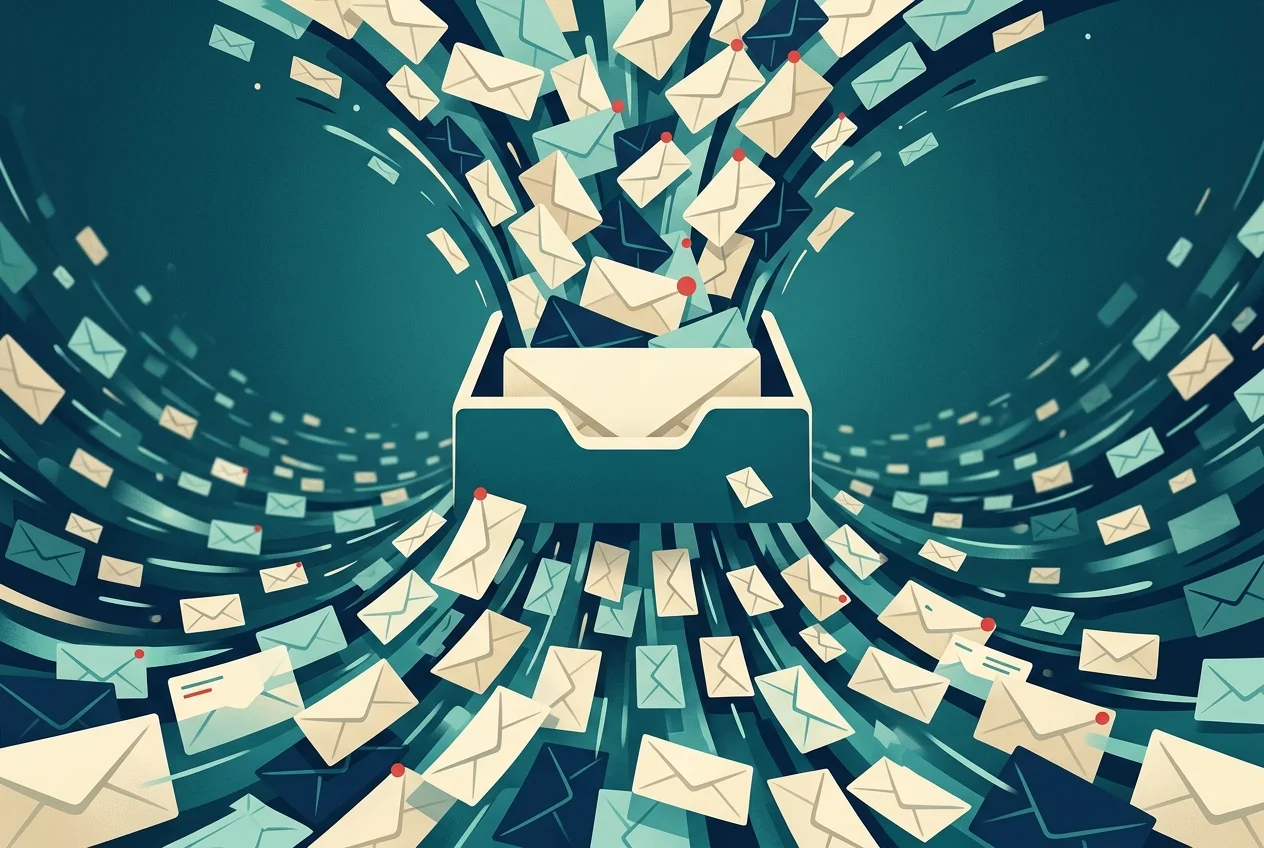
Microsoft's Work Trend Index found that the average knowledge worker receives 117 emails per day and is interrupted by email or notifications every two minutes during focus time — and roughly half of those interruptions are self-initiated. Not because a notification fired. Because the pull is there, waiting, and the gap between tasks is just quiet enough for the compulsion to speak up.
The mechanism behind it is the same one that makes slot machines the most addictive form of gambling. Psychologists call it variable-ratio reinforcement — you can't predict when the next reward will arrive, so you keep checking. Each inbox visit might contain something urgent, interesting, or validating. Or it might be three newsletters and an automated receipt. You never know until you look. And because you never know until you look, you keep looking.
The checking isn't irrational. It's your brain doing exactly what it's built to do when faced with an unpredictable reward signal. The problem is that email's architecture is perfectly calibrated to exploit this. Push notifications, the unread count badge, the little preview text visible just over your shoulder — none of these are accidents. They are deliberate design decisions that exploit the brain's prediction circuits to keep you checking more often than you need to.
The 23-Minute Tax You Pay Every Time You Check
Here's what makes the email habit expensive in a way that doesn't show up on any calendar. The cost isn't the checking itself — the actual act of opening the inbox takes seconds. The cost is in the refocusing.
Gloria Mark, a researcher at UC Irvine who has spent years studying workplace interruptions, found that after a single interruption, it takes an average of 23 minutes and 15 seconds to fully return your attention to the original task. And workers typically don't go straight back — they complete two unrelated tasks before circling around. You check email, you fire off a reply, you get pulled into a related thread, you spend some time thinking about a project that was referenced — and your actual work is still sitting there, waiting, twenty minutes older than it should be.
Multiply that by ten self-interruptions in a workday. That's not ten seconds of lost time. That's four hours of cognitive overhead spread invisibly across everything you're trying to do. The work gets done — people do compensate, often by working faster — but the context-switching cost is paid in focus quality and error rate, not just time.
Most people who check email constantly don't feel scattered. They feel responsive. That's part of what makes it hard to see. The inbox becomes a proxy for being engaged — a way of telling yourself you're on top of things, when what you're actually doing is trading depth for the appearance of availability.
Scheduled Blocks, Not Open Loops
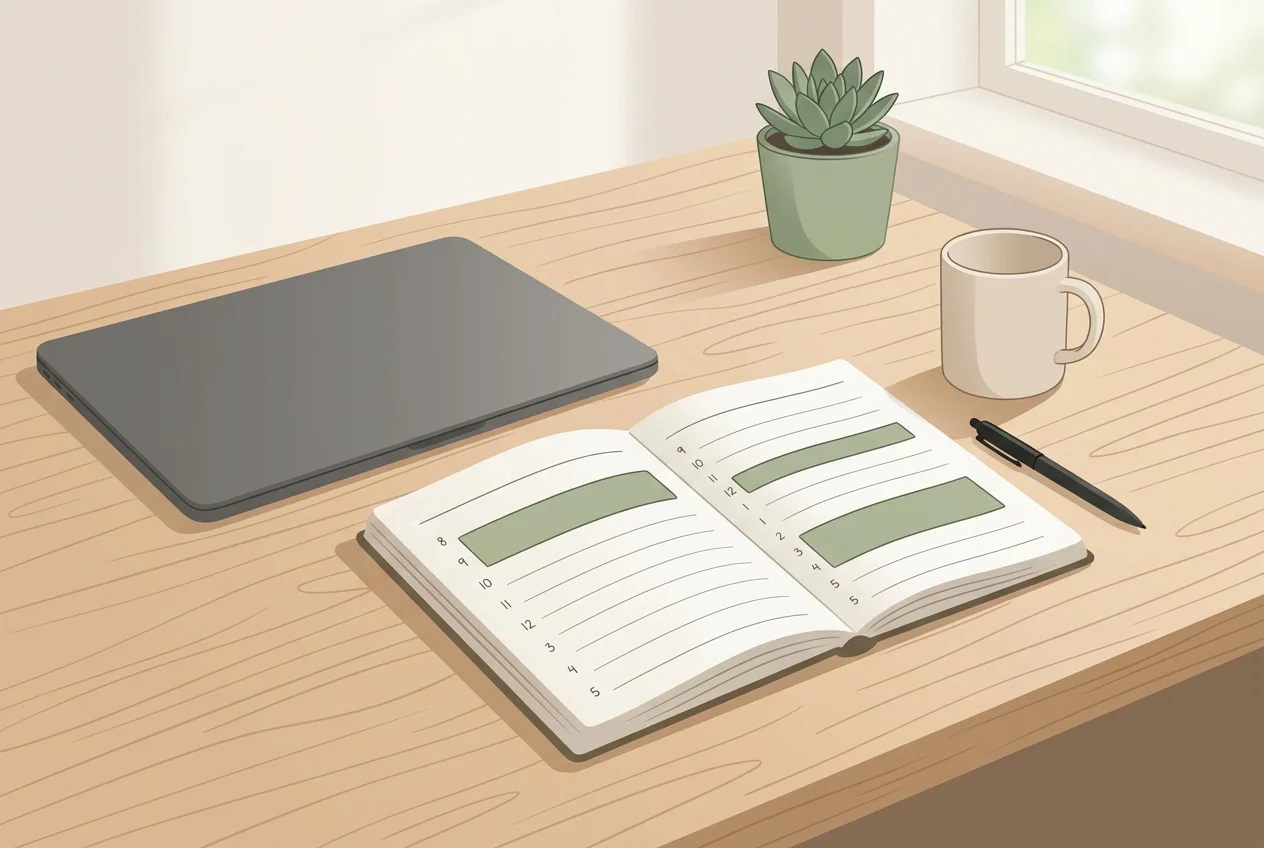
The structural fix is time blocking: schedule two or three specific windows for email each day and close the inbox completely between them. Morning, midday, late afternoon. Outside those windows, the tab is closed, the notifications are off, and email does not exist.
This feels alarming the first time you try it. You'll catch yourself reaching for the tab out of pure reflex — not because something came in, but because the habit is that old and that automatic. That's not a sign you're doing it wrong. That's the point. The reflex is what you're interrupting.
Cal Newport, who has written extensively about intentional technology use and deep work, argues that the shift from "always-on inbox" to "scheduled email" is one of the highest-leverage changes a knowledge worker can make. Not because email is bad. But because treating it as a background process — something always partially open, always partially competing for attention — makes focused work structurally impossible. You cannot do deep work with an open inbox. The two are architecturally incompatible.
A few practical changes that reinforce the structure:
- Turn off all email push notifications on your phone and desktop
- Close the inbox tab during deep work sessions — not minimize, close
- Set an auto-responder that tells people your check times, if your role allows it
- Use "do not disturb" mode to block the notification urge, not just mute it
- Resist checking outside your windows for two weeks — the compulsion fades faster than you expect
The goal isn't inbox zero. Inbox zero is a destination that resets itself every twelve hours. The goal is protected time — hours in your day where email cannot interrupt you, because you've decided in advance that it won't.
The Architecture Underneath the Compulsion
The deeper issue is that email checking — like phone scrolling — is not a willpower problem. Willpower is a finite resource that depletes across the day, and it was never designed to stand up against systems engineered specifically to override it. Every notification, every unread badge, every preview pane is a tiny piece of behavioral architecture pointed in one direction: toward more engagement.
You cannot out-discipline a design built to be addictive. This is the same principle that applies to digital minimalism broadly — the people who successfully reduce their screen time don't do it through heroic self-control. They do it by changing the architecture. They put friction between themselves and the behavior they want less of.
For email, that friction is time blocking. For social media apps, it's the same logic — which is where Sip & Scroll comes in. Before you can open an addictive app, the app asks you to take a quick sip of water and snap a selfie proving it. Not a hard lockout. A pause — five seconds of physical action that interrupts the automatic motion from "idle" to "scrolling" and gives your brain enough time to register a choice. You can still open the app. You just have to want it first.
The principle is identical whether you're dealing with your inbox or your Instagram feed. Friction doesn't remove desire. It creates a gap between impulse and action — and in that gap, you get to decide. That's not restriction. That's reclaiming the architecture of your own attention.
Protect your attention at the source.
Sip & Scroll adds gentle friction before addictive apps — a sip of water and a quick selfie, then 45 minutes of free access. The pause that makes scrolling a choice, not a reflex.
Download Sip & Scroll