BeReal vs Instagram: Why Authentic Social Media Is Still a Performance
BeReal changed the editing constraints. It didn't change the fact that you have an audience. And audiences, it turns out, change everything.
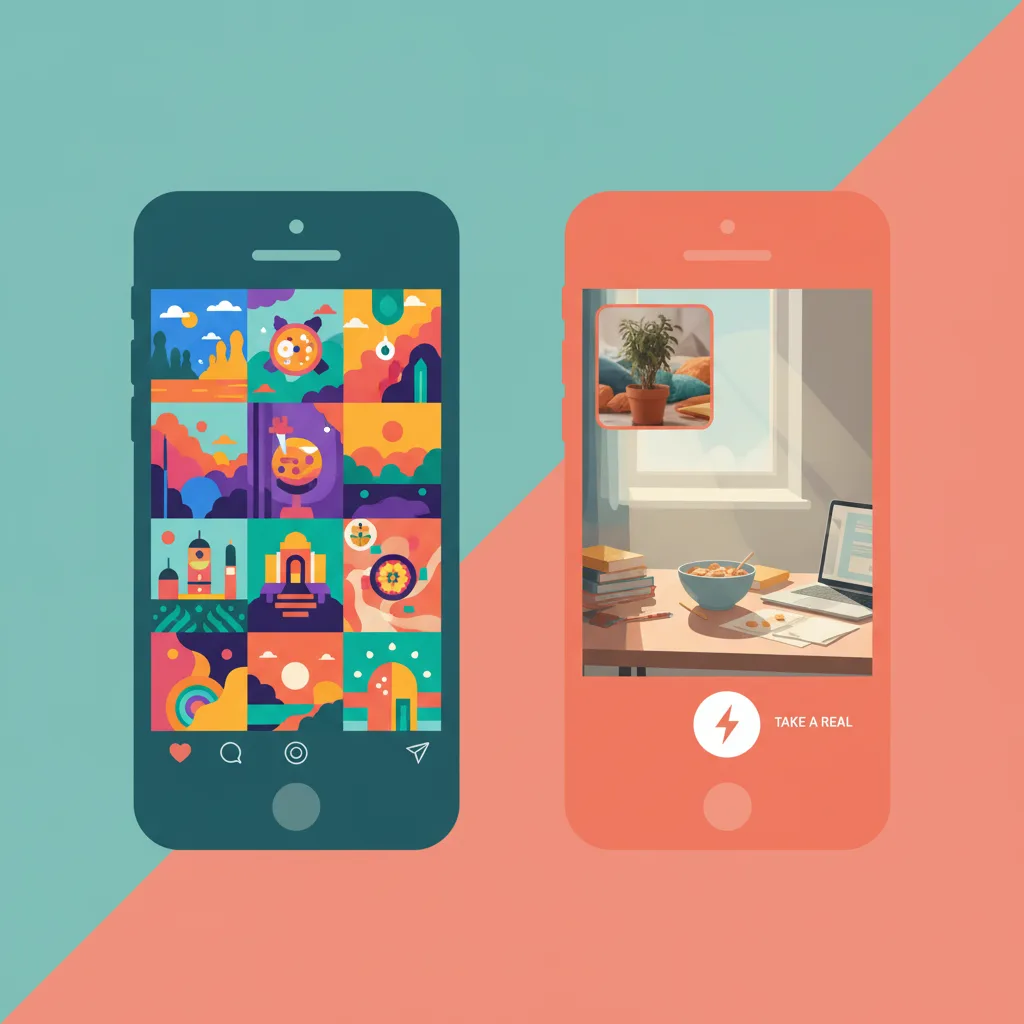
Notice what you do when the BeReal notification lands. The buzz, the word "Time to BeReal!" — and watch what happens before you open the app. Something in you is already assessing. What are you doing? Where are you? Is this worth posting? The notification is supposed to catch you unguarded, mid-life, unfiltered. And still, in that two-second gap, you're performing.
That tiny hesitation is the whole story of BeReal vs Instagram in miniature.
BeReal is a social media app built on a single premise: spontaneity enforced by design. It sends a daily notification at a random time, giving you exactly two minutes to photograph simultaneously with your front and back cameras — what you see and what you look like seeing it. No filters. No retakes after the window closes. If you post late, your friends can see exactly how many minutes you waited. The theory was elegant: remove the tools of curation and you remove the performance. What you'd be left with is authentic social media — real people, real moments, real life. That was the pitch. It spread fast enough to reach tens of millions of users within two years of launch. And then people figured out how to game it. They always do.
Instagram's Model: Performance as the Product

Instagram has never pretended to be anything other than a presentation layer for your life. When it launched in 2010, filters were the feature — you could make your ordinary Tuesday look like a Kodachrome memory from the 1970s. The explicit value proposition was transformation. Your food became photographic. Your vacation became cinematic. Your face became whatever the best version of it looked like at 11am in good natural light after the third attempt.
By 2022, 62% of U.S. teens were using Instagram, and the platform had evolved far beyond photo editing into a full identity-curation engine — Reels, Stories, Highlights, Close Friends, collabs. Every feature was another tool for controlling how you appear. The performance was the point. Nobody was surprised.
The problem wasn't that Instagram made life look curated. It was what that curation did to the people watching it. Experimental research cited by Jonathan Haidt at After Babel found that exposure to manipulated Instagram photos directly produced lower body image satisfaction and increased negative affect — measured immediately after exposure, in controlled conditions. The mechanism is social comparison — evaluating yourself against the edited highlights other people choose to share. You're not comparing your life to their life. You're comparing your interior experience to their exterior presentation. That's a contest with no winning condition.
BeReal's Experiment: Could You Engineer Honesty?
BeReal's founding insight was that curation tools are what corrupt social media, and that removing them would restore something more human. The dual-camera format was clever — you can't hide behind a beautiful scene if your face is also in the frame. The 2-minute window was designed to prevent considered positioning. The late-timer was meant to create social accountability for gaming the system.
It was thoughtful design. And it still didn't work. Not entirely.
The gaming happened quickly. People learned to hold the phone preemptively, pointed at something interesting, and wait. Or they let the notification expire and posted late — minutes, then hours — on the days when their real life wasn't presentable. Or they selectively kept their back camera pointed at something interesting while managing the front camera angle with practiced ease. The authenticity constraint turned out to be softer than it looked from the outside.
This isn't a critique of BeReal users for being dishonest. It's an observation about human behavior in the presence of an audience. Social psychologists call it the observer effect — or, in its most famous form, the Hawthorne effect — the documented phenomenon that people change their behavior when they know they're being watched. You can remove the filters. You cannot remove the fact that someone is looking.
When Instagram Copied BeReal — And Why It Didn't Help
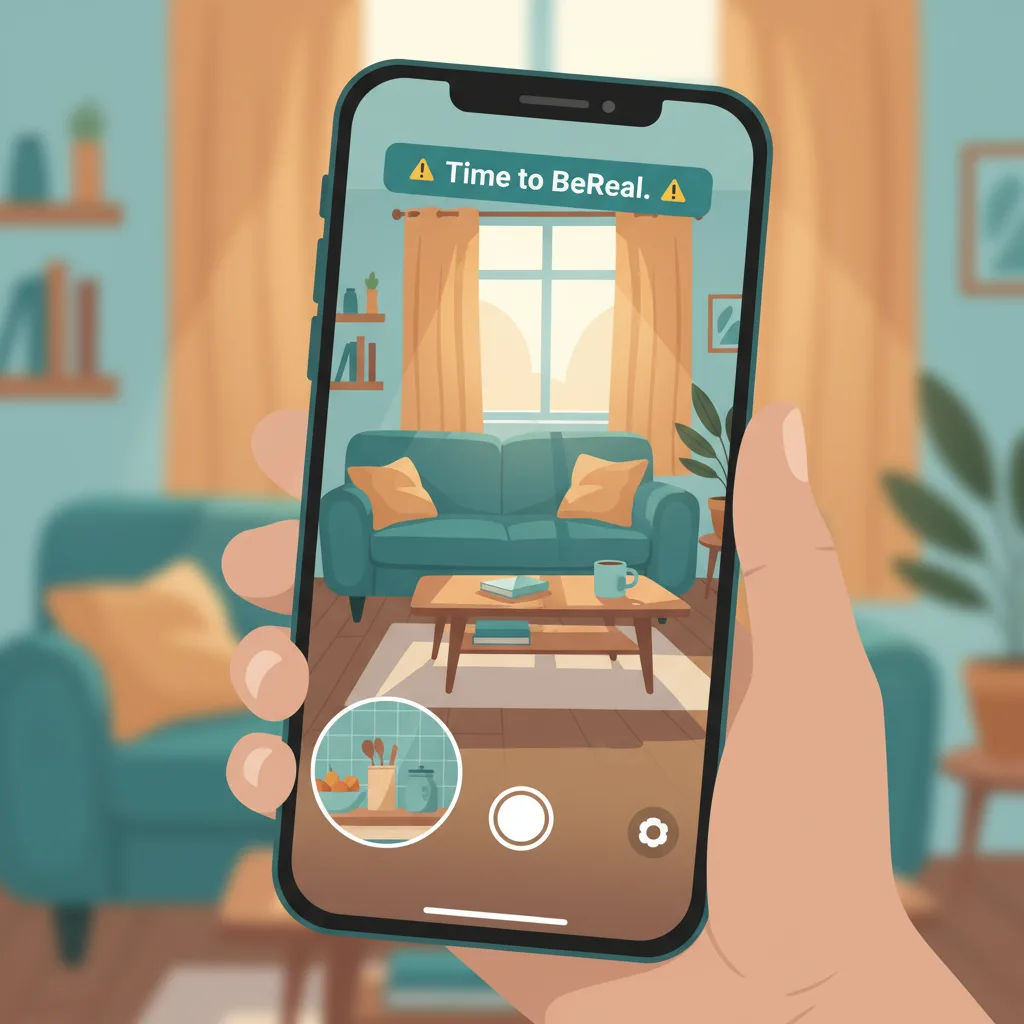
In 2023, Instagram launched Candid Challenges — a nearly direct copy of BeReal's core mechanic. Daily random notifications, dual-camera capture, limited editing. The feature arrived with Meta's usual speed and resources, and it had approximately zero effect on Instagram's fundamental nature.
That's instructive. When the platform with billions of users and every conceivable technical resource tried to graft authenticity onto a curation engine, the result was a slightly different format for carefully composed content. The audience was still there. The engagement metrics were still there. The social comparison was still there. Adding a honesty feature to Instagram is like adding a salad to a fast food menu — the nutrition is technically available, but it doesn't change the underlying incentive structure.
What determines how people use a platform isn't its stated values or its design constraints. It's what behavior the platform rewards. Instagram rewards beautiful, engaging content. It always has. BeReal's constraint was novel enough to temporarily override that dynamic for some users in some moments. But novelty fades. And when it does, you're left with the same audience, the same social comparison, and the same fundamental question: what do I want these people to think of me?
The Deeper Problem: Any Audience Creates Performance
Here's the thing neither platform can solve. The problem with social media isn't the editing tools or the lack of them. It's the audience itself — specifically, the experience of being observed while living your life, in real time, by a population of people who are also comparing themselves to you.
A landmark study published in PLOS ONE tracked participants multiple times daily for two weeks and found that the more they used Facebook, the worse they felt at subsequent check-ins — and the more their life satisfaction declined over the entire study period. Direct social interaction showed the opposite effect. The difference wasn't about content quality or curation. It was about what the platform interaction was doing to the psychological experience of being in relationship with other people — turning it into something measured, comparative, and always slightly insufficient.
BeReal's users weren't more authentic because they tried harder or cared more about honesty. They were operating under the same constraints as Instagram users: they had followers, and followers create an invisible performance pressure that operates below conscious choice. The mental health effects of social media don't come primarily from the editing — they come from the sustained experience of living your life as something being watched and evaluated.
No design mechanic removes that. It is the condition of the medium.
What Authenticity Online Would Actually Require
If the problem is the audience, and you can't eliminate the audience and still have a social platform, what does authentic social media actually look like? The honest answer is: it probably doesn't look like a platform at all. It looks like a text thread with three people you trust. A voice memo sent at midnight. A group chat that's too small for performance to feel worth it.
The scale is the problem. When your potential audience is everyone who follows you — hundreds, thousands, sometimes more — the stakes of any individual post are high enough to produce calculation, even unconsciously. When your audience is your best friend, you can afford to be boring, uncertain, half-formed. You don't need to be interesting. You just need to be present.
This is something worth noticing about your own usage. Watch what you feel in the moment before you post — not after, when you're watching for likes, but before. Is there a small audit happening? A question about how this will land? That's the performance. It lives in the gap between the experience and the share. The vocabulary people use to describe social media's effects on their mental health often focuses on the content they consume — but the production side, the self-curation, is equally costly.
You do not have to solve the BeReal vs Instagram question to start using either of them differently. The question worth asking isn't which platform is more honest — it's whether the time you spend producing and consuming social content is leaving you with more or less of yourself than you started with.
That's a question a platform can't answer for you. But a pause before you open it might help you hear the answer more clearly. Sip & Scroll builds exactly that pause into the habit — a sip of water before you open any app you've flagged, giving your brain a two-second window of intentionality before the feed loads. Not a wall. A breath. It won't make Instagram authentic. But it might make your scrolling session a choice rather than an accident.
This article is part of our series on social media addiction and brain rot. For the full picture, see our guide: Is TikTok Giving You ADHD, or Is It Just Brain Rot?.
Make every scroll a choice.
A sip of water before Instagram, TikTok, or BeReal. Small friction, big difference.
Download Sip & Scroll