The Phone-Reaching Reflex: What to Do Instead of Scrolling in Filler Moments
The quiet gaps between activities are where phone habits live. Here's how to fill them with something that doesn't leave you feeling worse.

Before you've decided to check your phone, it's already in your hand. The line at the coffee shop has stopped moving. The meeting hasn't started yet. The elevator doors closed behind you. There's a pause — half a second, maybe a full one — and then the phone is there, screen on, and you can't quite remember making that choice.
That's the filler moment. The brief, unstructured gap between tasks, places, or intentions. Waiting in line, the elevator ride, the minute before a call connects, the transition from one thing to the next. These moments used to be ordinary — you'd think about something, notice something, do nothing in particular. Now, for most people, they're immediately occupied by a screen.
What to do instead of scrolling isn't primarily a question of willpower or discipline. It's a question of what behavior you've pre-loaded to fill the gap. The phone-reaching reflex runs on automatic — trained by thousands of repetitions — and you can't reliably override an automatic behavior with a conscious decision made in the moment. What you can do is train a different automatic behavior to take its place.
Why the Filler Moment Is Where the Habit Lives
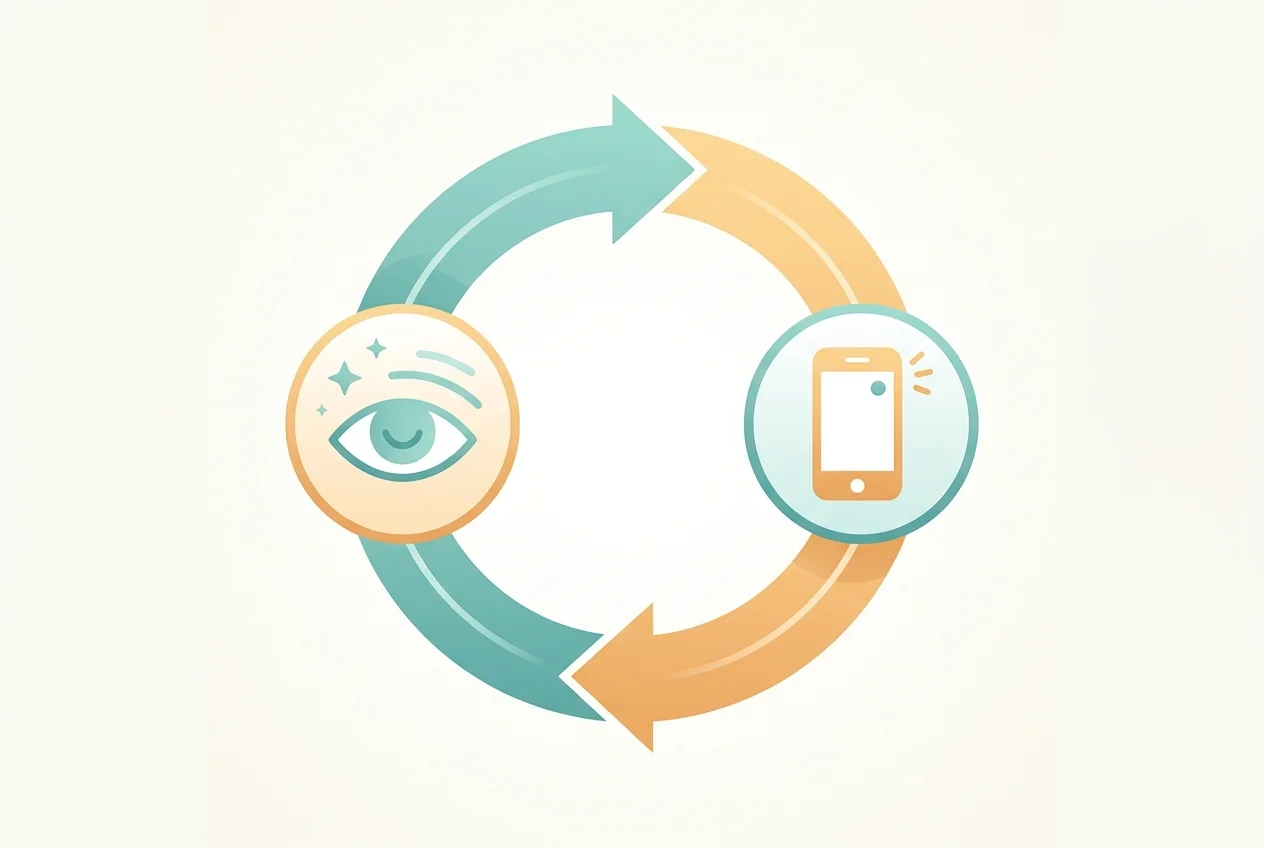
The phone-reaching reflex isn't random. It concentrates in the transitions. Finishing a task and not yet starting the next one. Standing up from your desk. The thirty seconds while the microwave runs. These are the cognitive soft spots — moments when one frame of activity has ended and another hasn't begun, leaving a brief window of unoccupied processing.
Your brain experiences that window as mild discomfort. Not boredom, exactly — more like the slight restlessness of an engine idling. And it has learned, through repetition, that the phone resolves the restlessness. Not well, and not for long. But immediately. Dopamine drives seeking behavior — the reaching, the checking, the scrolling — not pleasure itself. Your brain doesn't reach for the phone because it expects to feel good. It reaches for it because reaching has become the automatic response to the specific sensation of an open gap.
This is important because it means the cure isn't suppression — it's substitution. You need a different behavior that's triggered by the same cue and provides enough resolution to satisfy the seeking impulse. Something you've already decided on, so you don't have to decide in the moment when your brain is already mid-reflex.
Research on digital technology and brain health consistently finds that the default mode network — the neural system associated with rest, reflection, and internally-directed thought — is suppressed when the brain is continuously stimulated by screens. The filler moments are when the default mode network wants to activate. The phone prevents it. When you protect those gaps from your phone, you're not just avoiding distraction. You're letting your brain do something it's been trying to do all day.
What Actually Works in a Filler Moment
The criteria for a filler-moment alternative are specific. It has to be: available without any setup, completable in 30 seconds to 3 minutes, not reliant on willpower to initiate, and — ideally — something that leaves you better off than you would have been scrolling.
Here are the ones that consistently work across different contexts:
Box breathing. Four counts in, four counts hold, four counts out, four counts hold. One cycle takes about 16 seconds. Three cycles takes under a minute. It activates the parasympathetic nervous system, reduces cortisol, and gives your brain something specific to do that doesn't require a screen. It's invisible, works in any setting, and can be abandoned mid-cycle if the line starts moving. This is the easiest one to install as a default because it requires no supplies and no decision.
Water. If you have it with you, drink some. It's a physical action that occupies the hands, takes 15-20 seconds, and is unambiguously good for you. It sounds too simple to matter, but its simplicity is the point — it's a behavior that competes directly with the phone-reaching motion (both involve picking something up) and wins at least some of the time. Sip & Scroll is built around exactly this observation.
Environmental observation. Look at the room. Pick three things you haven't noticed before. This activates the same novelty-seeking circuitry that the phone exploits — your brain is still scanning for something interesting — but it's directed outward at the actual environment rather than at an engineered feed. It's a mild form of the mindfulness skill that makes long-term phone reduction easier: noticing what's here, rather than reaching for what might be somewhere else.
One text to one person. Not opening a social app. One specific text to a specific person you've been meaning to reach — you probably have a few in mind right now. This takes two minutes, uses the phone, and produces a real social connection rather than a simulated one. It also ends naturally, which scrolling doesn't.
Mental planning. Walk through the next two hours. What's next? What do you need to have ready? What haven't you thought about yet? This works especially well in the transitions between activities because your brain is already half-oriented toward what comes next. Directing that orientation deliberately — rather than filling it with a feed — turns an idle moment into a low-key planning session.
A single stretch. Roll your neck, open your chest, loosen your shoulders. These are the areas that tighten with phone use and screen-forward posture. A filler moment is exactly the right time to undo 90 minutes of sitting in the same position, and the movement gives your nervous system something physical to process. You'll notice your next period of focus is easier than it would have been.
Podcasts or audiobooks (for longer waits). If the gap is 5 minutes or more — waiting for an appointment, riding transit — audio gives you something genuinely interesting without requiring your eyes or fragmenting your attention across 12 different formats. You stay in one thing. It ends when the wait ends. The difference between a podcast and an Instagram feed isn't just content quality — it's that a podcast doesn't have an infinite scroll.
The Micro-Habit Framework: Making It Automatic
None of these work reliably if you try to decide in the filler moment itself. The goal is to decide in advance what you'll do in specific contexts — so that when the gap appears, the behavior is already loaded.
Pick two contexts where the phone reflex is strongest — maybe "waiting in a line" and "between ending a task and starting the next one." For each context, assign one alternative behavior. Not a menu of options. One.
"When I'm waiting in a line, I breathe." That's a complete rule. Write it down if it helps. The specificity is what makes it executable. "I'll try to be more mindful with my phone" is too diffuse to trigger automatically. "Line → breathe" can be encoded as a habit.
The first week is conscious. You'll remember the rule inconsistently. You'll succeed some filler moments and miss others. By week two, the new association is strengthening. By week three, the rule sometimes fires before you've consciously invoked it. That's habit formation — not discipline, just repetition.
What helps the replacement take hold is reducing the phone's availability during transitions. Keep it in your pocket or bag rather than in your hand. When the phone isn't already in your hand, the filler moment passes through its window and the alternative behavior has a chance to run. This is why physical distance from your phone works — not because distance prevents you from reaching for it, but because it creates a beat of friction that gives the alternative behavior time to load.
When You Still Want to Scroll
Sometimes the filler moment is long, you're genuinely tired, and you want to look at something. That's fine. The goal isn't to eliminate scrolling from every transitional moment of the day — it's to make it a choice rather than a reflex.
This is exactly where Sip & Scroll fits in. When you reach for Instagram or TikTok, it pauses you for a sip of water and a quick selfie. The pause itself — five seconds of a different physical action — is enough to interrupt the automatic and give your prefrontal cortex a moment to participate. You still get your 45 minutes of unblocked access. But you've arrived there deliberately, not drifted there from a filler moment that carried you somewhere you didn't choose.
Most filler moments don't actually call for a phone. They call for a beat of rest, or a breath, or a glance at the world that's already around you. The phone habit colonized those moments because it was always there, always easy, always delivering just enough to keep the hand from putting it down. But the moments themselves are yours. And they're surprisingly good once you stop filling them before they can fill themselves.
This article is part of our series on digital minimalism and intentional phone use. For the full picture, see our guide: Digital Minimalism: A Practical Guide.
Turn the scroll reflex into a ritual
Sip & Scroll adds a sip of water and a selfie before you scroll — a 5-second pause that converts a reflex into a choice. Then 45 minutes of intentional access.
Download Sip & Scroll