Nomophobia: The Science Behind the Fear of Being Without Your Phone
It's not just attachment. It's a measurable anxiety condition — and your phone's design is why it keeps getting worse.

"I just need to have it with me." Most people who carry their phone into every room — every meeting, every bathroom, every ten-foot walk to the kitchen — have said some version of this to themselves. It sounds like practical caution, not compulsion. What if there's an emergency? What if someone needs to reach you? What if you need a map and don't know the way?
Notice what happens the next time you leave without it. The triple-check of your pockets at the door. The moment of decision — go back or continue — that feels slightly weightier than it should for a piece of glass. Then the first ten minutes outside: a background hum that isn't quite anxiety but sits right next to it, a sense that something is unresolved.
That background hum has a clinical name. Researchers call it nomophobia — and it affects far more people than most realize.
Nomophobia — short for no-mobile-phone phobia — is the fear or anxiety triggered by being without access to your smartphone. It's not the same as simply preferring to have it nearby. Clinical nomophobia produces measurable psychological and physiological responses: restlessness, irritability, compulsive checking behaviors, and a persistent sense of exposure when the device is unavailable. A 2025 meta-analysis of 43 studies across 36,656 participants found that 51% of smartphone users experience moderate nomophobia symptoms and another 21% report severe symptoms — meaning nearly three-quarters of regular smartphone users aren't just attached to their devices. They're measurably anxious without them.
What Nomophobia Actually Measures
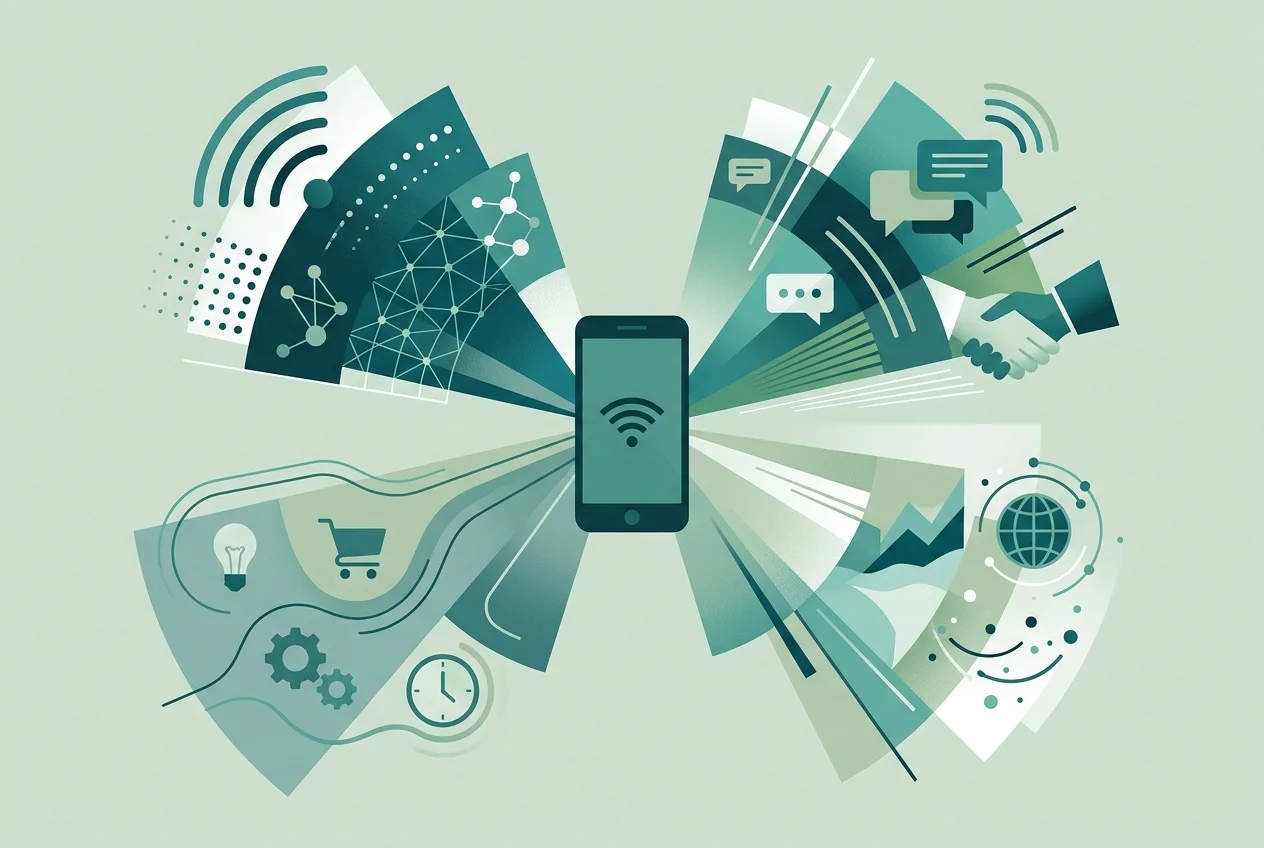
The term entered academic research following a 2012 UK survey that found roughly two-thirds of users reported significant distress at the prospect of phone separation. But the science has grown considerably since then. In 2015, researchers Yildirim and Correia developed the Nomophobia Questionnaire (NMP-Q) — now the most widely used validated instrument in the field — and what it revealed was that nomophobia isn't a single, unified fear. It clusters around four distinct dimensions:
- Not being able to communicate — anxiety about being unreachable to others
- Losing connectedness — fear of being cut off from your social network and its ongoing feed
- Not being able to access information — distress at losing on-demand access to search, maps, and facts
- Giving up convenience — discomfort at losing the utility layer the phone provides (alarms, payments, tickets)
What's striking about this breakdown: only two of the four dimensions involve other people. The fear of missing a call is social. The fear of not being able to search something is not. It's a specific attachment to a system of convenience — and systems, unlike relationships, are much harder to rationalize your way out of depending on.
This distinction matters clinically. If nomophobia were purely social anxiety with a phone-shaped trigger, social anxiety treatment would resolve it. It doesn't. Because the fear isn't only about losing people. It's about losing access — to information, to utility, to the system that manages uncertainty in your daily life.
Why Your Brain Can't Just Let Go
Developmental psychologists describe something called a transitional object — a security blanket, a stuffed animal — that provides comfort during separations from primary caregivers. The object's value isn't in itself; it's what it represents: continuity, availability, the capacity to manage uncertainty in the absence of direct support. Children use them to self-regulate. Adults, it turns out, have developed a functionally identical relationship with their smartphones.
This isn't metaphor. Clinical research has documented that smartphone separation produces measurable physiological stress responses — not just self-reported feelings of discomfort. Elevated cortisol, increased blood pressure, impaired cognitive task performance. The brain reads the missing phone as a real threat, not an abstract inconvenience. Documented physical symptoms include "anxiety, respiratory alterations, trembling, perspiration, agitation, disorientation, and tachycardia" — the same physiological signature as other specific phobias.
The dopamine layer compounds this. Every notification is a variable-ratio reward — you don't know if the next alert will be trivial or genuinely important, so your brain maintains a low-level anticipatory state across the day. When you separate from the device, that anticipatory state has nowhere to resolve. The discomfort you feel is an interrupted dopamine loop, registered by your nervous system as a kind of hunger. This is also what makes smartphone withdrawal symptoms feel surprisingly physical — the restlessness isn't psychological fragility. It's a conditioned reward system coming up empty.
The Safety Behavior Loop
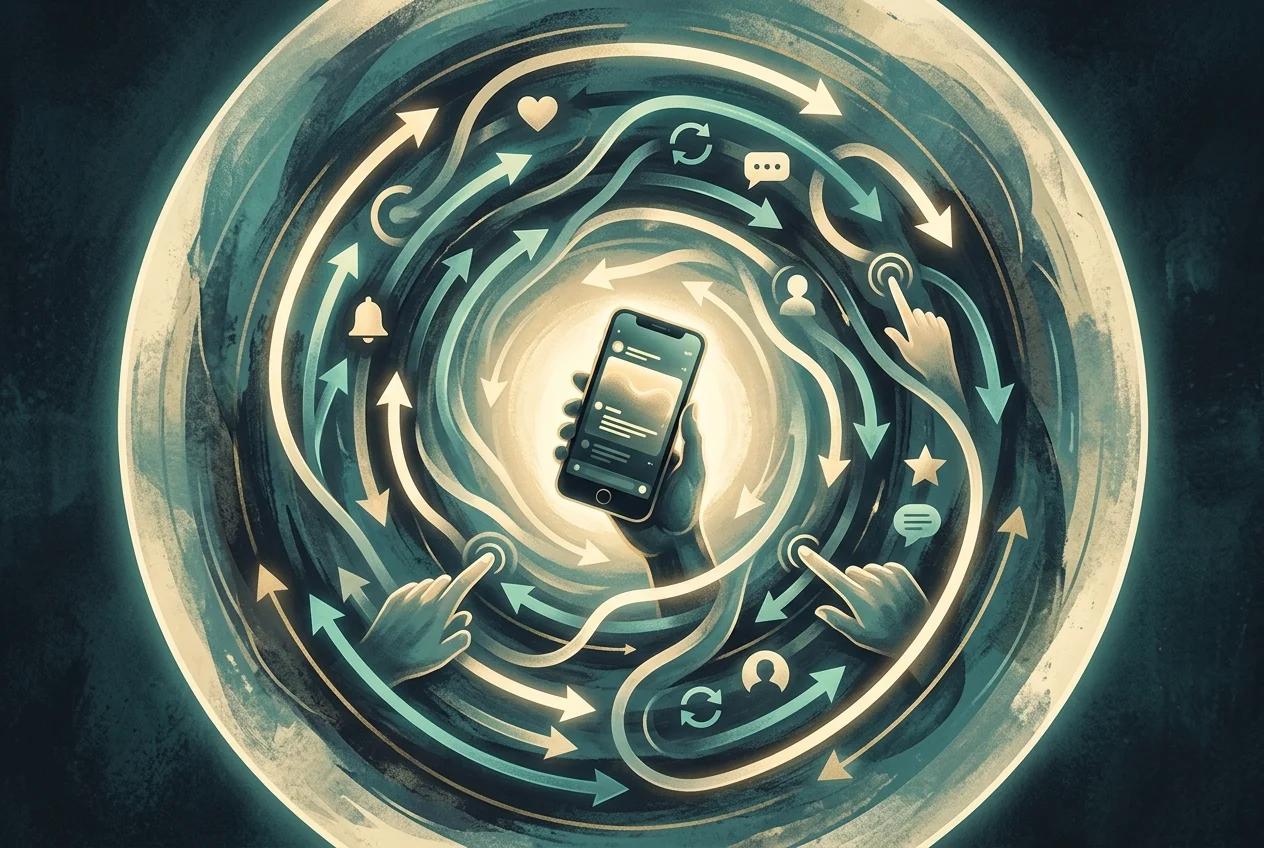
Nomophobia doesn't stay at whatever level it starts at. It escalates through a mechanism that clinical psychologists recognize from other anxiety conditions: the safety behavior cycle.
Here's how it works. You feel low-level discomfort about being without your phone. You check it — or carry it with you specifically to avoid the discomfort — and the anxiety subsides. Your nervous system files this as a successful solution. The next time anxiety surfaces, it routes you back to checking or carrying. Each cycle reinforces the association between separation and threat, and gradually lowers the threshold for discomfort. Over months, even brief voluntary separations produce a pull that feels disproportionate to the actual stakes.
You're not maintaining your dependency. You're actively training it.
The relationship between screen time and anxiety shows this loop with particular clarity: heavy phone use correlates with higher baseline anxiety, which correlates with heavier phone use. Each direction feeds the other. The tool you're using to manage the anxiety is, in part, the source of it. Notice what happens the moment you find your phone after misplacing it — the small release of tension. That relief is the safety behavior paying off. Which is exactly the problem.
Is This Nomophobia or Just a Habit?
The distinction isn't about frequency of use. It's about what happens when you can't.
A few questions worth sitting with:
- Does your battery hitting 15% trigger something that feels closer to urgency than inconvenience?
- Do you bring your phone into situations where you know it won't be needed — primarily because leaving it behind would feel uncomfortable?
- When you can't find your phone, do you notice a physical response — faster breathing, a spike in alertness — before you've had time to evaluate whether this is an actual problem?
- Does the possibility of missing a message create anxiety that persists after you've acknowledged, rationally, that the message can wait?
Two or three yeses places you in the mild-to-moderate range — where most regular smartphone users land. One systematic review found that nomophobia correlates with "negatively affected personality, self-esteem, anxiety, stress, and academic performance" in the populations studied. Not dramatically or acutely. Subtly, persistently, over time.
Nomophobia is not yet in the DSM-5 as a standalone diagnosis. But researchers increasingly argue it meets the criteria for a specific phobia — and a body of validated measurement tools now exists for assessing it clinically. The question of whether it "counts" matters less than whether the pattern is costing you something.
The Structural Fix
The standard advice for phone anxiety is some version of "just put it down more." This is accurate the way telling someone with a fear of heights to just look down more is accurate. The anxiety doesn't live in the conscious, rational layer of your brain where willpower operates. It lives in the subcortical systems that govern threat detection — the systems that generate a flinch before you've had time to evaluate whether there's actually anything to flinch at.
What clinical research consistently supports is graduated exposure: deliberately and incrementally increasing your tolerance for phone separation. Leave it in one room while you're in another — for a meal, then a walk, then an evening. The goal isn't to prove the phone is unimportant. The goal is to accumulate repeated experiences of separation without consequence, so your nervous system revises its threat estimate downward. Each uneventful separation is a small recalibration.
This works better with structural support. Digital minimalism — deliberately redesigning your environment so phone use is a conscious choice rather than a default — removes the ambient pull that makes every separation feel like a small deprivation.
Sip & Scroll takes a complementary approach. Rather than forcing separation — which activates the anxiety response you're trying to reduce — it inserts a brief physical ritual before each session with addictive apps. A sip of water. A quick selfie. A few seconds of deliberate participation in the choice. What that pause does, neurologically, is insert prefrontal cortex involvement into what would otherwise be a pure subcortical reflex. You're not being blocked. You're being asked to consciously decide.
Over time, every pause that ends without catastrophe is evidence your nervous system uses to revise its estimate of how dangerous phone separation actually is. The phone is not the problem. The reflexiveness is. And reflexes change through exactly the mechanism by which they were formed: repetition.
This article is part of our series on phone addiction and doomscrolling. For the full picture, see our guide: What is Doomscrolling?.
Reclaim the pause your nervous system needs.
A sip of water before the scroll. Small friction, real change.
Download Sip & Scroll