Your Brain Doesn't Have an Attention Problem. It Has a Container Problem.
The Pomodoro technique isn't a time hack — it's a structure that gives attention edges. Here's how to use it to rebuild focus when the ability to concentrate feels gone.
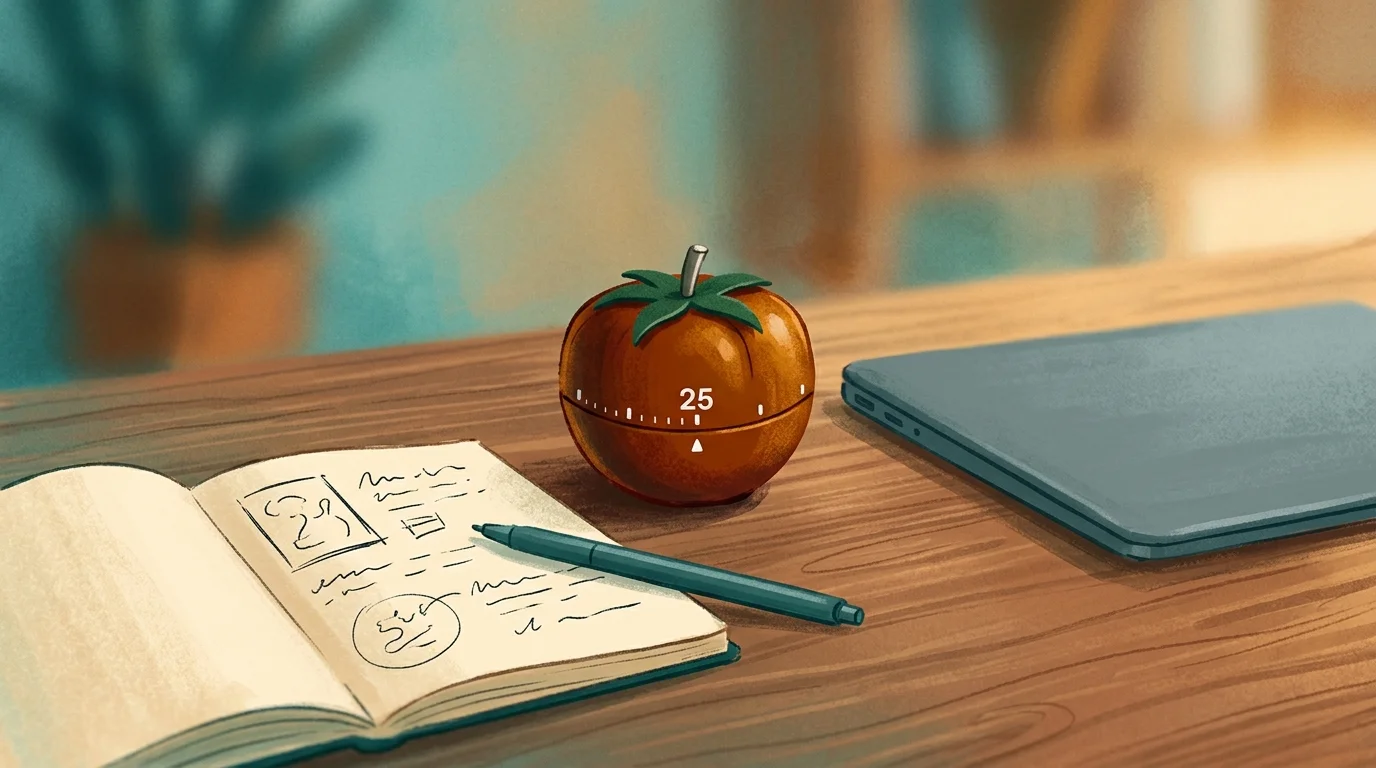
Notice what happens to your focus in the first minutes of any task you haven't set a time for. It doesn't simply start — it hesitates, skirts the edges, checks something adjacent, remembers an email it should have sent, and settles into something that looks like working but isn't quite. Not because you lack discipline. Because attention, left without a container, does what any fluid does: it spreads.
This is the thing the Pomodoro technique actually fixes. Not your schedule. Not your calendar. Your attention's relationship with edges.
The Pomodoro technique is a focused work method built on 25-minute intervals — called Pomodoros — each followed by a 5-minute break, with a longer 15–30 minute break after every four sessions. Developed by Francesco Cirillo in the late 1980s (named after the tomato-shaped kitchen timer he used as a student), it's become one of the most widely practiced attention management methods in the world. Not because it's complicated. Because it's a container — and a container is what scattered attention needs most.
Why Attention Needs a Container

Your brain's capacity for sustained, high-quality attention is finite and measurable. Cognitive neuroscience research has documented that most people can maintain peak focused attention for roughly 20 to 45 minutes before performance begins to decline — not because of character weakness, but because the neurochemicals that drive motivation and focus, including dopamine and acetylcholine, deplete during sustained effort and need time to recover.
This mirrors the ultradian rhythm — the 90-minute biological cycle that governs both sleep architecture and waking attention. During the day, your brain cycles through periods of high alertness followed by a natural dip. The 25-minute Pomodoro interval is designed to work inside a single high-alert window, stopping before the decline arrives rather than pushing through it into diminishing returns.
The other reason attention drifts without a container is the cost of switching. When there's no defined end to a task, every interruption — a notification, a wandering thought, an unopened tab — presents itself as equally valid. The task has no boundary, so the interruption doesn't have to force its way in. It just fills the available space. A timer changes this. When you know the session ends in 18 minutes, the interruption has to compete against something concrete: this defined window. Most interruptions lose that competition.
The Pomodoro Method, Step by Step
The actual method is simpler than most productivity systems, which is part of why it works:
- Choose a single task. One task per Pomodoro. Not "work on the project" — "write the second section of the draft." The specificity matters. Vague tasks create vague focus.
- Set a timer for 25 minutes. A physical timer is better than a phone timer. Your phone is a distraction engine; don't ask it to help you focus.
- Work on that task only. If something else surfaces — an idea, an email urge, a thing you just remembered — write it down on a piece of paper and return to the task. The thought is captured; your attention stays where it is.
- When the timer rings, stop. Even if you're mid-sentence. Stopping builds the psychological safety that makes starting easier next time.
- Take a 5-minute break. Stand up. Move. Look away from the screen. Don't check your phone — the break is cognitive restoration, not entertainment.
- After four Pomodoros, take a longer break — 15 to 30 minutes. Eat something. Walk outside. Let the system reset before the next block.
That's it. The power isn't in the complexity. It's in the repetition — and in what the structure trains your brain to do over time.
Why the Break Is the Whole Point
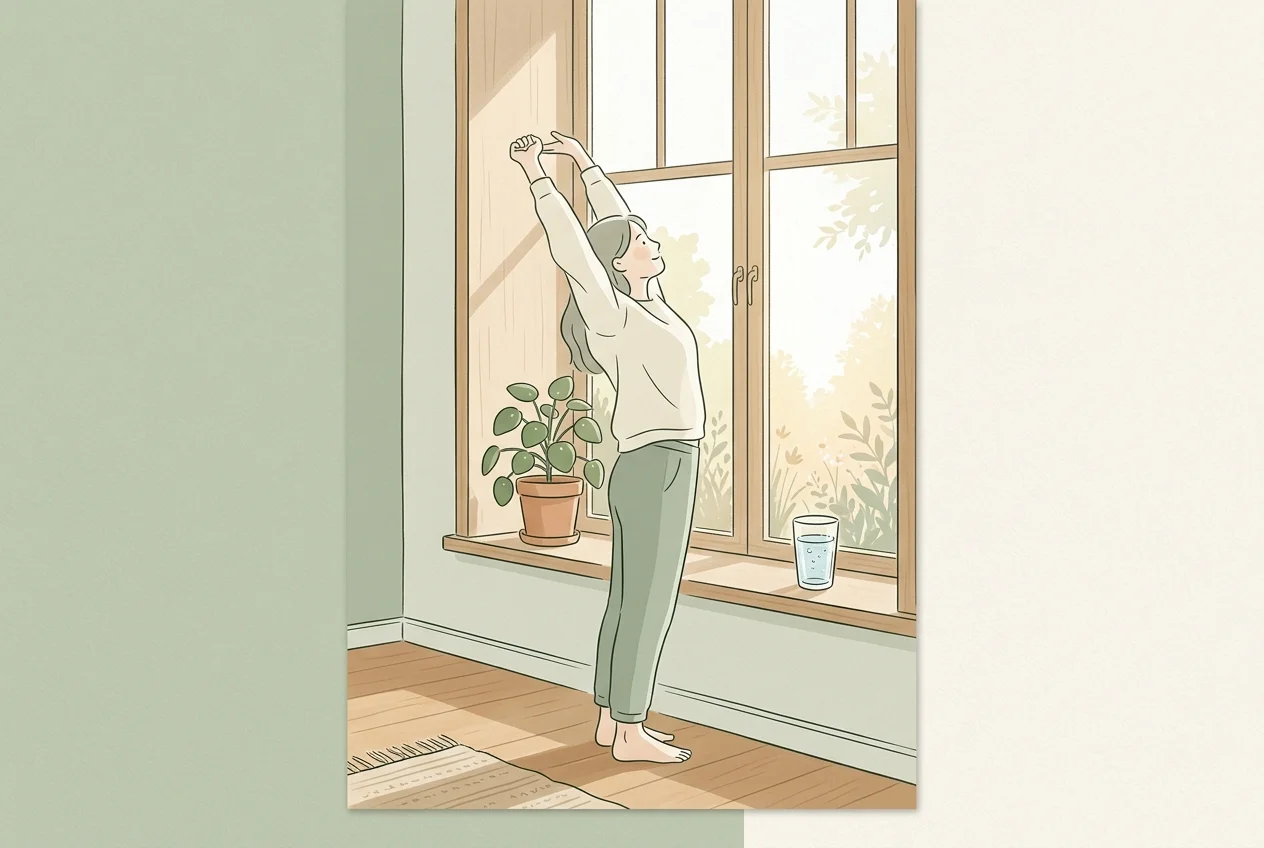
Most people treat the Pomodoro break as a reward for completing the work interval. It isn't. The break is where mindful productivity actually happens — where the brain deactivates the working memory load, consolidates what it just processed, and restores the neurochemical baseline for the next round. Without the break, the sessions compound into fatigue rather than focus.
The worst thing you can do with a Pomodoro break is check social media or email. Both re-engage the same attention systems the break is supposed to rest. You can't restore a depleted focus resource by pulling it in a different direction at the same intensity. The break needs to be genuinely low-stimulation — movement, a drink of water, looking at something that isn't a screen.
The Phone Rule That Makes It Actually Work
There is one variable that determines whether a Pomodoro session is genuinely focused or just 25 minutes sitting at your desk: where your phone is.
Research from the University of Texas at Austin found that the mere presence of a smartphone on your desk measurably reduces available working memory and fluid intelligence — even when the device is face-down, silent, and off. The brain allocates a portion of its resources to actively resisting the pull toward the phone, leaving less for the task. Put the phone in another room and that resource comes back.
This sounds extreme. It isn't. The phone on the desk isn't neutral furniture — it's a competing priority dressed as an object. And during a 25-minute Pomodoro, you want competing priorities removed from the room entirely, not just muted.
Here's what a Pomodoro-ready environment looks like: timer set, phone in another room, inbox tab closed, a single task defined. Everything else — the scrolling, the checking, the wandering — has been pushed outside the container. Inside the container, there's only this: 25 minutes and one thing to do.
The Pomodoro technique is, at its core, a friction system. It creates a structured boundary between your attention and the things competing for it — and it does this without requiring willpower to hold that boundary, because the timer is doing the holding. This same principle extends to the apps pulling at your attention outside of work. You can't out-discipline a design built to interrupt you. You need a structure that makes the choice for you, so you don't have to make it a hundred times a day. That's what Sip & Scroll does for your phone the same way a timer does for your work: it adds a brief, intentional pause — a sip of water and a quick selfie — between the impulse to open an addictive app and the act of opening it. Not a wall. An edge. The container that makes the choice visible.
Give your attention a container.
Sip & Scroll adds the same gentle friction to social apps that the Pomodoro timer adds to your workday — a brief pause that turns a reflex into a choice.
Download Sip & Scroll