Surgeon General Screen Time Advisory: What Families Need to Know
This is stronger than the social media warning. Here's what the advisory actually says — and what it's asking families to do differently.

It starts before the conversation happens. A parent hands a phone to a child to end a tantrum in a restaurant, or sets up a tablet to get thirty minutes of uninterrupted work. It's not a decision, exactly — it's a reflex, a practical solution to an immediate problem. And by the time the pattern is established, asking the question "how much is too much?" already feels like closing a barn door.
The US Surgeon General's screen time advisory lands inside that moment — not with judgment, but with evidence that the reflex has a price that compounds over time. And this advisory is different from the social media warnings that came before it. It's broader. It's more urgent. And it's asking for structural change, not just individual behavior.
The Surgeon General's screen time advisory is a formal public health warning calling for limits on children's recreational screen use, platform accountability for protecting minors, and phone-free policies in schools and homes. It is one of the strongest governmental statements on digital technology and child health in US history, and it escalates a series of warnings that began with social media specifically and now extends to all recreational screen time.
What the Research Behind It Shows
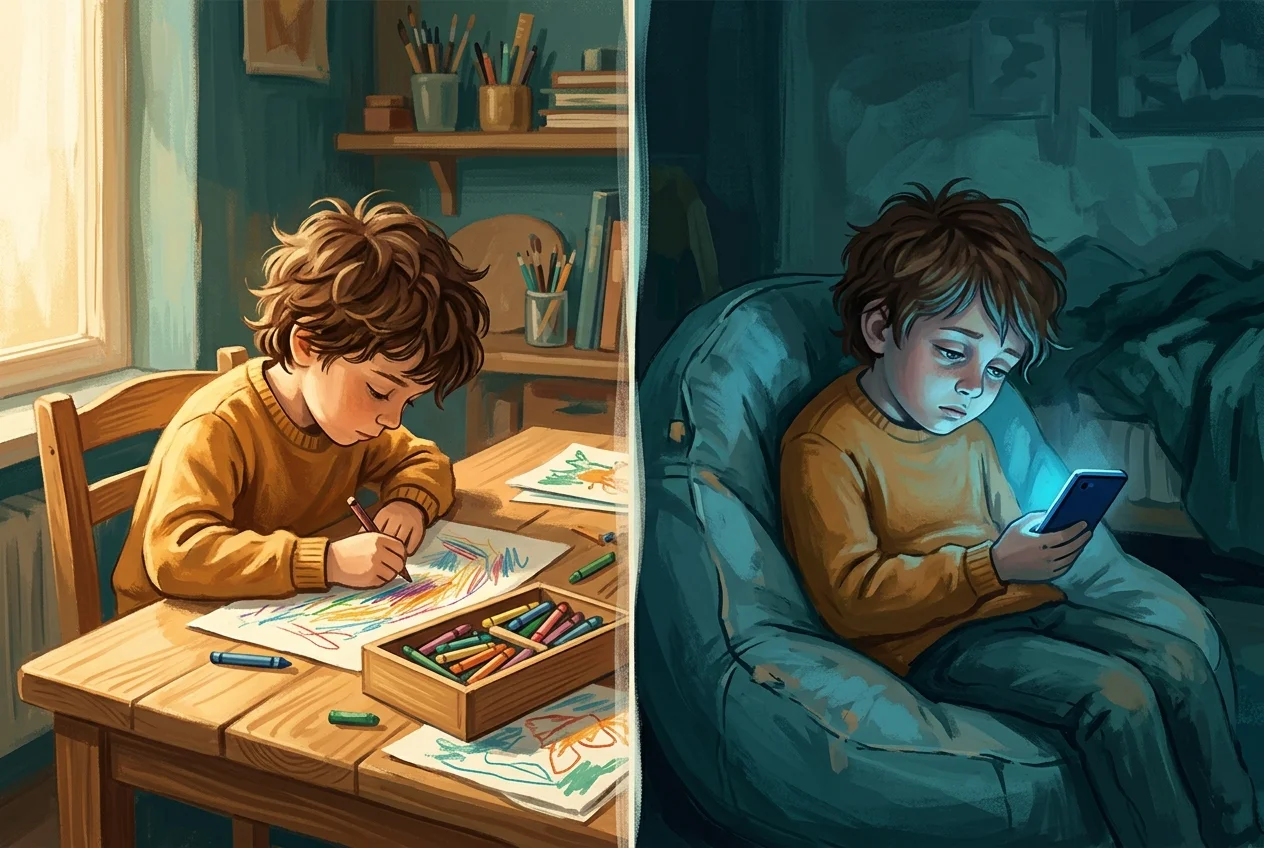
The advisory isn't based on one study. It synthesizes a converging body of research that has been building for nearly a decade, and the convergence is what makes it notable — individual studies can be challenged, but when findings replicate across methodologies, populations, and countries, the signal becomes harder to dismiss.
Research published in preventive medicine journals found that teens spending 7 or more hours daily on screens are more than twice as likely to be diagnosed with anxiety or depression compared to those spending one hour per day. This is a dose-response relationship — the harm scales with exposure — which is one of the stronger forms of causal evidence in epidemiology. It doesn't prove screens cause depression, but the pattern is consistent with it.
Separate research tracks the mechanism: digital technology use is associated with measurable changes in attention, memory consolidation, and emotional regulation — the cognitive skills most vulnerable during developmental years. Adolescent brains are still forming the prefrontal cortex connections that govern impulse control and long-term decision-making. Exposing that developing system to thousands of hours of variable-ratio reinforcement — the core mechanic of every social feed — is not a neutral intervention. It shapes the architecture it encounters.
Sleep is its own chapter. The combination of blue-light suppression of melatonin and the stimulating content of social feeds — the minor social anxieties, the comparison spirals, the unresolved conversations — keeps adolescent nervous systems activated past the point where sleep should begin. Chronic sleep deprivation in teenagers is associated with increased depression risk, impaired learning, and emotional dysregulation. The phone in the bedroom is a well-documented contributor.
What the Advisory Is Asking Families to Do
The advisory makes specific recommendations rather than just describing the problem. They fall into a few categories:
Phone-free times and zones. Meals, bedrooms, and the hour before sleep are the three zones the advisory highlights. These aren't arbitrary — they map to the moments when phone use most consistently disrupts the social connection, sleep quality, and transition time that support wellbeing. A phone-free dinner table is a simple structural intervention that most families can implement without technology.
Parental modeling. Children's screen habits are predicted in part by their parents' screen habits. This is uncomfortable and also consistent with how behavioral learning works — children encode patterns by observation before they can articulate rules. If the parental habit is to reach for a phone during every quiet moment, that becomes the default pattern. The advisory names this explicitly: changing children's relationship with screens requires changing the household norms, not just the children's access.
Ongoing conversation over one-time rules. The advisory distinguishes between setting rules and building media literacy — the capacity to think critically about why apps are designed the way they are, what they're optimizing for, and how to recognize when use is no longer serving you. Rules get worked around; understanding gets internalized. The research on what predicts healthy digital habits in adolescents consistently shows that family conversation matters more than the specific limits imposed. Ness Labs' work on the anxiety-curiosity overlap in the brain offers a practical reframe for those conversations: teaching a teenager to get curious about why an app feels compelling — what it's doing, how it's built — is more durable than telling them it's off-limits. The link between screen time and anxiety is more navigable when young people understand the mechanism, not just the prohibition.
Structural advocacy. The advisory is unusual in explicitly calling on parents to advocate for school phone-free policies and legislative protections for minors on digital platforms. This signals a recognition that individual family decisions operate inside a larger system — one where platforms are designed by engineers with engagement targets, not child development researchers. Individual households can limit access; they cannot redesign the feeds their children encounter when access happens.
Why This Advisory Is Different From the Last One
The Surgeon General's 2023 advisory focused specifically on social media and adolescent mental health. The current screen time advisory broadens the scope in two important ways.
First, it extends the concern downward in age. The earlier warning was targeted at adolescents on social platforms. The screen time advisory engages with all recreational screen use, including younger children, and aligns with pediatric guidance that even pre-social-media screen time patterns shape cognitive and social development in ways that matter.
Second, it escalates the regulatory language. Where the 2023 warning called on platforms to act voluntarily, the 2026 screen time advisory explicitly supports legislative frameworks — analogous to how the WHO treats sedentary behavior as a public health concern requiring policy-level responses, not just individual behavior change. The implicit message is that voluntary industry self-regulation has not worked, and the public health community is no longer content to wait for it.
For parents, this shift is significant. It means the conversation is no longer framed as "are you using your parental authority well enough?" It's framed as "here is a systemic risk that requires systemic responses, and here is your role in that system." That framing reduces blame and increases the clarity of action.
What Families Can Actually Do Today
The research and the advisory both converge on the same observation: the problem is architectural. Screens are embedded in every room, every transition, every idle moment. Willpower — for children and adults — is not a reliable defense against systems designed to capture attention. The fix requires changing the environment, not just the intention.
For families with younger children, the most evidence-backed intervention is simple: devices out of the bedroom at night, and phone-free meals. These two changes remove screen use from the two contexts where it does the most documented harm — sleep and face-to-face connection — without requiring constant enforcement.
For families with teenagers — where the balance of autonomy and protection is genuinely complicated — the advisory's emphasis on conversation over control is well-supported. Understanding why Instagram is designed to be difficult to stop scrolling is more durable than a rule that Instagram is off-limits. The digital minimalism framework — using technology intentionally, with defined purposes — gives teenagers a framework they can own rather than a restriction they can resent.
For adults, the advisory is a mirror as much as a warning. The same attention-capture systems that the Surgeon General is concerned about for children are running on the same psychological mechanisms in adult brains. The difference is that adults can consent and reason about the tradeoff. Sip & Scroll is built for exactly this — adding a small, ritual pause before opening TikTok, Instagram, or YouTube Shorts on your iPhone. A sip of water. A selfie. Then 45 minutes of intentional, unblocked access. The pause is the structural change: it converts a reflex into a choice, which is what both the advisory and the research suggest is the most effective single intervention available at the individual level.
The Surgeon General's advisory names the problem clearly. The tools to address it — at the household level, at least — are already available. The gap between knowing and doing has always been architecture. Now there are structures for closing it.
This article is part of our series on digital culture and screen time trends. For the full picture, see our guide: The Impact of Infinite Scroll on Gen Z Mental Health.
Put structure between the impulse and the scroll.
Sip & Scroll converts a reflex into a ritual — a sip of water before TikTok, Instagram, or YouTube Shorts, then 45 minutes of intentional access.
Download Sip & Scroll Free