Infinite Scroll Is Rewiring Gen Z Mental Health
The feed has no bottom. That's not a glitch — it's the design. And adolescent brains are paying the price.

There's a price hidden inside something free. You're not charged for TikTok, Instagram, or YouTube Shorts — no subscription fee, no invoice. But someone is paying. The currency is attention, and for Gen Z, it's being spent at a rate the human brain was never designed to sustain — withdrawn in four-second increments, hundreds of times a day, starting before the prefrontal cortex has finished forming.
That last detail matters more than any statistic. Because infinite scroll wasn't designed by people who were thinking about adolescent neuroscience. It was designed by people optimizing for engagement metrics. And those two goals — what keeps teenagers in the feed longest, and what's good for teenage brains — are, in many cases, direct opposites.
The impact of infinite scroll on Gen Z mental health is a design problem masquerading as a willpower problem. The feed has no bottom because removing the bottom was a deliberate engineering choice. And it works — which is precisely the issue. A 2022 Pew Research Center survey found that 46% of U.S. teens now say they use the internet "almost constantly" — nearly double the 24% who said the same in 2014–15. On TikTok alone, 16% of teen users say they're on it almost constantly. These numbers don't reflect weak willpower. They reflect effective engineering.
The Adolescent Brain Isn't a Smaller Adult Brain
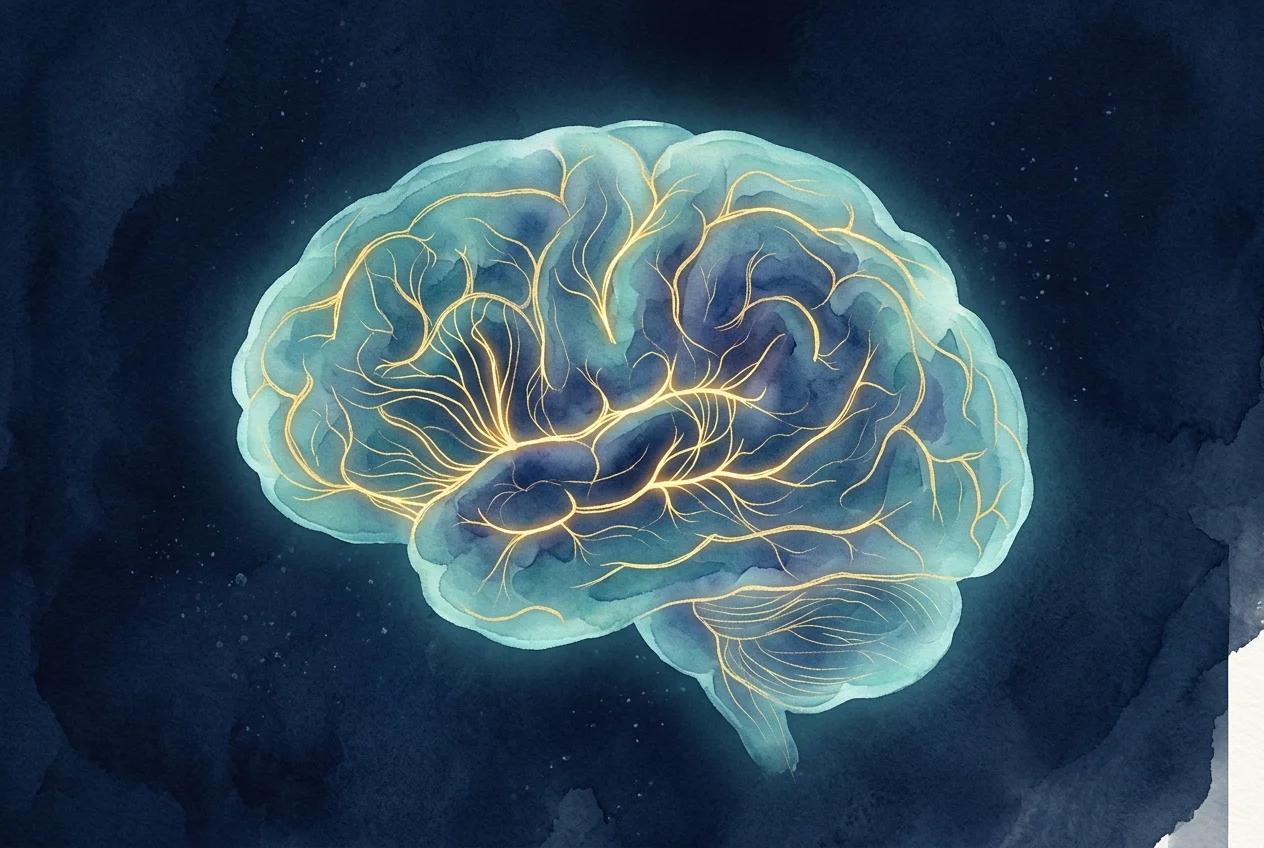
When a 35-year-old spends two hours scrolling Instagram, they're making a poor decision with a fully developed prefrontal cortex — the brain region responsible for impulse control, long-term consequence thinking, and the ability to say "okay, enough." When a 15-year-old does the same thing, the prefrontal cortex hasn't finished building yet.
Neuroscientists call this the dual-systems imbalance. Adolescents have a limbic system — the emotional, reward-seeking, socially attuned part of the brain — that is fully online and highly sensitive. What's lagging behind is the regulatory counterweight. The part that says "this dopamine hit isn't worth the hour I just lost" doesn't mature until approximately age 25. It's not a metaphor. The white matter tracts connecting the prefrontal cortex to the rest of the brain are still being myelinated — essentially still being insulated and wired — throughout adolescence.
This makes teenagers unusually responsive to social signals. A like, a comment, a share — each one triggers a dopamine release that lands harder and lasts longer than it does in an adult brain. And it makes them dramatically less capable of resisting the pull once it starts. The deck is stacked. Infinite scroll exploits exactly the gap between those two systems — high sensitivity, low regulation — with algorithmic precision.
What the algorithm has learned, through billions of data points, is how to keep a teenager in the feed longer than they intended to stay. The feed learns what makes your thumb pause. It surfaces more of that. It spaces out the peaks — a video that makes you laugh out loud, then three that are fine, then something that makes your stomach flip — in a pattern that maintains anticipation without delivering satisfaction. Psychologists call this variable-ratio reinforcement. It's the same mechanism that makes slot machines the most addictive form of gambling. You don't know when the next payoff is coming. So you keep pulling.
The Statistics Gen Z Is Living Inside
The mental health data for Gen Z is stark in a way that should command more attention than it gets. The CDC's 2021 Adolescent Behaviors and Experiences Survey — covering 7,705 U.S. high school students — found that 44.2% reported persistent feelings of sadness or hopelessness in the prior 12 months. Nearly one in five (19.9%) had seriously considered suicide.
These are not pandemic anomalies. The decline in teen mental health began around 2012 — several years before COVID — a timeline that maps almost precisely to the widespread adoption of smartphones and the launch of Instagram's algorithmically sorted feed. Psychologist Jonathan Haidt documented this pattern in exhaustive detail in The Anxious Generation, analyzing data across multiple countries and finding the same deterioration wherever smartphone adoption outpaced teen mental health infrastructure. His review of controlled experiments found that 12 of 18 studies (67%) showed measurable mental health improvements when teens reduced or eliminated social media use. This isn't correlation dressed up as causation. It's the kind of convergent evidence — longitudinal, experimental, cross-national — that researchers call a signal. It's also the evidence that prompted the U.S. Surgeon General to issue a formal advisory publishing a formal screen time advisory for families and calling for warning labels on social media platforms, similar to those required on tobacco products.
Girls are affected more severely than boys, and researchers have a theory about why. Social media for teenage girls functions primarily as a social comparison engine. The comparison is constant, visual, and curated — bodies, relationships, achievements, aesthetics, all filtered through optimization. Boys' online use, by contrast, skews more toward gaming and video content, which involves less direct social comparison. This isn't to say boys are unaffected. It's to say that for teenage girls, the feed is a hall of mirrors that never stops moving, and the cumulative effect on self-image is difficult to overstate.
This connects directly to what researchers call the real neurological effects of social media — not dramatic "brain damage," but measurable changes in how adolescents process social information, tolerate boredom, and regulate emotional responses over time.
What "Infinite" Actually Does to the Brain

Before infinite scroll was invented, social media had a bottom. You'd reach the last post from the last time you'd checked, and you'd stop. Not because you'd decided to stop — because the feed stopped. There was a natural exit ramp built into the architecture.
Infinite scroll removed that. It was patented by Aza Raskin in 2006 and quickly adopted across every major platform. Raskin has since publicly stated that he regrets the invention. His estimate: infinite scroll costs the world approximately 200,000 hours of human attention every day — and that figure predates TikTok.
What the bottomless feed does, neurologically, is eliminate the moment of decision. Every natural stopping point — the end of a page, the end of a list — is a tiny opportunity for your prefrontal cortex to check in. Do I want to keep going? Infinite scroll erases those checkpoints. By the time you notice you've been scrolling for forty-five minutes, the decision to keep going was never consciously made. You just never stopped.
For an adult, this is a nuisance. For an adolescent, it's closer to a trap. The regulatory circuitry that might otherwise catch the moment of drift — "wait, I didn't plan to spend an hour here" — hasn't finished developing. The feed is designed to exploit exactly the gap in that circuitry. And it's getting better at it every year, as the algorithms collect more data and the models grow more accurate at predicting which content will keep a specific user's thumb moving.
There's a secondary effect worth naming: the emotional residue that accumulates during an extended scroll session. This isn't the active distress of doomscrolling — endlessly consuming negative content and feeling progressively worse. It's subtler. The feed delivers a rapid sequence of emotional micro-events — funny, alarming, beautiful, envious, nostalgic, anxious — without resolution time between them. Emotions are processed in the limbic system, and they take time to metabolize. When the feed delivers a new emotional trigger every four seconds, the backlog accumulates. What you feel at the end of a long scroll session isn't any one emotion — it's a vague, difficult-to-name distress that researchers associate with elevated cortisol levels and disrupted emotional regulation.
For teenagers already navigating the identity formation, peer pressure, and hormonal flux of adolescence, that kind of chronic low-grade emotional dysregulation can compound into something harder to shake. The data suggests it has. It has also produced a distinctive cultural vocabulary for describing these effects — concepts like nervous system dysregulation, trauma responses, and emotional boundaries have spread through the very platforms that created the problem. The rise of therapy-speak on social media is partly a generation trying to name what infinite scroll has done to them.
This Isn't About Weakness. It's About Architecture.
Here's the framing that matters: the conversation about Gen Z mental health and social media is often conducted as if it's a story about teenagers lacking discipline. They should just put the phone down. They should use Screen Time. They should be more like previous generations, who didn't have this problem.
This framing is not just unhelpful — it's backwards. Previous generations didn't have this problem because previous generations didn't have engagement-optimized infinite-scroll feeds designed by the most sophisticated behavioral engineering teams in human history. The growing sense that something has been lost is real — our piece on why everyone is nostalgic for the pre-smartphone era captures how broadly this feeling has spread. The problem isn't the teenagers. The problem is the architecture they inherited.
No generation in history has been asked to voluntarily disengage from a system that has been precisely calibrated to prevent disengagement, using a brain that is simultaneously at peak sensitivity and under peak development. Asking a 16-year-old to out-willpower that using nothing but self-discipline is like asking someone to win at blackjack when the house has seen all their cards. The game is not fair.
Structural responses are emerging at a policy level too: right-to-disconnect laws in several countries now give workers legal protection from after-hours contact, and the broader rejection of hustle culture reflects a generation that has recognized the cost of always-on availability. The structural answer — the one that doesn't rely on willpower — is friction. Not a ban. Not a punishment. A pause. Something that breaks the automatic quality of the scroll just long enough for a conscious choice to happen. The prefrontal cortex is there; it just needs a moment to catch up to what's already happening.
This is what the research on TikTok's effects on attention keeps pointing toward, and what designers like Aza Raskin, Tristan Harris, and others who helped build these systems now argue: the fix has to be structural. You cannot out-willpower a system engineered to override your prefrontal cortex. You can, however, redesign your environment so that the system has less surface area to work with.
What Structural Friction Looks Like in Practice
If you're a parent of a Gen Z kid, or a Gen Z adult who recognizes this pattern in yourself, the instinct might be to reach for a hard solution: delete the apps, install a blocker, lock the phone in a drawer. Some people go further — the flip phone trend is real, as is the broader move toward enforcing cleaner boundaries around digital availability. These approaches occasionally work. More often they create resentment, lead to workarounds, and get abandoned.
The research on behavior change consistently finds that the most durable interventions introduce friction without removing autonomy entirely. You're not removing the choice to scroll — you're inserting a moment of awareness before the choice is made. That moment is enough for the prefrontal cortex — even a developing one — to register that a choice exists.
That's the design philosophy behind Sip & Scroll. Before you open an app like TikTok or Instagram, you get a gentle pause — a prompt to take a sip of water and snap a quick selfie confirming it. The pause isn't a punishment. It isn't a lockout. It's a micro-interruption: enough time for the reflex to soften into a decision. After the sip, you get up to 45 minutes of unblocked access. You've earned it, and more importantly, you've chosen it — consciously, with a moment of physical presence between impulse and action.
For teenagers who've grown up inside infinite scroll, this kind of deliberate design works differently than willpower. It doesn't ask them to resist the feed. It asks them to take one sip of water first. That's achievable. And the habit it builds — the brief moment of pause before the reflex completes — is the same habit that the brain's own regulatory architecture is still learning to provide on its own.
Even brands are beginning to name the problem publicly — the KitKat digital detox experiment is one signal that cultural awareness of the scroll problem has moved well beyond wellness blogs. Gen Z didn't create the system they're scrolling through. They were handed a feed that never ends, optimized by engineers they'll never meet, running on models trained to exploit the exact developmental stage they're passing through. The least anyone can do is give them a pause. A sip. A moment where the choice belongs to them.
Give the feed a speed bump.
Sip & Scroll adds a gentle pause — one sip of water — before opening addictive apps. No lockouts. Just friction.
Download Sip & Scroll — Free