Is Social Media Causing Brain Damage? What the Science Actually Says
The phrase is trending at breakout levels. Here's what the peer-reviewed research actually shows — and why the framing matters.
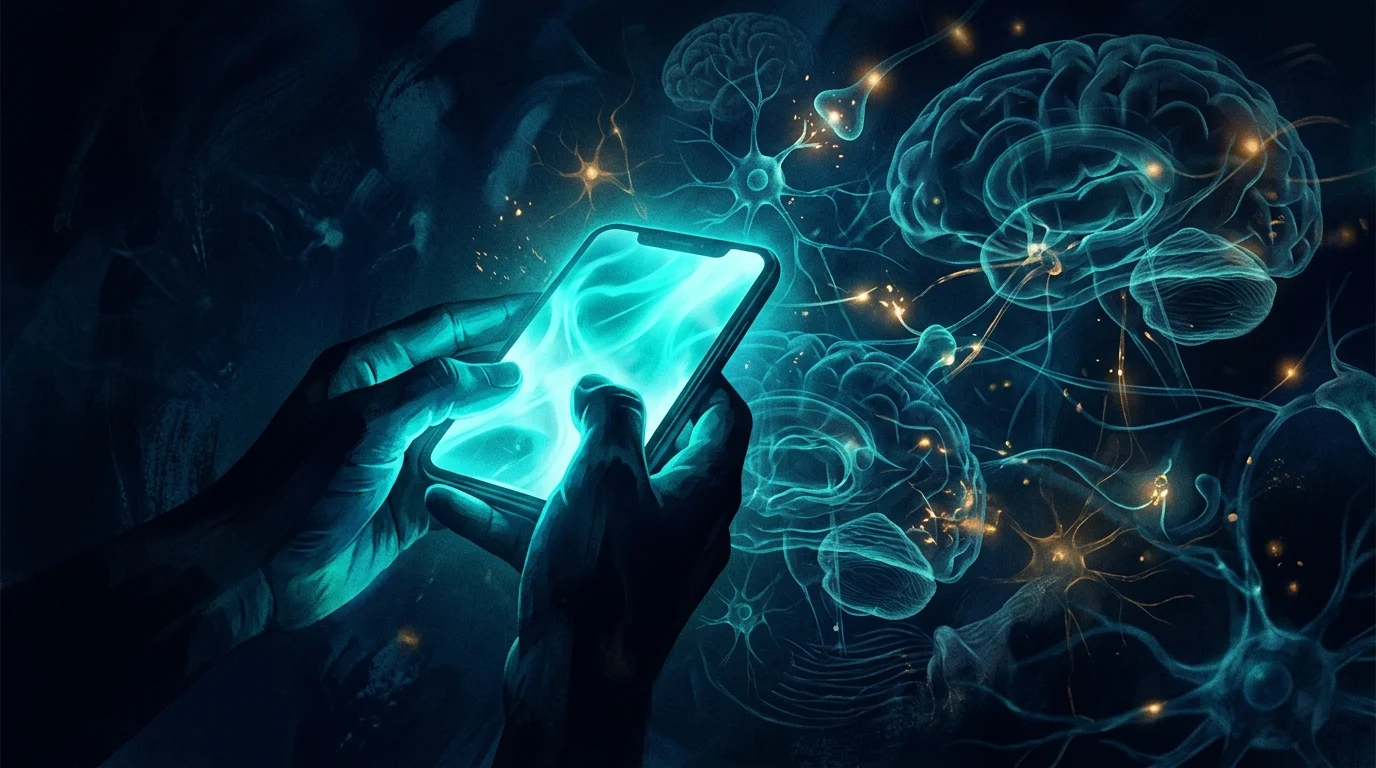
Suppose a neuroscientist handed you two brain scans and said: one of these belongs to a heavy social media user — pick it. You'd probably expect something obvious. A lit-up reward center, a visible lesion, something darkened in a region you'd recognize from a diagram. You'd scan both images looking for the one that looks wrong.
What if you couldn't tell the difference? What if the question itself was more complicated than the headlines are letting on?
The phrase "social media is damaging your brain" has been circulating for years. In recent weeks it reached breakout status on Google Trends — meaning the growth percentage is so large the system doesn't display a number, just the word Breakout. Something about that framing is landing hard, and at a scale that suggests it's not just algorithm noise. Which is exactly why it's worth examining what the peer-reviewed science actually says, separate from what the algorithm rewards people for saying about it.
Here's the direct answer: social media does not cause brain damage in the clinical sense. No scroll session is destroying your neurons the way a traumatic injury does. But that isn't the same thing as saying social media has no measurable effect on the brain. Neuroimaging research has found consistent, replicable reductions in gray matter volume in regions associated with impulse control and decision-making among heavy users. Whether those changes are harmful, permanent, or reversible is where the science gets more nuanced — and more interesting.
What "Brain Damage" Actually Means
The word matters. In neurology, damage typically refers to cell death, lesions, or irreversible structural destruction — the kind that follows traumatic brain injury, stroke, or degenerative disease. None of the research on social media use is showing that. Nobody's neurons are dying from Instagram.
What researchers measure is something different: gray matter volume in specific regions, functional connectivity between brain networks, and behavioral markers like attention span and impulse control. These are measurable. They change. And they're distinct from damage in one important way — they change in both directions.
The brain is constantly reshaping itself in response to how it's used. Every habit you build, every skill you practice, every environment you spend time in — all of it alters neural architecture through a process called neuroplasticity. The same mechanism that adapts your brain to two hours of daily scrolling is the mechanism that allows those adaptations to reverse when conditions change. Damage suggests permanence. Adaptation does not.
This distinction isn't a way of minimizing the concern. The changes are real and documented. It's a way of placing the concern accurately — because the framing determines what you do about it.
What the Research Actually Shows
A 2021 meta-analysis published in Molecular Psychiatry synthesized 15 neuroimaging studies of people with problematic internet usage — the clinical category that includes compulsive social media use. The researchers found consistent reductions in gray matter volume in the medial prefrontal cortex, the anterior cingulate cortex, and adjacent frontal regions. These are areas associated with decision-making, impulse control, and the ability to delay gratification.
The finding held across studies. That matters. Replicability is the bar that separates a real signal from noise in science, and consistent results across 15 independent research teams suggests something systematic is happening — not a statistical artifact from a single poorly-controlled study.
The prefrontal cortex, in plain terms, is the part of your brain that says "wait a second" before you act. It weighs consequences, evaluates options, and applies the brakes when the impulse-driven parts of the brain want to just go. When gray matter volume is reduced in that region, the brakes get softer. Have you noticed that the thought "I should close this" and the action of actually closing the app have grown further apart? That gap is partly architectural.
A separate 2019 review in World Psychiatry examined how internet use affects cognition more broadly. The researchers found that heavy internet users perform worse on sustained attention tasks, with measurable differences in brain activation during focused work. The constant context-switching encouraged by social media feeds — notification, scroll, refresh, notification — appears to train the brain away from the kind of sustained focus that difficult work requires. Not through damage. Through practice. The brain gets very good at rapid context-switching. It gets less good at staying with one thing.
And a 2025 review in Brain Sciences, examining the "brain rot" phenomenon — named Oxford's Word of the Year in 2024 — found that excessive consumption of low-quality online content correlates with impaired memory, shortened attention spans, weakened problem-solving capacity, and emotional desensitization in young adults. The average young adult in the study population was spending over six hours per day online, predominantly consuming short-form content.
The research isn't subtle. Something is changing.
The Causality Problem Science Can't Fully Resolve
Here's where intellectual honesty requires a pause. The Molecular Psychiatry meta-analysis was careful to note that the studies couldn't fully settle the causality question: do people with reduced gray matter in impulse-control regions get drawn into problematic social media use more easily — or does the use cause the reduction? It might be both. The relationship might look different depending on when in life the heavy use starts, since the adolescent prefrontal cortex is still developing and may be more susceptible to structural change than the adult brain — a vulnerability that sits at the center of the Gen Z mental health crisis that researchers have been tracking since 2012.
This isn't a reason to dismiss the research. It's a reason to hold the framing carefully. "Social media damages your brain" implies a clear causal arrow that the science supports — directionally, at least — but cannot yet fully confirm in controlled human trials. What the evidence does robustly support: if your scrolling is heavy enough, frequent enough, and automatic enough, your brain is adapting to that condition in ways that make it harder to stop.
That's the useful framing. Not damage, but adaptation — and adaptation that makes more adaptation more likely. The attention effects documented in TikTok brain rot research follow the same pattern: the platform optimizes for behaviors that make the platform stickier. The brain optimizes for the behaviors it's most frequently practicing. The two systems are working together.
Why the Trend Hit "Breakout" Right Now

The search query "social media brain damage" hitting breakout levels isn't just about scientific curiosity. It's a cultural inflection point. Something about the phrase is resonating at a scale that suggests a lot of people already feel like something has changed in them — and are searching for confirmation of what they suspect.
That feeling is worth taking seriously. The research supports it. The link between heavy screen time and anxiety is well-documented, and the subjective experience of being less able to focus, less patient, less able to sit with boredom — these aren't imaginary. They're documented correlates of the same structural changes the neuroimaging studies are measuring.
What the trending framing gets wrong is the implied conclusion. "Brain damage" sounds permanent. If it's permanent, nothing can be done. If nothing can be done, the only response is either panic or resignation — and most people choose resignation. The algorithm benefits from resignation. The accurate version of the claim is harder to make viral, but more useful: these are adaptations, and they're reversible.
What You Can Do With This Information
If your brain is adapting to the conditions of heavy social media use, changing the conditions is the actual fix. Not willpower — conditions.
Notice how willpower-only approaches to screen time tend to fail inside a few days. The research on this is consistent: the variable-ratio reward structure of social media feeds — where you never know if the next swipe will be throwaway or something you send to five people — is specifically designed to override deliberate intention. You decide to close the app. Four minutes later you're back in it without having made a conscious choice to return. That's not weakness. That's the architecture working as designed, engaging the dopamine prediction system in ways the dopamine detox research describes in detail.
The brain responds to architecture. If the design of your phone makes mindless opening the path of least resistance, your brain will take that path — not because you're weak, but because that's what brains do with friction-free behaviors. Add friction to the path, and the automatic behavior starts losing its grip. The prefrontal cortex gets a moment to reenter the loop. That moment is where the choice lives.
This is why the gentle-friction model works better than hard lockouts. A wall creates resentment and gets deleted. A pause creates space — just enough space for the part of your brain that can actually make a decision to participate in the decision. You don't need to reprogram yourself. You need to give your existing judgment a chance to run.
Sip & Scroll is built on this principle. Before you can open TikTok, Instagram, YouTube Shorts, or any app you've flagged, it asks you to take a sip of water and snap a quick selfie to confirm it. That's the friction layer — brief, non-punitive, something you get something out of. After that, you get 45 unblocked minutes. The session resets: another sip to continue, or you decide you're done. No lockout, no guilt, no negotiating with a digital hall monitor. Just a moment of intentionality before the scroll.
The research on brain adaptations is worth knowing. What it points toward isn't alarm. It points toward conditions. Your brain got here because the conditions made it easy to get here. The conditions can change — and when they do, so does the brain. That's what neuroplasticity is actually for.
How Long Does Recovery Actually Take?
The neuroplasticity research that confirms social media's effects on the brain contains a less-discussed corollary: the same mechanism works in reverse. Gray matter volumes that decrease under conditions of heavy use can, at minimum partially, recover when those conditions change. The question most people actually want answered is: how long?
The honest answer is that the timeline research is still limited — we have fewer controlled studies on recovery than on degradation, partly because it's harder to get study participants to meaningfully reduce their social media use for months than it is to document what heavy use looks like. What existing research suggests is that attention-related recovery begins measurably within weeks, not months — a 2025 PNAS Nexus study found measurable cognitive gains after just 14 days of reduced phone use, equivalent to reversing a decade of age-related attention decline. The prefrontal cortex changes more slowly than the behavioral symptoms that reflect it — meaning you'll likely notice improved focus and reduced compulsive checking before neuroimaging would show structural recovery.
Stanford psychiatrist Dr. Anna Lembke, writing on behavioral addiction in Dopamine Nation, describes a typical recalibration window of two to four weeks for the dopamine system to reset after removing a compulsive stimulus — though the timeline varies significantly based on use intensity and individual neurobiology. That's the window where most people describe the discomfort of behavior change: stronger urges, more noticeable boredom, an increased awareness of how automatic the habit was. That discomfort is the signal of recovery beginning, not the signal that recovery is impossible.
The recovery process isn't binary. You don't choose between continuing at current intensity and abstaining entirely until you're "fixed." The gradient matters. Reducing daily social media time from three hours to forty-five minutes changes the brain's conditioning environment significantly — less than full abstention, but enough to interrupt the feedback loop driving the attention fragmentation documented in the research. The goal isn't a clean brain. The goal is a changed condition. The 30-day digital declutter is one structured way to create that changed condition long enough for recalibration to take hold — and the passive zombie scrolling pattern it targets is exactly the behavior most associated with the prefrontal changes researchers have documented.
What makes this genuinely hopeful: the brain is doing exactly the same thing in both directions. The structural adaptation to heavy social media use is not something that happened to your brain against its will. It's the brain doing what brains do — optimizing for the environment it's in. Change the environment, and the optimization follows.
Frequently Asked Questions
Does social media cause brain damage?
Not in the clinical sense — no scroll session destroys neurons the way traumatic injury or stroke does. But peer-reviewed neuroimaging studies have found consistent, measurable reductions in gray matter volume in prefrontal regions governing impulse control and decision-making among heavy users. A 2021 meta-analysis of 15 independent neuroimaging studies found the pattern replicable across research teams. These are functional adaptations, not permanent damage, and research suggests they are reversible through behavioral change.
What does social media actually do to your brain?
Heavy social media use is associated with reduced gray matter in the prefrontal cortex and anterior cingulate cortex — areas governing impulse control, attention, and emotional regulation. Frequent context-switching between apps and notifications also degrades performance on sustained attention tasks, as the brain adapts to rapid switching rather than sustained focus. Both effects appear to be functional adaptations driven by neuroplasticity, not permanent damage.
Can social media brain effects be reversed?
Yes. Neuroplasticity operates in both directions — the same mechanism that adapts the brain to heavy scrolling allows it to recover when usage patterns change. Attention-related improvements tend to appear within weeks of significant reduction; structural brain changes recover more slowly. Reducing daily social media from several hours to under an hour changes the conditioning environment enough to interrupt the feedback loop that drives attention fragmentation.
Why is "social media brain damage" trending so much right now?
The query hit breakout status on Google Trends — more than 700,000% growth — coinciding with broader cultural awareness of brain rot, Oxford's 2024 Word of the Year. The concern is real and research-supported, but "brain damage" overstates permanence. The more accurate framing is measurable functional changes in regions governing attention and impulse control, most of which appear reversible with sustained behavioral modification.
What areas of the brain are affected by social media?
Neuroimaging research consistently identifies the medial prefrontal cortex, anterior cingulate cortex, and adjacent frontal regions — areas involved in decision-making, impulse control, and delaying gratification. These are the regions that generate the "wait a second" response before you act. Reduced gray matter in these areas explains the gap most heavy users describe between deciding to close an app and actually closing it.
Add the friction your brain is missing
One sip before you scroll. 45 minutes of mindful access. No punishment, just a pause.
Download Sip & Scroll — Free