The Social Media Detox That's Going Viral: Does It Actually Work?
A study claims two weeks off your phone reverses a decade of brain decline. Here's what the research actually shows — and the part the headline left out.
"I need a social media detox." You've said it — maybe at the end of a particularly mindless evening, maybe after catching yourself checking Instagram for the fourth time in an hour. The phrase has the casual weight of something people say but rarely do, like "I should start meditating" or "I need to drink more water."
Then a headline started circulating in early 2026: a study claiming that a two-week break from your phone could reverse the equivalent of ten years of cognitive decline. It spread fast — not because it surprised people, but because people desperately wanted it to be true.
It is, largely, true. A social media brain damage detox works — multiple peer-reviewed studies confirm it — but the mechanism is more specific, and the path more achievable, than the viral version suggested. Here's what the science actually shows.
The Study Behind the Viral Headline
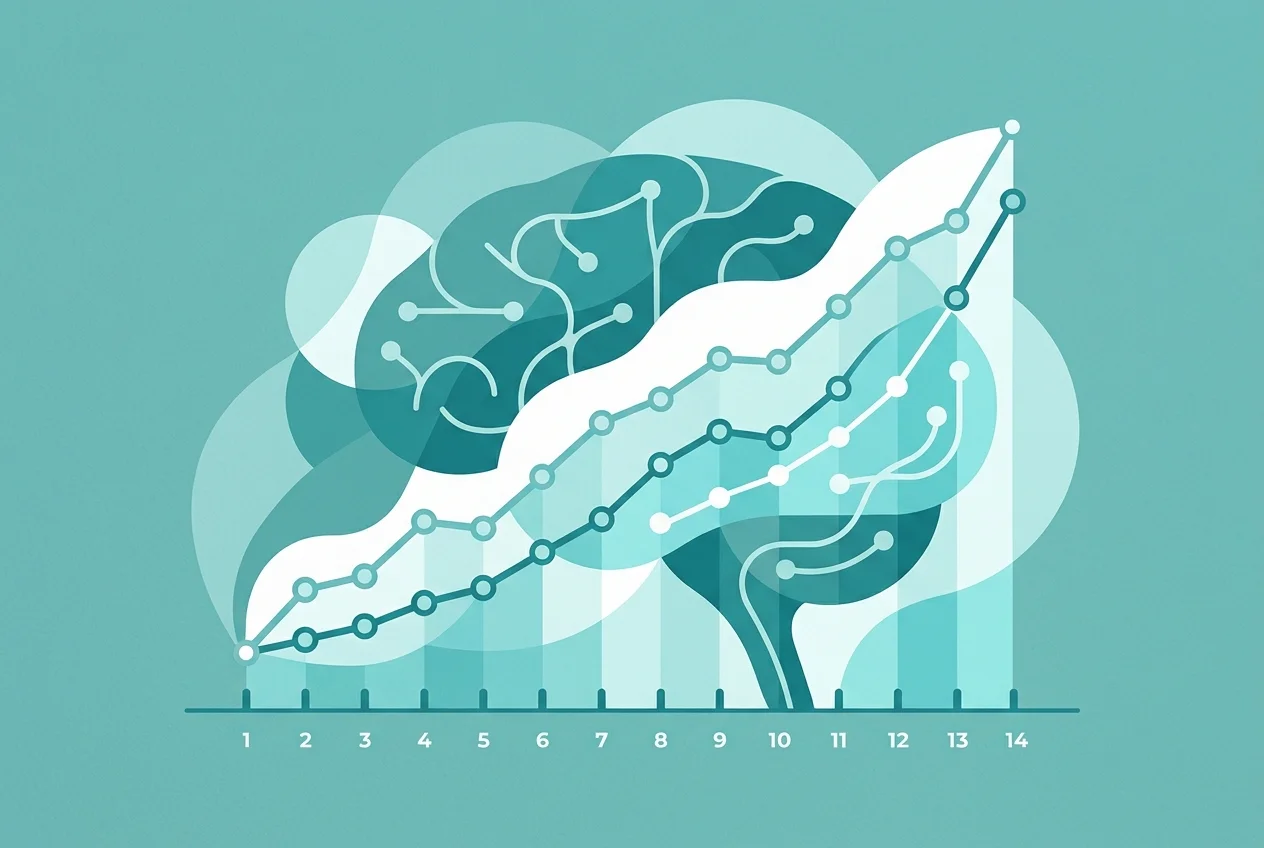
The research that went viral was published in PNAS Nexus by a team of neuroscientists and behavioral economists. They recruited 467 adults with an average age of 32 and asked them to block mobile internet access on their smartphones for 14 days using the Freedom app. Calls and texts were allowed. Laptops were fine. Only smartphone internet was restricted.
Daily screen time dropped from an average of 314 minutes to 161 minutes. After two weeks, the research team measured sustained attention, mental health markers, and subjective well-being. Ninety-one percent of participants improved on at least one outcome. The attention improvement was described as equivalent to reversing ten years of age-related cognitive decline — the headline that set the internet on fire.
A companion study, published in JAMA Network Open, looked at a shorter intervention: one week off social media for 373 young adults aged 18–24. Anxiety dropped 16.1%. Depression dropped 24.8%. Insomnia improved 14.5%. Both studies pointed at the same conclusion. The damage is real, and it reverses faster than most people expect.
What "Brain Damage" Actually Means
The headline phrase is doing heavy lifting. When researchers describe social media's effects on the brain, they're not talking about injury — they're describing use-dependent structural changes that accumulate the same way any repeated behavior shapes neural architecture.
Research on heavy social media use has documented decreased grey matter in the prefrontal cortex — the region responsible for decision-making, impulse control, and planning — and changes in the amygdala, which regulates emotional responses. The dopamine reward system recalibrates around the constant low-grade stimulation of feeds, notifications, and likes, raising the baseline your brain requires before something feels rewarding.
None of that is irreversible. The brain's plasticity — its capacity to reorganize in response to experience — is the same mechanism that created the problem. What was shaped by behavior can be reshaped by behavior. That's the actual scientific case for optimism buried inside the scary headline.
Heavy social media use also links directly to measurable cognitive and emotional costs that go beyond just "feeling distracted." But the research is increasingly clear that the direction of change can be reversed. The question is how.
What the Detox Is Actually Doing to Your Brain

The PNAS Nexus researchers found something interesting: the improvements in sustained attention couldn't be fully explained by the mental health gains alone. Sleep getting better doesn't account for all the cognitive recovery. Something specific to uninterrupted time — extended periods without the dopamine loop firing — appears to be doing its own repair work.
The mechanisms are less mysterious than they sound. When you stop feeding the loop hourly, several things happen in sequence:
- Sleep quality improves first. Reduced blue light exposure and lower pre-sleep arousal — no more anxious scrolling at 11pm — typically produce noticeable improvements within three to five days. Better sleep is one of the most powerful cognitive restoration tools available.
- Cortisol patterns normalize. Every notification, every swipe into a feed, activates a small stress response. Remove dozens of those micro-triggers per day and your nervous system stops spending so much energy managing low-grade threat activation.
- Dopamine recalibrates. Psychologists call what social media does to your reward system variable-ratio reinforcement — the same mechanism behind slot machines. You never know if the next swipe will be a throwaway or something worth sending to three friends. Take that away, and your brain slowly stops expecting the constant stimulation. Smaller things start feeling rewarding again.
- Attention pathways strengthen. Sustained focus is a skill, and it atrophies without use. Two weeks of uninterrupted time gives those pathways extended practice. This is likely the mechanism behind the cognitive gains the PNAS study couldn't attribute to sleep or mood alone.
The science behind dopamine detoxes points in the same direction: the goal isn't deprivation, it's recalibration. You're not punishing yourself — you're giving your reward system a chance to reset its baseline.
The Part the Headline Left Out
A few things the viral version glossed over:
The "ten years of cognitive decline reversed" is measured relative to the cognitive costs of heavy use — not absolute age-related neurodegeneration. If heavy social media use has degraded your sustained attention over a decade, two weeks can substantially restore it. That's meaningful. It's not a fountain of youth, and it won't reverse other things that happen to the brain over time.
The PNAS study also blocked all mobile internet — not just Instagram and TikTok, but every app requiring internet on the phone. That's a more comprehensive intervention than most people think of when they say "social media detox." Many popular detox approaches leave email, news apps, and YouTube untouched, which partially preserves the same dopamine loop.
The most practically useful finding got less coverage: participants who didn't fully adhere still showed improvement. The researchers didn't require perfect compliance. Even partial reduction — even doing it imperfectly, for a few days, with some slippage — produced measurable cognitive and emotional benefits. You don't have to be perfect. You have to be less.
What Actually Moves the Needle
The studies collectively point toward a few specific behaviors that drive most of the benefit:
Getting daily screen time consistently below two to three hours. The PNAS study's drop from 314 to 161 minutes daily is roughly the threshold where the gains appear. An hour a day of social media doesn't seem to produce the same cognitive load as five hours a day — the dose matters.
No phone in the bedroom. Sleep quality is one of the clearest pathways to cognitive recovery, and it's disproportionately damaged by phone use in the final hours before sleep. This is the single change with the highest return per unit of friction.
Replacing scroll time with offline activity. The PNAS researchers found that social connection, exercise, and time outdoors were the variables that best explained the mental health improvements — not just the absence of phone time, but what happened in that space. Sitting on your phone playing games while avoiding social media doesn't produce the same gains as actually doing something else.
A full two-week cold-turkey detox is one path to those outcomes. But the data suggest that intentional friction — something that slows you down and creates a deliberate pause before each session — may produce most of the same cognitive benefit without requiring you to cut the apps entirely. The improvement comes from structural change, not willpower. If you're weighing a permanent quit, it's worth reading what you actually lose when you delete social media before making the call.
You cannot think your way out of an architectural problem. The Freedom app in the PNAS study worked because it made the phone literally unable to open Instagram, not because participants resolved to try harder. If a two-week total block feels too extreme, the closest alternative is a ritual that adds friction before each session: a pause, a physical action, a breath between impulse and tap. That's the logic behind every effective approach to doomscrolling — not restriction, but a moment that makes the behavior feel like a choice rather than a reflex.
That's what Sip & Scroll is designed to do. When you try to open TikTok or Instagram, it pauses the app and asks for a sip of water and a quick selfie. Then you get 45 minutes of unblocked access. It won't erase a decade of social media use. But it will make every session a decision instead of a reflex — and that small architectural change, repeated consistently, is what the research says actually works.
This article is part of our series on social media addiction and brain rot. For the full picture, see our guide: Is TikTok Giving You ADHD, or Is It Just Brain Rot?.
Turn every scroll into a choice
A sip of water before you open the feed. That's the friction. That's the reset.
Download Sip & Scroll Free