Why Your Focus is For Sale: The Attention Economy Explained
The business model that turned your concentration into a commodity — and the structural fixes that can take it back.
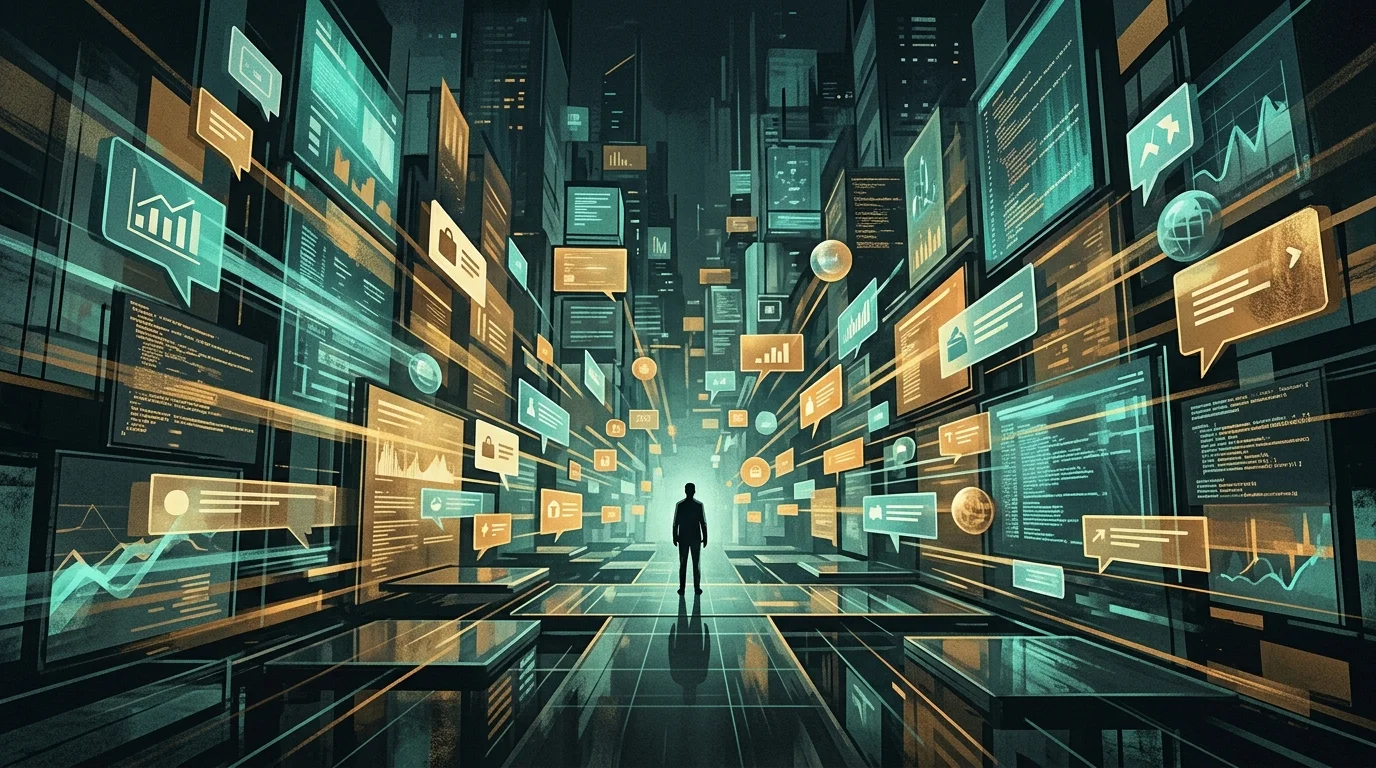
Every app you open for free has already decided what you're worth. Not as a person — as an attention unit. A slot in an ad auction. A data point that, combined with two billion others, lets a platform tell an advertiser it can reach 34-to-45-year-olds in a specific zip code who engage with fitness content after 9pm and recently searched for running shoes. That's the transaction happening in the background every time you open your feed.
You are, in the language of the industry, inventory.
This isn't a conspiracy theory — it's the disclosed business model, in every platform's SEC filing, ignored by nearly everyone who uses the product. The reason you can't figure out why you keep reaching for your phone isn't a personal failing. It's that the system on the other end of it was engineered, tested, and optimized specifically to make stopping feel harder than continuing.
The attention economy is the economic system in which human attention — not money, not raw data — is the primary commodity being bought and sold. Every social media platform, news site, and streaming service you use for free is actually an attention marketplace: advertisers pay for access to your eyes and mind, platforms compete to keep you on-screen as long as possible, and your focus is the product being traded. Understanding this system — how it was built, how it works on your brain, and why willpower alone cannot compete with it — is the first step toward opting out structurally rather than failing repeatedly on discipline alone.
How Your Attention Became a Trillion-Dollar Asset
Nobel Prize-winning economist Herbert Simon wrote in 1971 that "a wealth of information creates a poverty of attention." He was three decades ahead of the infrastructure required to fully exploit the insight. Simon understood the fundamental scarcity dynamic before anyone had the tools to weaponize it: as content becomes abundant, the scarce and therefore valuable resource is human concentration.
The modern attention economy crystallized in two phases. The first was Google's AdWords in 2000, which proved that search queries — moments of expressed intent — could be monetized at scale by showing relevant ads to people already looking for something. The second was Facebook's News Feed in 2006, which pioneered something more aggressive: using algorithmic curation to surface content that maximized time-on-platform regardless of what the user had searched for or intended to do.
The business model is straightforward. Give people something they want for free — connection, entertainment, information. Then sell advertisers access to their attention while they're there. Revenue scales directly with time-on-screen: more minutes watched means more ad impressions delivered, means higher earnings per user. According to Pew Research Center, 70% of U.S. adults now use social media — with a significant portion checking multiple times daily. Meta earned over $117 billion in 2023, almost entirely from advertising revenue tied to user engagement. Alphabet earned over $237 billion. These companies don't sell software. They sell attention minutes.
Every product decision flows from this. Infinite scroll. Autoplay. Push notifications. Algorithmic feeds. None of these features exist because they make your life better. They exist because they extend the time between you and the exit button.
The Six Design Features Built to Keep You Scrolling
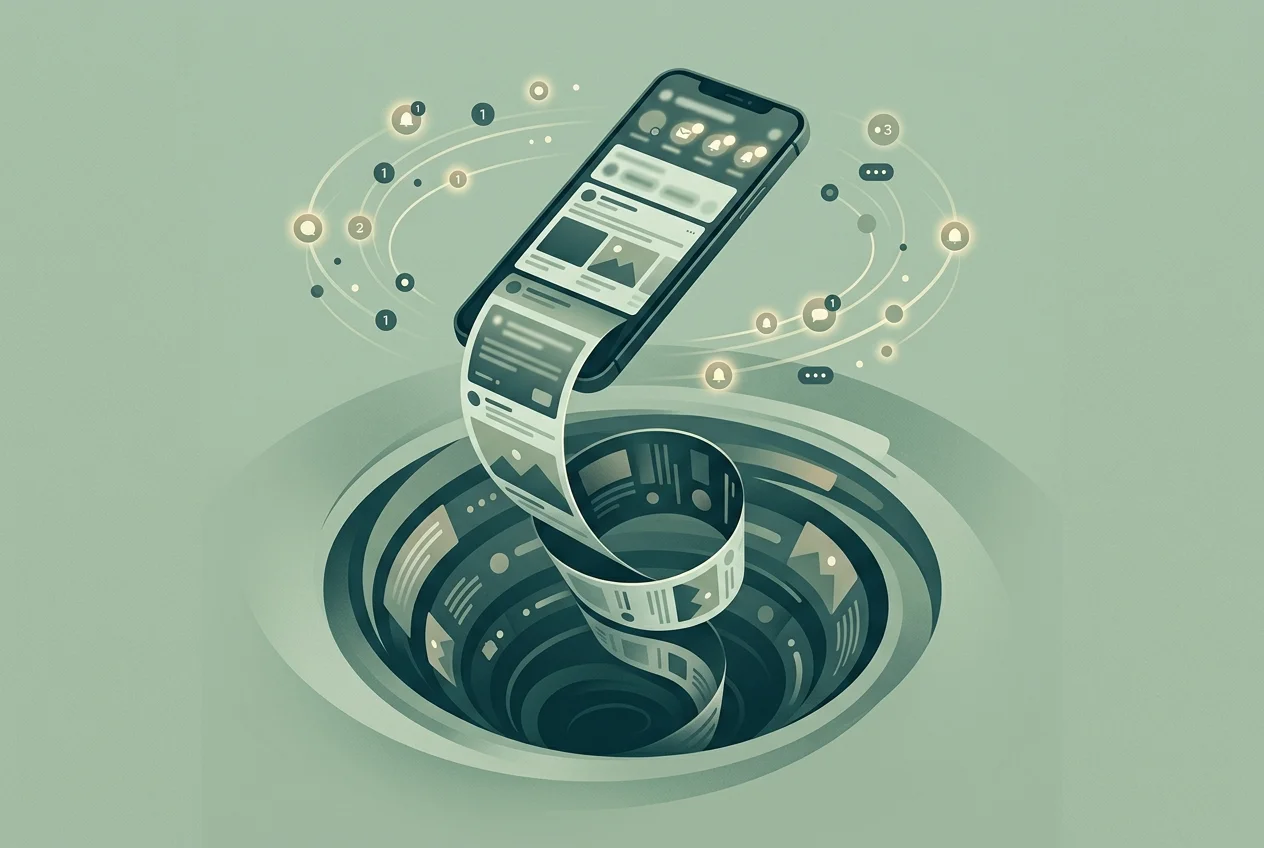
The tools the attention economy uses aren't accidents of product development. They're deliberate psychological mechanisms, many designed by engineers who understood exactly what they were building — and in some cases, later expressed public regret about it.
Infinite scroll eliminates natural stopping points. Pre-internet media had built-in endpoints: a newspaper ran out of pages, a TV show ended, a chapter finished. Infinite scroll replaced those boundaries with nothing — the feed simply continues, forever, until something external interrupts you. Aza Raskin, the engineer credited with popularizing the design, later estimated that infinite scroll wastes approximately 200,000 collective hours of human attention per day. He called it "a slot machine in our pockets."
Variable-ratio reinforcement is the mechanism that makes the slot machine metaphor precise rather than rhetorical. Psychologists use the term to describe reward schedules where the interval between rewards is unpredictable — you never know if the next pull will win or lose. This is the most powerful pattern for generating compulsive behavior ever identified in behavioral science, and it maps exactly onto algorithmic feeds: you never know if the next scroll will be throwaway or the most interesting thing you've seen all week. The uncertainty is the feature.
Algorithmic curation deprioritizes chronological order in favor of engagement-maximizing content. Not content you'd consciously choose, but content that generates the most emotional arousal — outrage, envy, surprise, laughter. AI recommendation systems have gotten remarkably sophisticated at predicting which emotions drive the most sustained engagement — and they get better every session. An enraging post drives more comments, shares, and time-on-screen than a measured one. The algorithm optimizes for the reaction, not the content quality.
Push notifications are timed to interrupt you at moments of potential disengagement. The engineering goal isn't just to bring you back when you've left — it's to prevent the psychological closure that would make leaving feel complete. A notification that arrives when you're about to put down your phone resets the loop.
Social metrics — likes, views, comment counts — exploit status anxiety and social comparison at scale. The number is always visible. The number can always be higher. The number is updated in real time. This turns every post into a tiny ongoing experiment in whether people approve of you, which is exactly the kind of unresolved question that keeps the mind returning compulsively.
Autoplay replaces the active decision to watch another video with the passive default of having one begin before the previous one has fully processed. The intentional choice to keep watching is replaced by the effort required to stop.
What Attention Fragmentation Actually Costs You
The cost of the attention economy isn't measured in hours lost. It's measured in cognitive capacity — the quality of thinking, focus, and emotional regulation you have available for the actual things in your life.
A 2020 literature review by researchers at UCLA, published in Dialogues in Clinical Neuroscience, found that frequent digital technology use produces measurable attention deficits, impaired emotional processing, and disrupted sleep patterns. The study found that using social media two or more hours daily doubled perceived social isolation scores — the platforms that promise connection are, at high-use levels, producing the opposite.
The mechanism that explains most of this is context-switching cost. Every notification that pulls you out of a focused task doesn't just cost you the three seconds it takes to read it. Research consistently shows that after a task interruption, the average person takes over twenty minutes to return to their original level of focused engagement. For anyone doing knowledge work, creative work, or any task requiring sustained concentration, this means the modern notification-saturated workday is structurally incompatible with deep focus — not because people lack discipline, but because the environment they're working in has been optimized to prevent it. This is why more than a dozen countries have enacted formal right to disconnect laws — legislative recognition that individuals cannot willpower their way out of an environment engineered against them.
The APA's 2023 health advisory on social media noted that technology use within an hour of bedtime is associated with sleep disruption and anxiety that compounds over time. Screen time is directly linked to elevated morning anxiety — the emotional weather you absorb in the first minutes of your day shapes the neurological baseline for everything that follows.
This is the full picture of what the attention economy extracts: not just the hours you spend on the feed, but the cognitive remainder — the depleted focus, elevated cortisol, and fragmented thinking that follows you out of it and into the rest of your day. As Farnam Street's Brain Food newsletter puts it: "multitasking is not only not thinking, it impairs your ability to think" — and the attention economy is specifically optimized to keep you in that impaired state.
Why "Just Put the Phone Down" Doesn't Work
The standard advice — check your phone less, delete apps, take digital breaks — treats a structural problem as though it's a motivation problem. It assumes that if you wanted to focus badly enough, you could resist systems that have been engineered by thousands of people with billions of dollars in optimization behind them.
You cannot. Not reliably. Not over time.
Willpower is a finite resource that depletes over the course of the day. The algorithms you're fighting against are most aggressive at exactly the moments when your resistance is lowest: late at night when you're tired, first thing in the morning when you're anxious, during any unstructured gap in your schedule. The design exploits the gap between your intentions and your automated behavior — the space where the reflex fires before the decision does.
Digital minimalism and dopamine resets both point toward the same underlying principle: lasting behavior change doesn't come from trying harder, it comes from changing the environment. Behavioral science has demonstrated this across decades of research — people who successfully change high-frequency habits almost universally do it by changing the cues and context around the behavior, not by strengthening their resolve.
Reclaiming Your Focus: Architecture Over Willpower
Opting out of the attention economy doesn't mean deleting every app and moving to a cabin. It means redesigning the environment so that the attention-preserving choice is the easy choice, and the attention-fragmenting choice requires deliberate effort.
In practice, this looks like: turning off all push notifications and checking on your own schedule. Keeping your phone physically outside the bedroom. Using grayscale mode, which reduces the visual reward of the interface. Setting device-free windows during work hours. And — critically — creating friction before you open algorithmic feeds. Some countries have gone further, enshrining this principle in law: France, Australia, and Canada have all enacted right to disconnect legislation that protects workers from after-hours communication demands — the same logic applied at the employer level.
Friction is the key mechanism. The attention economy works by reducing friction to zero: no pause, no interruption, no moment of decision before the feed loads. Reintroducing a small, tolerable pause before high-stimulation apps is enough to shift the dynamic — from reflex to choice, from automatic to intentional.
This is exactly why Sip & Scroll is built around a friction layer rather than a hard block. Before you can open TikTok, Instagram, or YouTube Shorts, you take a sip of water and snap a quick selfie confirming it — a five-second physical act that is enough for your prefrontal cortex to register a choice rather than a reflex. You then get up to 45 minutes of unblocked access, after which the friction layer resets. No punishment. No lockouts. Just a momentary pause that turns an automated habit into an intentional one — and delivers a glass of water as a side effect.
The attention economy is real, it is enormous, and it was built with your cognitive vulnerabilities as the raw material. But it runs on the gap between your impulse and your awareness. Close that gap — even by five seconds — and you begin to reclaim the cognitive real estate that the feed has been quietly occupying. That gap is the margin between the life you're living on autopilot and the one you actually intend.
Add five seconds between you and the feed.
Sip & Scroll turns a mindless reflex into a mindful choice — one sip of water at a time.
Download Sip & Scroll Free