Popcorn Brain: Why You Can't Read a Full Paragraph Anymore
Your attention hasn't disappeared. It's been recalibrated — trained to pop from one thing to the next, faster and faster, until stillness feels like a malfunction.
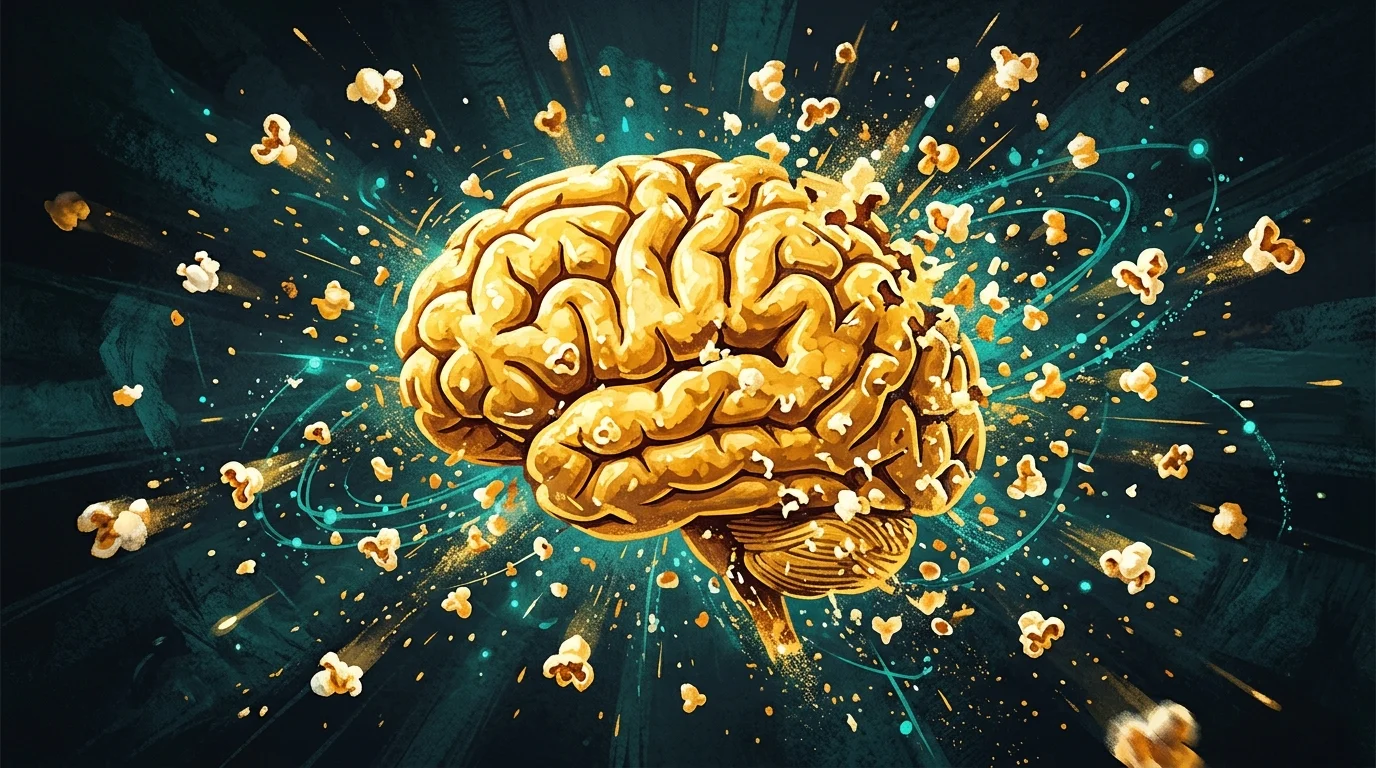
Notice what happens when you try to read. Not skim — actually read, the way you used to, where paragraphs passed under your eyes like water and you surfaced twenty minutes later somewhere completely different in your own mind. Notice what your hand is doing. Notice the pull. The small, persistent tug toward the phone that doesn't wait for boredom to arrive — it shows up three sentences in, before anything has even had a chance to get interesting.
That pull has a name now. Researchers and psychologists call it popcorn brain — a term coined by David Levy, a computer scientist at the University of Washington who studies information overload. The idea is simple and slightly horrifying: constant exposure to rapid-fire digital stimulation reconditions your brain to expect that pace everywhere. Your attention starts popping — from thing to thing, input to input — like kernels in a bag, unable to hold still even when you want it to. Slow things start to feel broken. Books feel like a slog. Conversations lose ground to the phone. Even leisure — actual rest — gets edged out by the compulsive pull toward novelty.
Popcorn brain is what happens to a mind that has been trained, one swipe at a time, to treat sustained focus as a problem to be solved rather than a state to inhabit.
How Short-Form Content Rewires the Attention Loop
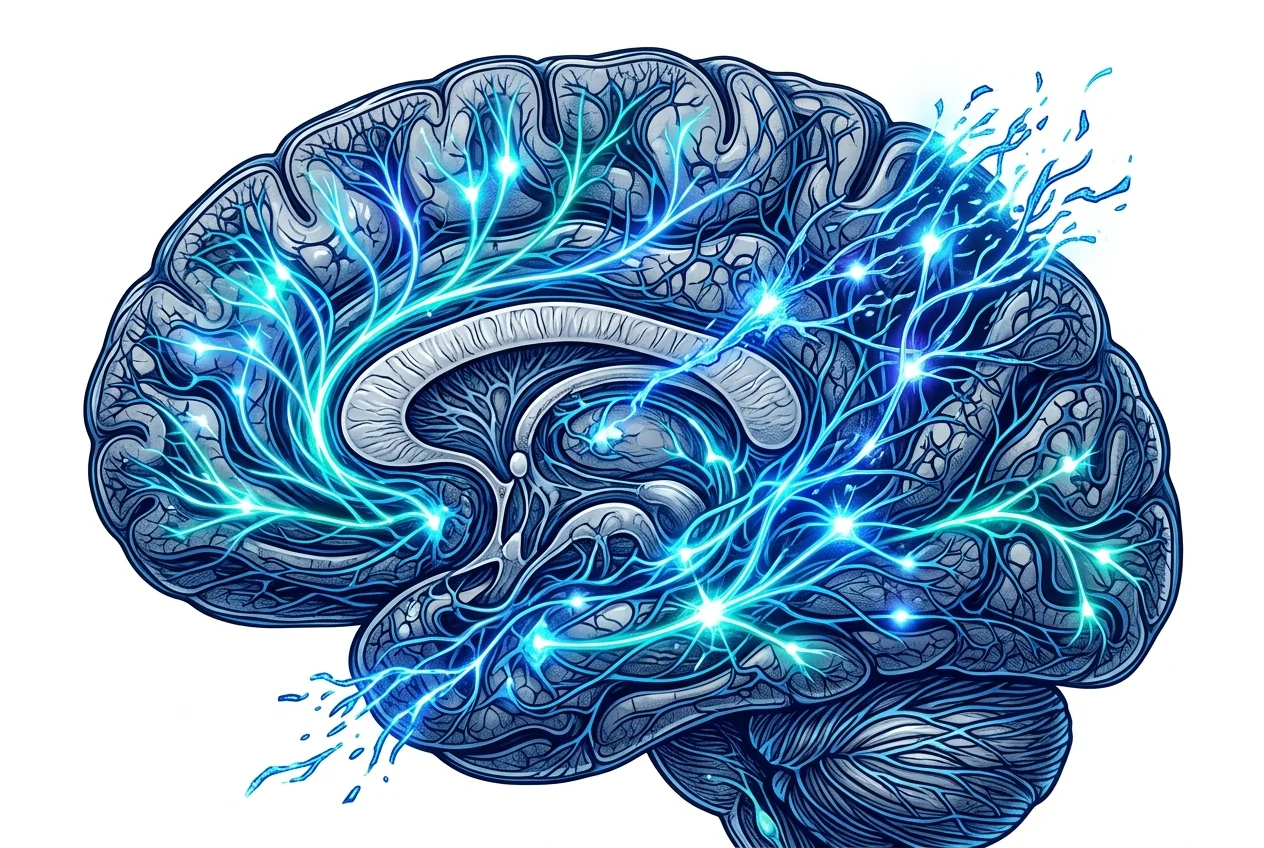
Your brain is not a fixed object. It is a prediction machine — constantly updating its models of the world based on what it encounters most often. Neuroscientists call this neuroplasticity: the brain's ability to reorganize its own structure and connections in response to experience. It's the reason learning a new language changes the brain, the reason trauma leaves physical traces, and the reason doomscrolling is more than just a bad habit.
When you spend hours a day consuming content that changes every fifteen to sixty seconds — Reels, Shorts, TikToks — your brain learns that this is the rhythm of experience. Dopamine fires not in response to the content itself but in anticipation of the next piece, calibrated to a cycle of roughly one new stimulus per twenty seconds. The mesolimbic pathway — the brain's reward circuit, the same one that drives cravings for food, sex, and drugs — gets tuned to this tempo.
Sustained attention requires a different circuit entirely. Reading a book, following a long argument, sitting with a complex feeling — these activate the prefrontal cortex and demand that the reward system stay quiet while the cortex does its work. But if the reward system has been calibrated to fire every twenty seconds, quieting it for twenty minutes feels physiologically wrong. Not boring. Wrong. Like trying to hold your breath.
Research published in JAMA Pediatrics found that children with higher screen use showed measurably lower integrity in the brain's white matter tracts — the neural highways that support language, executive function, and sustained attention — with corresponding drops in vocabulary and literacy scores. The brain, quite literally, is being shaped differently. And children are not the only ones affected. The same neuroplasticity that makes young brains especially malleable operates, more slowly, throughout adulthood.
What Popcorn Brain Actually Feels Like
The diagnostic criteria for popcorn brain aren't clinical yet — the term is still making its way from research circles into mainstream psychology. But the symptoms are recognizable, and if you've spent the last few years scrolling heavily, you've probably experienced most of them.
You sit down to read and find yourself rereading the same paragraph three times. Not because the prose is difficult. Because something keeps pulling your attention sideways before the sentence resolves. You open a long article with genuine interest and find yourself skimming for bold text and bullet points, looking for the gist without the connective tissue. Meetings feel long. Long films feel punishing. Even relaxing activities — walking, cooking, sitting quietly — produce a low hum of restlessness that only the phone seems to quiet.
And here's the part that's easy to miss: the phone doesn't actually quiet it. It feeds it. Each scroll session recalibrates the baseline a little higher — requiring slightly more stimulation next time to produce the same sense of relief. Research from the University of Texas at Austin found that the mere presence of a smartphone nearby reduces available cognitive capacity — even when the device is face-down and silent — because the brain actively expends energy suppressing the urge to check it. You're paying an attention tax just by having the phone in the room. Farnam Street captures the baseline that gets eroded: genuine concentration requires staying with one idea long enough to develop it — the exact cognitive mode that constant short-form stimulus is engineered to prevent.
This is how screen time becomes anxiety: not through any single piece of content, but through the structural effect of constantly split attention. A mind that can't settle isn't just unproductive. It's chronically slightly stressed.
The Cost of Context-Switching
Every time you shift your attention — from reading to checking your phone, from a task to a notification — your brain pays a switching cost. It takes time, measurable in seconds, to disengage from one thing and engage fully with another. According to the American Psychological Association, this task-switching penalty can eat up as much as 40% of your productive time in a given day — not because you're doing less, but because you're spending so much cognitive energy on the transitions between things rather than the things themselves.
Popcorn brain industrializes this tax. If your baseline state is already one of rapid switching — if you've trained your attention to treat any sustained focus as something to interrupt — then even when you're not actively on your phone, you're operating with a fragmented attention architecture. The context-switching is internal now. Your own mind keeps jumping ahead, looking for the next thing, before the current thing is finished.
The good news, and it is real good news, is that neuroplasticity works in both directions.
How to Recalibrate Your Attention

The same neuroplasticity that let short-form content rewire your attention will let you rewire it back. But the mechanism is identical — repetition over time, not willpower in the moment. You cannot think your way to a longer attention span. You have to give your brain repeated experiences of sustained, undistracted engagement until it recalibrates its baseline.
The research on rebuilding attention span consistently points to two drivers: reducing high-frequency interruptions and increasing long, slow-paced activities. Reading physical books. Walking without headphones. Cooking from scratch. Having conversations that go somewhere unhurried. None of these feel as immediately satisfying as a Reel. That's precisely the point — the slightly lower stimulation level is what trains the reward system to recalibrate downward, back toward a pace where sustained attention feels natural rather than effortful.
But recalibration also requires changing the conditions that trigger the popcorn pattern in the first place. And this is where willpower-based solutions consistently fail. By the time you're sitting on the couch with your phone in your hand, the context has already made the decision for you. The reflex is faster than the reflection.
Structural friction is what actually works. A brief mandatory pause — something that requires a physical action before the app opens — interrupts the automaticity of the habit at the moment it's most automatic. That's the logic behind Sip & Scroll: before opening any protected app (TikTok, Instagram, YouTube Shorts), you take a sip of water and snap a quick selfie to confirm it. Fifteen seconds, tops. But those fifteen seconds transform an unconscious reflex into a conscious choice — and at the moment of a popcorn-brain craving, the mere act of pausing is often enough to dissolve it. Not because the friction is punishing, but because it's long enough for your prefrontal cortex to catch up with your thumb.
You don't have to stop scrolling. You just have to stop scrolling automatically. That's a different problem — and a much more solvable one.
Give your attention a fighting chance.
A sip of water before every scroll session. That's the pause your prefrontal cortex needs.
Download Sip & Scroll Free