You're Not Nostalgic for Flip Phones. You're Nostalgic for Your Own Mind.
The feeling isn't about technology. It's about what your brain could do when it wasn't always on call.

The cost of being perpetually connected doesn't show up on your phone bill. It shows up in the conversations you half-had, the books you started and put down before chapter three, the mornings you can't reconstruct even though nothing eventful happened, and the persistent low-grade sense that you were somewhere else even when you were right there. You didn't sign up for any of that. You signed up for a device that could take photos, play music, and get you directions.
The rest came later — packaged as convenience, delivered as constant transaction.
Nostalgia for life before smartphones is now one of the most consistent threads running through communities like r/digitalminimalism, where posts about missing the pre-2007 era routinely rack up hundreds of upvotes from people in their twenties, thirties, and forties. The feeling isn't technophobia, and it isn't just older people lamenting change. It's something more specific: the recognition that a particular cognitive state — sustained, undivided, unhurried attention — used to be ordinary, and now it requires effort. Life before smartphones isn't a simpler time your brain is mourning. It's a cleaner attentional architecture.
The Numbers Behind the Feeling
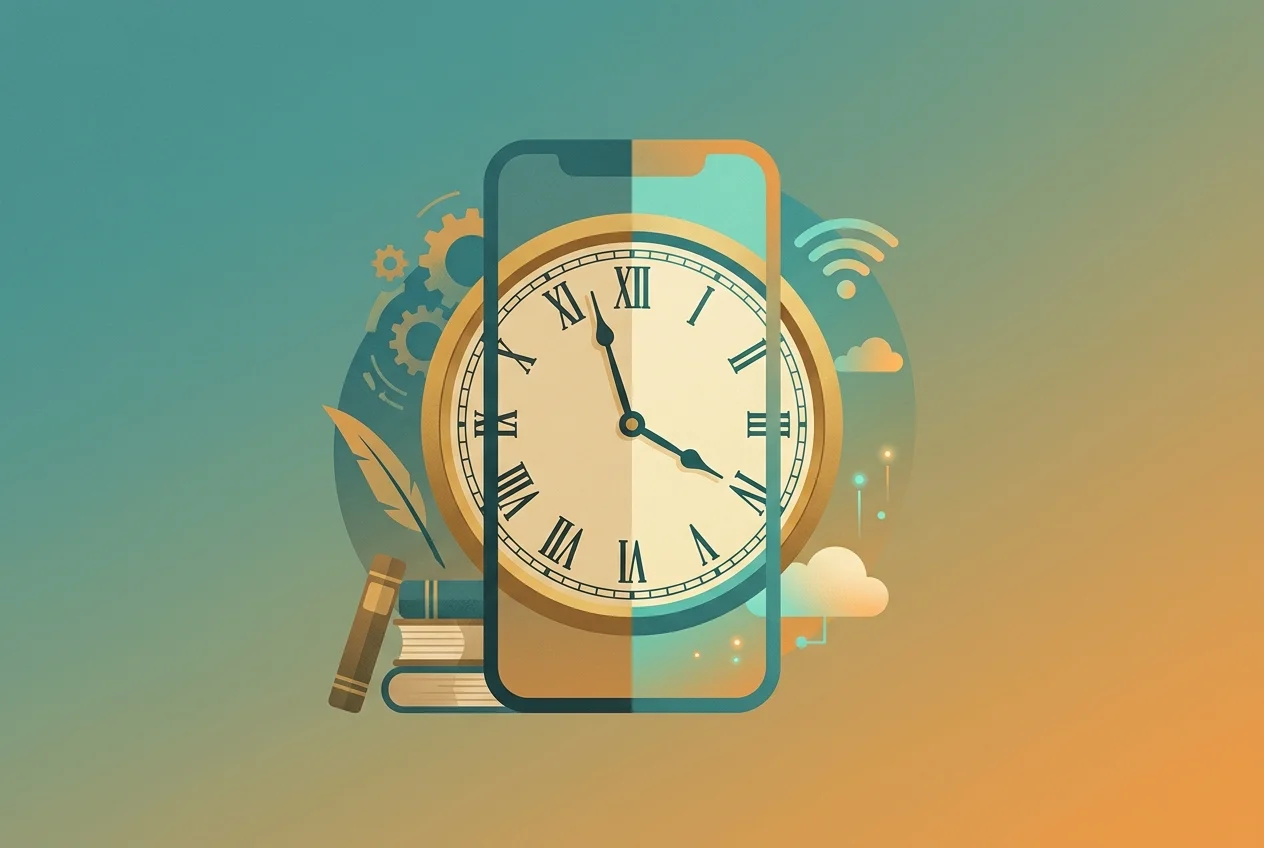
Pew Research Center data shows that roughly 72 percent of American adults now use at least one social media platform, with many checking their feeds multiple times a day. The average person unlocks their phone over 80 times per day. Common Sense Media found that teenagers spend roughly nine hours daily on screens — more time than they spend sleeping.
Those numbers are striking, but they still miss the deeper issue. It's not just the total time. It's the fragmentation — the way attention is interrupted every few minutes by a notification, a reflex unlock, a quick check that turns into twenty minutes. The 2007 iPhone didn't just give people new tools. It restructured how attention itself is allocated, inserting dozens of tiny context switches into time that used to flow uninterrupted.
The nostalgia, then, is a signal. It's your brain telling you something about the gap between how it evolved to function and how it's currently being used.
What Your Brain Did in Dead Time
Neuroscientists have a name for what your brain does when you're not actively doing anything: the Default Mode Network, or DMN. It activates during idle moments — waiting in line, staring out a train window, lying in the bath, sitting in silence between tasks. The DMN sounds passive. It's anything but.
Think of it as your brain's maintenance mode. When the DMN runs, it's consolidating memories from the day, connecting disparate ideas you haven't consciously linked yet, simulating future scenarios and social situations, and processing emotional experiences that didn't get resolved in real time. This is where insights arrive. It's when the answer to a problem you've been stuck on suddenly appears while you're doing the dishes. It's when you figure out how you actually feel about something that happened last week.
Before smartphones, daily life was full of DMN time. Commutes. Waiting rooms. Standing in grocery store lines. The gap between waking up and the first demand of the day. None of this felt productive — which is precisely why it was. The brain was running processes that don't happen when it's occupied with external input.
Smartphones didn't just fill that time. They made idle time feel intolerable, rewiring the discomfort threshold for boredom so that any pause longer than a few seconds triggers the reflex to pick up the phone. Research consistently finds that while the total hours of screen time matter, what matters at least as much is what those hours displace — including the unstructured downtime that allows the DMN to run. What screens take away may matter more than what they deliver.
The Architecture of Always-On
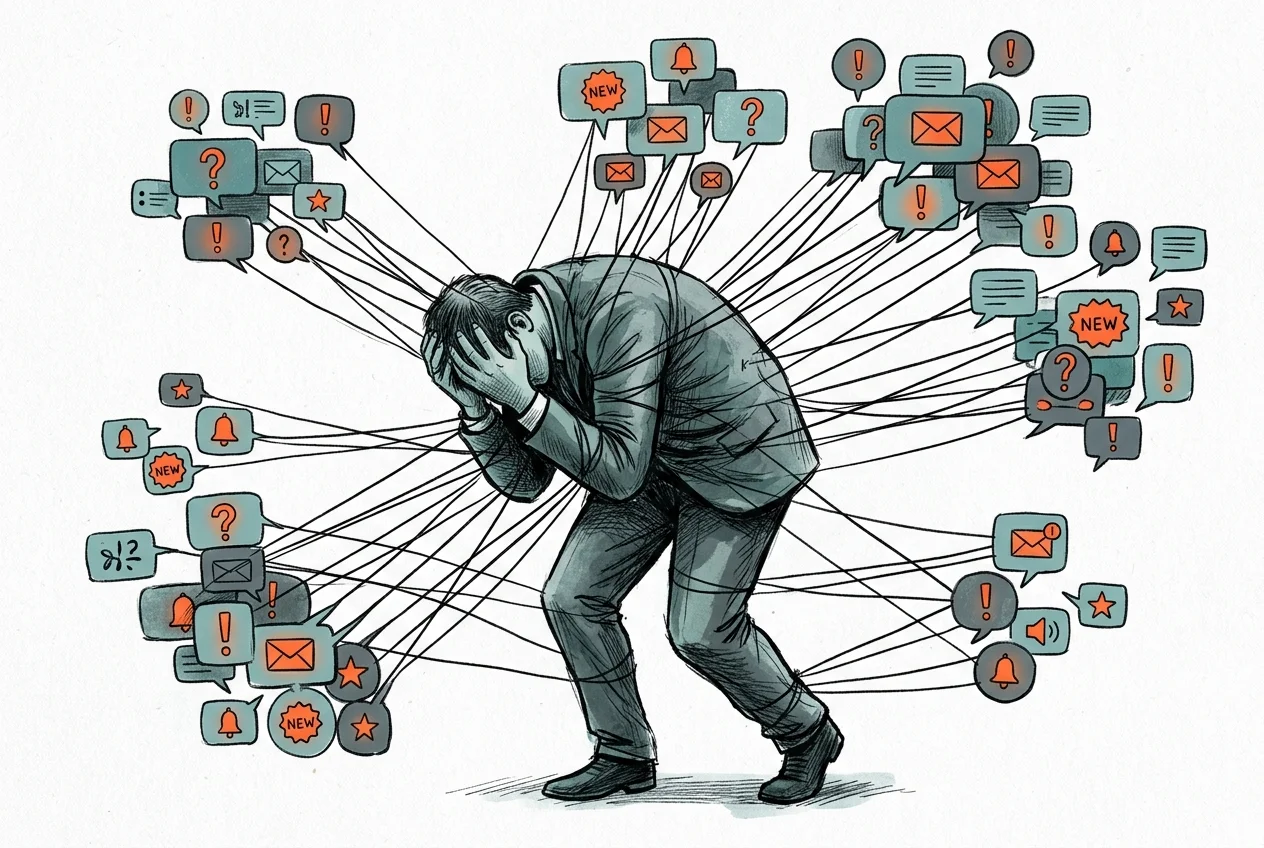
Here's something worth sitting with: the pre-smartphone era wasn't better because people had more discipline. It was better because the architecture of their media didn't demand constant interaction.
A book stops when you close it. A TV show has credits, channel gaps, the slow lag of a cable schedule. A phone call ends. Even early internet — the kind that required sitting down at a desktop — had clear physical boundaries. You went online. Then you went offline. The separation was literal.
Smartphones collapsed that separation. And then the apps that lived on them were engineered specifically to keep you there. Notification badges designed to create urgency. Infinite scroll designed to remove natural stopping points. Variable-ratio reinforcement — the same mechanism that makes slot machines the most addictive form of gambling, where rewards come at unpredictable intervals so you never know when to stop pulling — baked into every feed. The result is a device that is architecturally hostile to the cognitive state your brain needs most.
This is what the attention economy actually sells: not content, but the time between your intentions. Every scroll is a small withdrawal from the account of unstructured mental rest. And unlike money, you don't get a statement.
Why the Feeling Keeps Getting Stronger
If nostalgia for life before smartphones were simply about missing the past, it would fade as time goes on and people adjust. Instead, it keeps intensifying. Communities dedicated to digital minimalism are growing, not shrinking. Searches for "life before smartphones" and "pre-internet nostalgia" have trended upward consistently since 2020. Dumb phone sales are rising. Analog hobbies — reading physical books, journaling with pen and paper, cooking without a screen — are experiencing genuine cultural revivals.
Part of this is simple contrast. As recommendation algorithms become more sophisticated and platforms become more deliberately engaging, the gap between the always-on state and any alternative widens. People who do phone-free weekends, dopamine detoxes, or even just phone-free mornings consistently report the same experience: a strange, unfamiliar slowing down that feels unexpectedly right. Like returning to a temperature you didn't know you'd been missing.
The feeling isn't delusion. It's data. Your nervous system is giving you accurate feedback about the difference between the state it finds restorative and the state it's in most of the day.
What You Can Reclaim Without a Time Machine
You can't go back to 2006. You wouldn't want to — not really, not entirely. What you're after isn't the era. It's the cognitive state: the periods of genuine mental quiet that modern life has nearly abolished.
The good news is that the state is available. It just requires designing for it instead of assuming it will appear on its own.
Phone-free mornings are the highest-leverage starting point — letting the DMN run its maintenance cycle before apps claim first contact with your attention for the day. The phone foyer method, popularized by Cal Newport, creates physical separation between living spaces and the device: the phone stays near the door, not on your person, not on your nightstand. Physical distance is surprisingly effective because the urge to check is often proximity-triggered.
Then there's friction. Not blockades — friction. The brief pause between the impulse and the action, long enough for your prefrontal cortex to register that a choice is being made. That's a gap that didn't need to be engineered before smartphones, because the architecture of older media built it in. Today, you have to install it deliberately.
That's exactly what Sip & Scroll does. Before you open Instagram, TikTok, or YouTube Shorts, it interrupts the automatic motion with a prompt: take a sip of water, take a quick selfie confirming it. Then you get 45 minutes of unblocked access. The pause isn't a punishment — it's a moment of DMN activation, a beat of non-transaction between your intention and your screen. What felt ordinary in 2004 — the small gap between the impulse and the action — is what you're recreating. The technology is different. The cognitive architecture is the same.
You don't need a simpler time. You need a more honest structure. One that treats your attention as something worth pausing for, instead of something to be harvested before you notice it's gone.
This article is part of our series on digital culture and screen time trends. For the full picture, see our guide: The Impact of Infinite Scroll on Gen Z Mental Health.
Reclaim your idle moments
A sip of water before you scroll. The pause your brain has been asking for.
Download Sip & Scroll