Screen Time Before Bed: Does It Actually Ruin REM Sleep?
Those thirty minutes in bed with your phone aren't free. You're paying for them in the morning — and the currency is the most valuable kind of sleep you get.
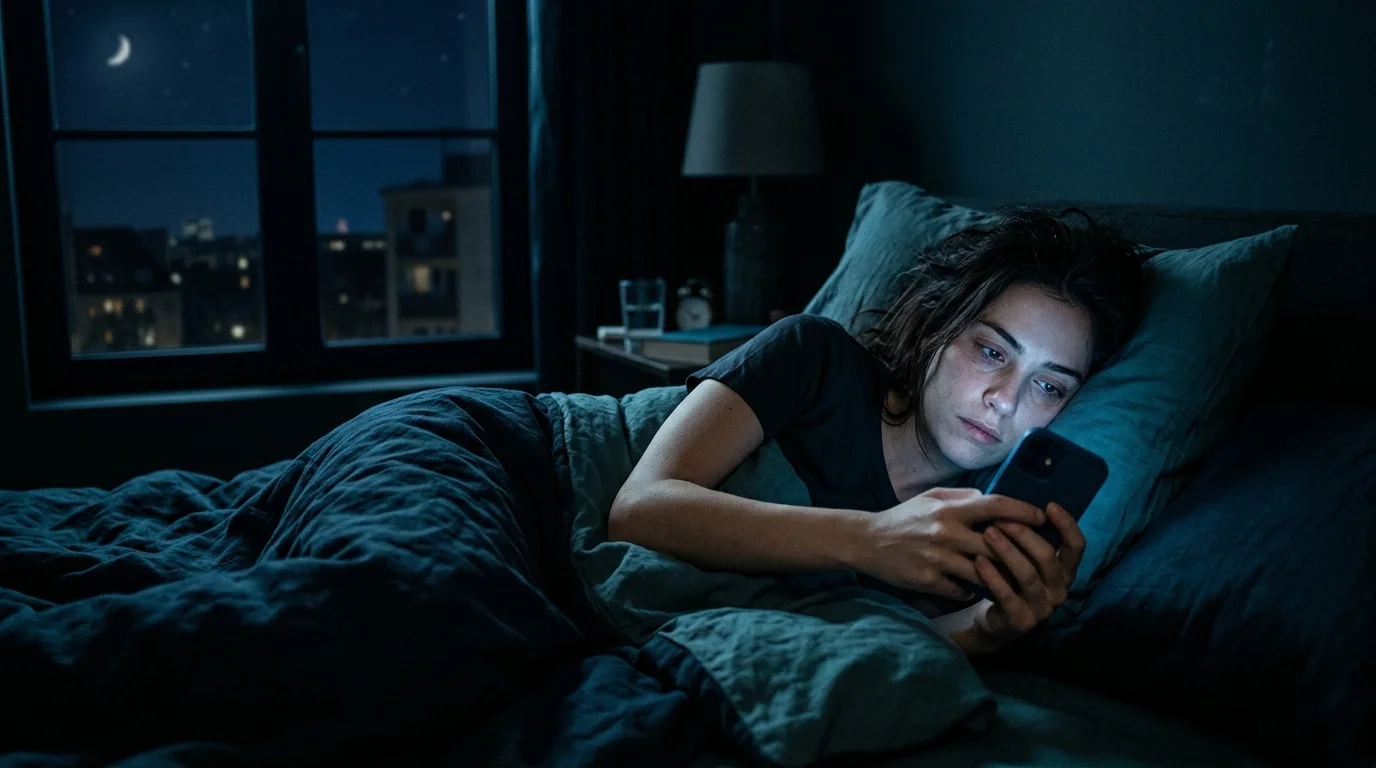
Thirty minutes of scrolling in bed feels free. No subscription fee. No obvious hangover. The phone goes on the nightstand, you close your eyes, and sleep comes — eventually. The next morning you're tired, a little foggy, maybe quicker to snap than usual. But that's just being tired. That's just life.
Except it's not free. There's a price — it just doesn't appear on the bank statement you'd think to check. The payment is extracted not from the thirty minutes of scrolling, but from the sleep that follows it: specifically, from the slow-wave and REM cycles that your brain was going to spend consolidating memory, processing emotion, and clearing the metabolic waste that accumulates during waking hours.
Screen time before bed doesn't just delay sleep. It changes the architecture of the sleep you get — and the part it cuts most is the part you can least afford to lose.
What Blue Light Actually Does
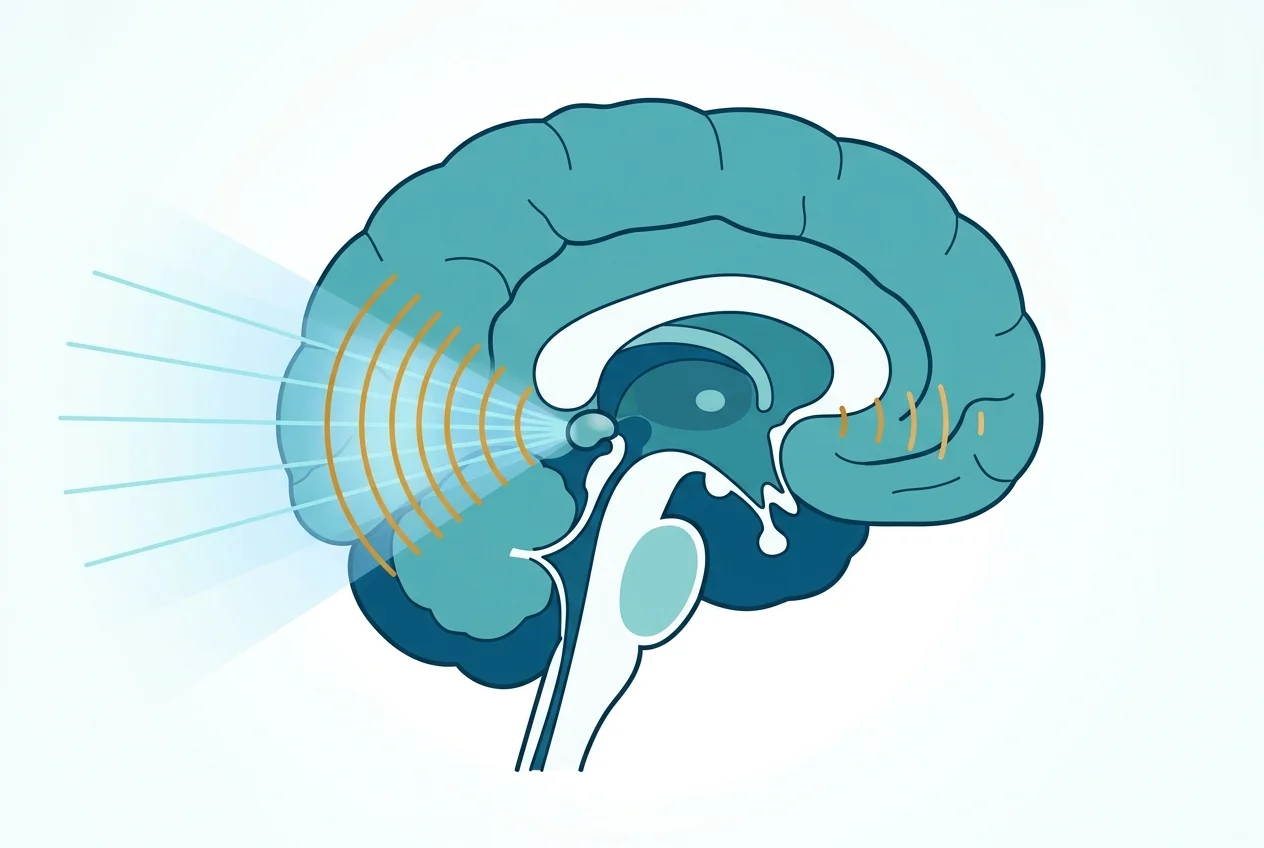
Your body uses light as a clock. Specifically, it uses the ratio of blue wavelengths to everything else as a proxy for "is it daytime?" When that ratio is high, a small gland at the base of your brain — the pineal gland — holds off on releasing melatonin, the hormone that makes you feel drowsy and initiates the cascade of physiological changes that prepare you for sleep.
Phones, tablets, and laptop screens emit light that is disproportionately blue. According to the Sleep Foundation, this blue light exposure at night tricks your brain into thinking it's still daytime, suppressing melatonin and delaying sleep onset. Harvard researchers went further: in a controlled study, they found that blue light suppressed melatonin for about twice as long as green light, shifting subjects' circadian rhythms by as much as three hours in a single evening.
Three hours. From one night of screen exposure before bed.
Most people know the blue light story at this point. What they don't fully appreciate is what happens downstream — specifically, what it does to REM sleep specifically.
Why REM Sleep Is the One You Can't Afford to Lose
Sleep isn't a single state. It cycles through distinct phases across the night — light sleep, deep slow-wave sleep, and REM (rapid eye movement) sleep — and the distribution of those phases is not uniform. Slow-wave deep sleep is front-loaded, concentrated in the first half of the night. REM sleep is back-loaded. The longer you sleep, the more REM you accumulate, with the richest cycles happening in the final two hours before you wake.
This matters enormously for what you lose when screen time delays your sleep onset. If you'd normally fall asleep at 11 pm and wake at 7 am, getting a full eight hours including robust late-night REM cycles, but phone use pushes your sleep onset to midnight — you don't just lose one hour of sleep. You disproportionately lose REM, because the REM-heavy tail of your sleep is what got compressed or cut off when the alarm fired at 7 am regardless.
And REM sleep does things that nothing else does. Research on sleep deprivation's effects on the brain shows that reduced REM impairs attention, working memory, and emotional regulation — leaving you more reactive, more distracted, and less able to consolidate what you learned or experienced the previous day. Memory consolidation — the process of transferring short-term experiences into long-term storage — happens largely during REM sleep. So does emotional processing: the brain uses REM cycles to essentially "re-file" emotionally charged memories in a way that reduces their acute charge. Skip enough REM and the world starts feeling sharper, more reactive, more exhausting. Not because something is wrong with you. Because the maintenance didn't run.
The Second Problem: It's Not Just the Light
Blue light is half the problem. The other half is the content itself — and this is where most people's mental model of the issue stops short.
Sleep onset requires your nervous system to downshift from a state of arousal into a state of restful disengagement. Cortisol needs to be low. Noradrenaline needs to settle. The default mode network — the part of your brain associated with rumination and self-referential thinking — needs to quiet down enough to let the transition begin. Scrolling social media, reading the news, watching short-form video: all of these activities actively work against that downshift.
The content is engineered for engagement. Not for relaxation. Doomscrolling — the compulsive consumption of anxiety-inducing content late at night — is the most extreme version of this, but even benign entertainment triggers the same physiological response: mild cortisol elevation, dopamine anticipation, an alert and forward-leaning cognitive state that is the opposite of sleep-readiness.
Blue light glasses and Night Shift mode help. They reduce the melatonin suppression. But they do nothing for the arousal problem. Filtering the light while continuing to scroll is like wearing noise-canceling headphones at a concert to "reduce the noise." The main problem is still happening.
This is why people who switch to "dark mode" on their phones and report no improvement aren't imagining it. The screen color was never the only issue. Stopping at midnight feels the same as stopping at 11:30 if your nervous system is still running hot from the last hour of content.
The Cumulative Debt
A single night of late scrolling is recoverable. One morning of grogginess, one slightly impaired day, and you're roughly back to baseline after the next good night's sleep. The problem is that late-night phone use is rarely a single incident.
It's a habit. It compounds. And unlike financial debt, sleep debt doesn't accumulate with interest you can clearly see — it manifests as a slow degradation of your baseline that you stop noticing because you've adjusted your sense of normal. You're not "tired." This is just how you feel now.
The research on screen time and anxiety is unambiguous on this: chronic sleep disruption from phone use raises your cortisol baseline, which makes anxiety more likely, which makes sleep harder, which makes the phone more appealing as a distraction. The loop feeds itself. And because the payoff from scrolling is immediate — dopamine, novelty, a sense of connection — while the cost is invisible and distributed across future days, your brain never gets clear feedback that the behavior is hurting you.
What Actually Helps (and What Doesn't)
The straightforward fix — "just put the phone down" — fails for the same reason all willpower-based solutions fail at the end of a long day. Your prefrontal cortex, the decision-making part of your brain, is the most depleted part of you by 11 pm. The phone is in your hand. The feed is already open. The momentum is already carrying you forward.
What works is changing the architecture before that moment arrives.
The phone foyer method — leaving the phone to charge somewhere other than the bedroom — removes the in-bed option entirely. No phone in arm's reach means no unconscious 2 am scroll. It's blunt, but effective, because it operates at the environment level rather than the willpower level.
For people who use their phone as an alarm, or who aren't ready to go fully cold turkey, friction is the next best thing. A brief mandatory pause before opening an addictive app in bed — even thirty seconds — is often enough to interrupt the automaticity and let a conscious choice happen. Research on compulsive phone use consistently shows that the behavior is largely automatic: not decided, just executed. Any intervention that requires a moment of active decision-making, before the app opens, dramatically reduces mindless late-night sessions.
That's exactly what Sip & Scroll is built for. Before any protected app opens — TikTok, Instagram, YouTube Shorts — you get a brief prompt: take a sip of water, snap a quick selfie to confirm it. The ritual takes maybe fifteen seconds. But those fifteen seconds transform an unconscious reflex into a conscious choice, and at 11:30 pm with melatonin finally starting to rise, that moment of consciousness is often enough. You put the phone down. Not because a hard lockout forced you. Because you caught yourself mid-reflex and actually asked: do I want to do this right now? Often, the answer is no.
Turn bedtime scrolling into a conscious choice.
A sip of water and a quick selfie. That's all it takes to break the reflex — and protect your sleep.
Download Sip & Scroll Free