Scrolling Feels Like Rest. Your Brain Disagrees.
You reach for your phone when you're tired. You're still tired when you put it down. That's not a coincidence.
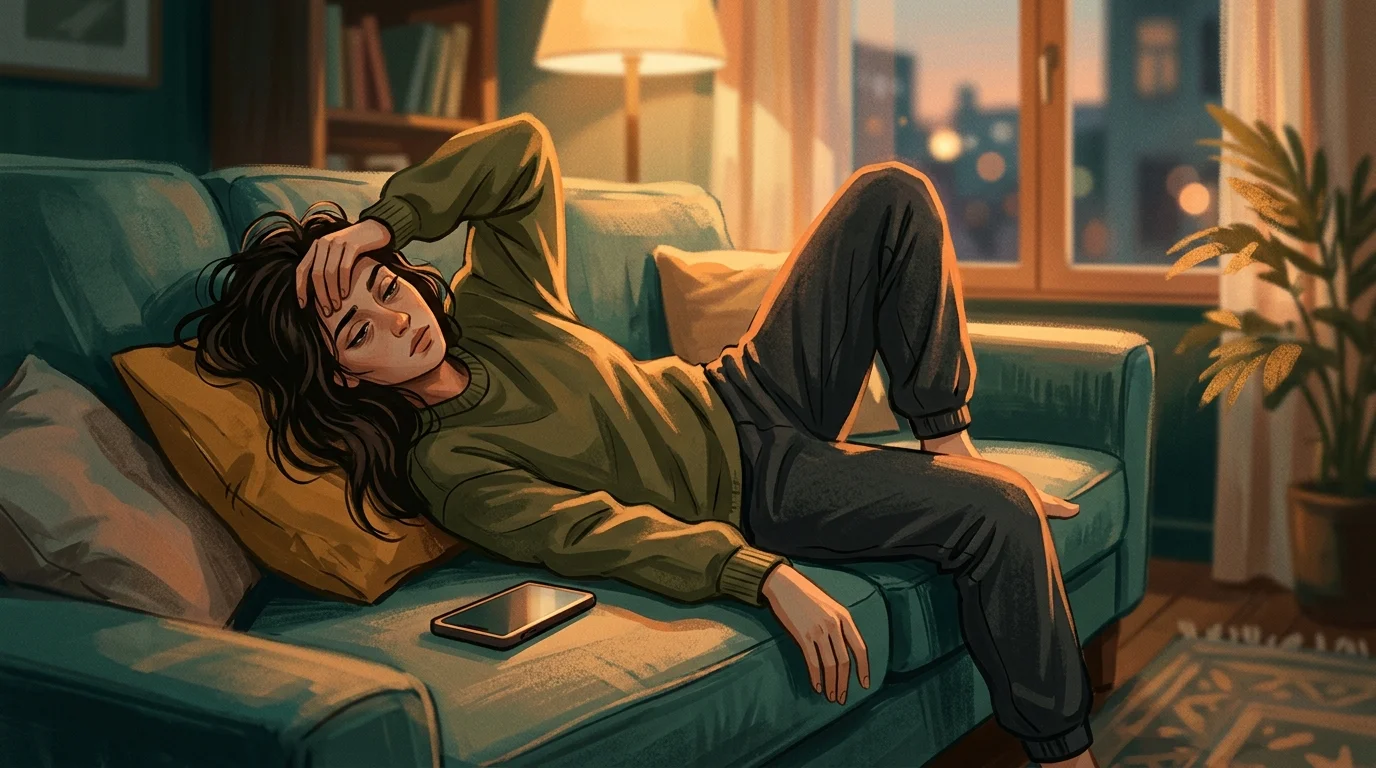
"I just need to zone out for a few minutes." You say this when you're depleted — after a long day, after a difficult conversation, after two hours of concentrated work that left your brain feeling scraped hollow. The phone is there. You open something. You scroll. And then you keep scrolling, because stopping requires a decision you don't currently have the energy to make.
Thirty minutes later, you put the phone down. You notice something odd: you don't feel better, exactly. You feel softer — but also emptier. The tiredness is still there. Maybe more present than before. You needed rest. What you got was something else.
This isn't a personal failure. It's a category error. Scrolling is not rest. It feels like rest because it requires no performance, no output, no conversation, no obvious effort. But your brain's experience of scrolling is nothing like your brain's experience of genuine recovery. Understanding the difference changes how you approach the end of every hard day.
What Your Brain Actually Does During Rest

There's a network in your brain that activates specifically when you stop doing focused tasks. Neuroscientists call it the default mode network (DMN). It's most active during mind-wandering, daydreaming, and unstructured thought — the mental state you're in when staring out a window or walking without a destination. It's the opposite of the focused attention network, which handles deliberate, goal-directed tasks.
The DMN is not idle. It does some of the most important work your brain performs: consolidating memories, processing emotional experiences, generating insight, and building the coherent sense of self that connects your past and future. When people report having their best ideas in the shower or on a walk, that's the default mode network at work. It runs on the absence of external demands.
Genuine rest, in the neurological sense, is what happens when directed attention is allowed to disengage — when the task-focused network quiets and the DMN is free to run. This is what you actually need when you're cognitively depleted. Not the absence of activity. The absence of attentional demand.
Scrolling eliminates that possibility entirely. Every piece of content in a feed is a micro-demand: evaluate this, react to this, decide whether to stop or continue. The feed is engineered to keep your directed attention continuously engaged — which is precisely what produces the depletion in the first place. You haven't rested the exhausted system. You've kept it running at the same load, just without any output to show for it.
The Science Behind "Attention Fatigue" and Why Feeds Make It Worse
Rachel and Stephen Kaplan at the University of Michigan developed Attention Restoration Theory (ART) in the 1980s to describe why some environments recover depleted attention and others deepen the depletion. The theory identifies what restorative experiences share: soft fascination (gentle interest that doesn't require focus), being away from normal demands, a rich enough environment to occupy your mind without effort, and compatibility with what your brain actually needs.
Nature walks, sitting by water, aimless wandering — these meet all four conditions. Social media feeds fail three of the four. The fascination is not soft — it's engineered to spike your attention with every item. There's no being away from demands; the notification badge is a demand. And the content is deliberately mismatched with any given need, because mismatched content (surprising, emotional, unexpected) produces higher engagement than content you were actually looking for.
The result is what ART researchers call directed attention fatigue deepening. You come to the feed already depleted. The feed demands the same attentional resources that depleted you. You leave with less than you arrived with. This experience — using scrolling to rest and feeling worse afterward — is not a quirk of your psychology. It's the mechanism working exactly as designed.
Haidt's review of experimental studies on social media and mental health found consistent evidence that reducing social media use improves well-being across multiple measures — including energy and mood — in ways that passive viewing of other media (TV, reading) typically doesn't. The mechanism isn't just content. It's the attentional structure of the feed itself.
What Actually Restores a Tired Brain

The activities that actually restore directed attention are remarkably consistent across the research — and they share a characteristic that makes them feel almost embarrassingly low-tech.
Walking without a destination or audio. Not a podcast walk. Not a walking meeting. An aimless walk with no input. The gentle stimulation of moving through an environment — especially a natural or semi-natural one — provides exactly the soft fascination ART describes. Your eyes move, your attention follows, but nothing demands a response. The DMN comes online within minutes.
Sitting in silence or near natural sounds. The brain processes silence differently than it processes content. Research on sleep and screen exposure consistently finds that mental wind-down — the transition from alert to restful states — is disrupted by screens and accelerated by environments without artificial stimulation. What's true for sleep onset is true for cognitive recovery: the brain needs low-input time to shift states.
Physical movement that doesn't require focus. Cooking a familiar recipe. Stretching. Light household tasks. Activities where your body is occupied but your mind can wander freely are restorative in ways that consuming content is not — because they allow the DMN to run in the background while the motor system handles the foreground.
Genuine conversation. Not a performance, not a networking event — an actual exchange with someone you're comfortable with, on a topic that doesn't require you to be impressive. This is restorative because it offloads cognitive load to the social processing system, which operates on a different network than directed attention.
What all of these have in common: they are low in external demands, low in interruption frequency, and compatible with a depleted state. They give the attentional system permission to disengage. That permission is what scrolling specifically withholds.
The Scrolling Trap When You're Tired
Here's the cruel irony: the times when you most want to scroll are precisely the times when scrolling does the most damage. Cognitive depletion lowers inhibitory control — the same mechanism that normally helps you put the phone down. When you're tired, your brain is more susceptible to the feed's reward mechanics, less able to override the scroll reflex, and less capable of recognizing that you're getting worse rather than better.
This is why the evening scroll spiral is so common. You're depleted from the day. Your inhibitory control is low. The phone is there. You open something meaning to zone out for ten minutes. The feed captures what little attentional capacity you have left. An hour passes. You feel worse. You're now too wired from the stimulation to sleep easily, and too depleted from the scrolling to feel genuinely rested. The impact on sleep is real — it's not just that screens emit blue light, it's that the attentional demand of a feed prevents the mental deceleration that sleep onset requires.
The blank trance of zombie scrolling — where you scroll past content without it registering at all — is what directed attention fatigue looks like in real time. You're not even enjoying the feed. You're just continuing, because stopping requires a decision and decisions require the very resource you've run out of.
What to Do Instead (When You Actually Need Rest)
The practical reframe is this: your brain needs low-demand time, not zero-stimulation time. Total silence isn't required. What's required is the absence of content that makes demands on your attention. That distinction matters because it makes the alternatives more accessible.
If you reach for your phone when you're depleted, the most useful thing isn't to put the phone down and stare at the ceiling. It's to have a replacement that actually works — something that occupies your hands or your low-level attention without seizing your directed attention. A few minutes of stretching. Stepping outside without an agenda. Making tea and drinking it without a screen. These aren't ascetic acts of self-discipline. They're just activities that fit what a depleted brain can actually absorb.
This is also where intentional scrolling — if you still want to scroll — becomes meaningfully different from compulsive scrolling. When scrolling is a deliberate choice made from a non-depleted state, it can be genuinely pleasurable. When it's a reflex triggered by tiredness, it's almost always a net negative. The question isn't whether to use your phone — it's whether you're using it or it's using you.
Sip & Scroll exists precisely for the gap between those two states. When you've set up an app in Sip & Scroll, opening it when you're depleted means pausing for a sip of water and a quick selfie before the feed opens. That three-second pause is often enough to notice what you actually need — which is rarely the feed. If you want to scroll intentionally, you get 45 minutes. If the pause makes you reconsider, you put the phone down. Either outcome is a better result than the reflex scroll into the tired-exhausted loop.
You are allowed to rest. Actually rest. The phone will be there when you're recovered. The feed will still have content. None of it requires your depleted attention right now. You can just stop.
This article is part of our series on digital minimalism and intentional phone use. For the full picture, see our guide: Digital Minimalism: A Practical Guide.
Scroll intentionally. Rest actually.
A sip of water before the feed opens — the pause that turns a reflex into a choice.
Download Sip & Scroll