You're Not Addicted to TikTok. You're Addicted to the Format.
Reels, Shorts, and TikTok aren't just more social media. The format itself is what makes them impossible to stop — and it's a different neurological problem than scrolling a photo feed.
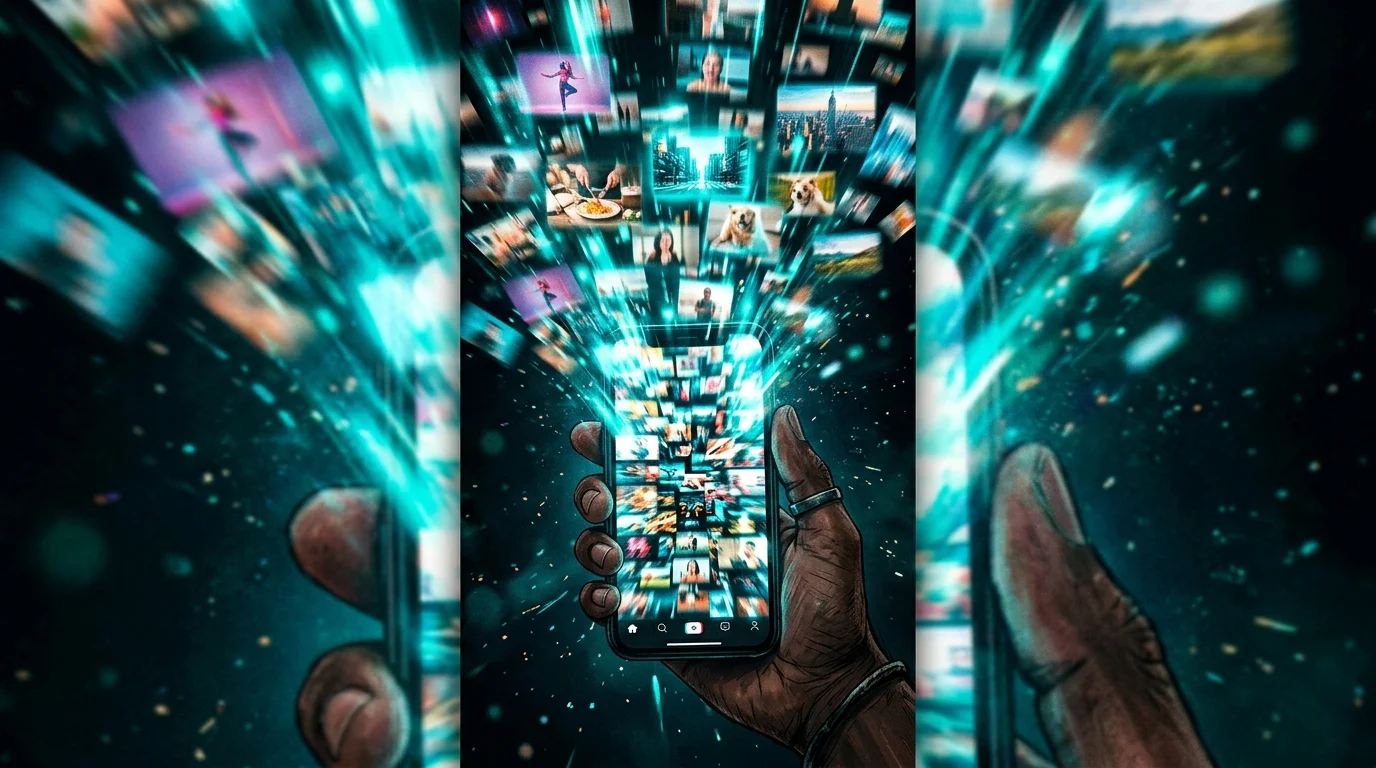
You picked up your phone for a quick break. One video. Maybe two. The break is forty-five seconds long — that's how long a Reel runs. Then there's another one already playing before you've decided to watch it. Then five videos, then twenty, then you're looking up and forty minutes have evaporated and you can't name a single thing you watched.
Here's the part that doesn't get talked about enough: longer content actually has stopping points. A ten-minute YouTube video ends. An article finishes. An episode concludes. Short-form video is the only format specifically engineered to have no natural ending — every clip that completes immediately triggers the next, and the next is already personalized to keep you for one more. You're not consuming content at a faster pace. You're consuming a format designed to make stopping structurally harder than continuing.
Short-form content addiction is the compulsive, loss-of-control consumption of brief video clips — typically 15 to 90 seconds — on platforms like TikTok, Instagram Reels, and YouTube Shorts. It's related to social media addiction broadly, but it isn't the same thing. The mechanism is different. The neurological effect is more acute. And — importantly — you can delete TikTok, reinstall Instagram, and be right back in the same loop, because the problem isn't the app. It's the format.
The Format Is the Drug

Think about what's different, structurally, between a photo feed and a short-form video feed. In a photo feed, you scroll. You stop at an image you find interesting. You look at it for a few seconds. You scroll on. There's no completion moment — the image doesn't end, it just stops getting attention. The reward cycle is vague: you stopped because something caught you, but you didn't finish anything.
Short-form video has a completion cycle built in. The clip starts. The clip ends. Your brain receives a signal that feels like finishing something — a micro-satisfaction, a small resolution. Then the next clip starts immediately. Then that one ends. The reward fires again. You're not scrolling past things that interest you. You're completing dozens of tiny reward cycles in sequence, each one resetting the loop before the previous dopamine signal has fully cleared.
Behavioral researchers call the underlying driver variable-ratio reinforcement — the same reinforcement schedule that makes gambling the most difficult habit to walk away from. You never know if the next clip will be throwaway filler or the funniest thing you've seen all month. That unpredictability is the feature, not the bug. It keeps the behavior firing long past the point where a rational accounting would say there's nothing here worth staying for. The slot machine doesn't pay on every pull. Neither does the feed. But the occasional hit is calibrated precisely enough to make the pulls feel worth it.
What makes the short-form version particularly potent is the density. A slot machine might give you one pull every thirty seconds. A short-form feed gives you a complete reward cycle — start, middle, end, dopamine signal — every thirty to ninety seconds. You're running the same gambling psychology at three to five times the frequency. And unlike a slot machine, the content is personalized in real time to match your specific taste, so the hits keep getting more calibrated and the misses keep getting shorter.
This is the underlying mechanism behind what many are now calling TikTok brain rot — not metaphorical damage, but a genuine recalibration of what your brain considers a normal stimulation cycle.
The Autoplay Trap: Why One More Is Always a Lie
Every other media format requires a micro-decision between items. You finish a song, the next one starts — but you chose that playlist. You finish a chapter, and closing the book is the default next action. You finish a YouTube video and the next one is suggested, but it isn't playing yet, and you decide whether to click.
Short-form video removed that micro-decision. Autoplay is the default. The next clip begins before you've processed whether you want to see it. By the time you've registered that the last one ended, you're already two seconds into the next one — which means you're already partially engaged, which means stopping now means stopping mid-video, which feels worse than just finishing this one. And now you're in the next loop.
That gap — the half-second between clips — is where your conscious intent would normally register. It's where you'd think: okay, that was good, I'll stop here. Short-form platforms spent years engineering that gap out of existence. Not out of negligence. Out of deliberate design. Research on media consumption patterns among young people shows that short-form video time has grown faster than any other format, precisely because autoplay extends sessions in a way that user-initiated browsing doesn't.
The reason Instagram Reels compulsion and TikTok addiction feel so different from being "on your phone too much" is exactly this: the autoplay loop has no internal off switch. Every natural stopping point was an engineering problem that got solved.
What It's Doing to Your Attention
Attention isn't a fixed capacity you either have or don't. It's a trained response — a skill that improves with practice and degrades without it. Heavy short-form video consumption is, in practical terms, an extended training session in the opposite direction: conditioning your attention to expect novelty on a 30-to-90-second cycle, making anything slower feel like a cognitive tax.
Research on attention and task-switching costs shows that even brief, frequent redirections between cognitive targets — the kind that happen naturally when watching short-form video — impose measurable overhead on the prefrontal cortex and can consume up to 40 percent of productive capacity across a day. Short-form viewing is essentially rapid task-switching in disguise: each new clip is a new topic, new tone, new register, and your brain is processing a context shift every 45 seconds.
The downstream effect shows up in two ways most people recognize. First, longer content starts to feel effortful. A ten-minute video, an article, a conversation that takes more than a minute to develop — these become mildly uncomfortable when your baseline stimulation rate has been calibrated up by a short-form habit. Second, quiet starts to feel wrong. The absence of input — sitting without a second screen, waiting without reaching for your phone — registers as a kind of discomfort your brain wants to resolve by resuming the feed.
This is what researchers describe as the popcorn brain effect — a brain recalibrated to rapid-fire stimulus that progressively loses the capacity to engage with experiences that develop slowly. The irony is that the content itself doesn't need to be interesting. The format delivers the stimulation regardless of quality. You can watch bad videos for an hour and feel just as drained as if you'd watched good ones — because the drain isn't about the content. It's the format running on your nervous system.
The Algorithm Has a Head Start
One reason short-form platforms feel different from earlier social media isn't just the format — it's the speed of the learning. A photo feed algorithm needs weeks of engagement data to build a useful model of what keeps you. A short-form algorithm learns you in an afternoon.
Every clip you watch to completion is a signal. Every clip you exit at three seconds is a signal. The total watch time per clip, whether you replayed it, whether you shared it before it finished — all of it feeds a model that, within your first session, has a working map of the specific emotional registers that catch you. Novelty. Nostalgia. Outrage. Ambient anxiety. Whatever it is, the algorithm finds the flavor of it that keeps your thumb still longest, and starts serving more of exactly that.
You don't notice this calibration happening because it happens incrementally, across many clips. But the personalization after one week of short-form use is significantly tighter than the personalization after one week of any other platform — because no other format generates this many behavioral data points per session. By the time you feel like the app "knows you," it does. Better, in some narrow sense, than you know yourself — because it's been watching your unconscious engagement patterns, not your stated preferences.
Why Deleting the App Doesn't Fix It
The most common response to a short-form compulsion is deleting the app — and the most common observation afterward is that the compulsion migrates. Delete TikTok, and Instagram Reels fills the slot. Delete Reels, and YouTube Shorts is there. The craving isn't for TikTok specifically. It's for the format. The 45-second clip, the completion cycle, the autoplay chain. Any app that provides those elements will absorb the behavior.
This is why disabling YouTube Shorts doesn't solve the underlying pattern, and why platform-level decisions — deleting this app, blocking that account — treat the symptom but not the cause. The cause is a trained behavioral response to a specific delivery mechanism. What changes the pattern isn't removing one app. It's interrupting the loop at the moment it fires — before the autoplay takes hold, before the completion cycle begins, before the decision to keep watching has been replaced by the simple fact of already watching.
You cannot think your way out of an automatic behavior. The behavior fires below the level of deliberate choice — in the gap between impulse and awareness that behavioral conditioning lives in. What interrupts it is architecture: a brief, physical pause between the impulse to open the app and the first clip starting. Ten seconds is enough for your prefrontal cortex to register that a choice exists. Without that pause, there is no choice — just the next video, already playing.
That's the mechanic behind Sip & Scroll. When you try to open TikTok, Instagram, or YouTube Shorts, there's a moment first: take a sip of water, take a quick selfie proving it. Then you get 45 minutes of unblocked access. It's not a lockout, and it's not trying to convince you not to watch — it's a structural pause inserted exactly where the automatic behavior was designed to skip one. That ten seconds is all the space most people need to ask the question the format was built to prevent: is this what I actually want right now?
Sometimes the answer is yes. Sometimes it isn't. Either way, you got to choose.
Put a pause before the autoplay.
A sip of water. A selfie. Ten seconds between the impulse and the feed — then 45 minutes, on your terms.
Download Sip & Scroll Free