How I Stopped Doomscrolling Before Bed (And Fixed My Sleep)
The cost isn't the lost minutes. It's what your brain can't do while you're still scrolling at midnight.
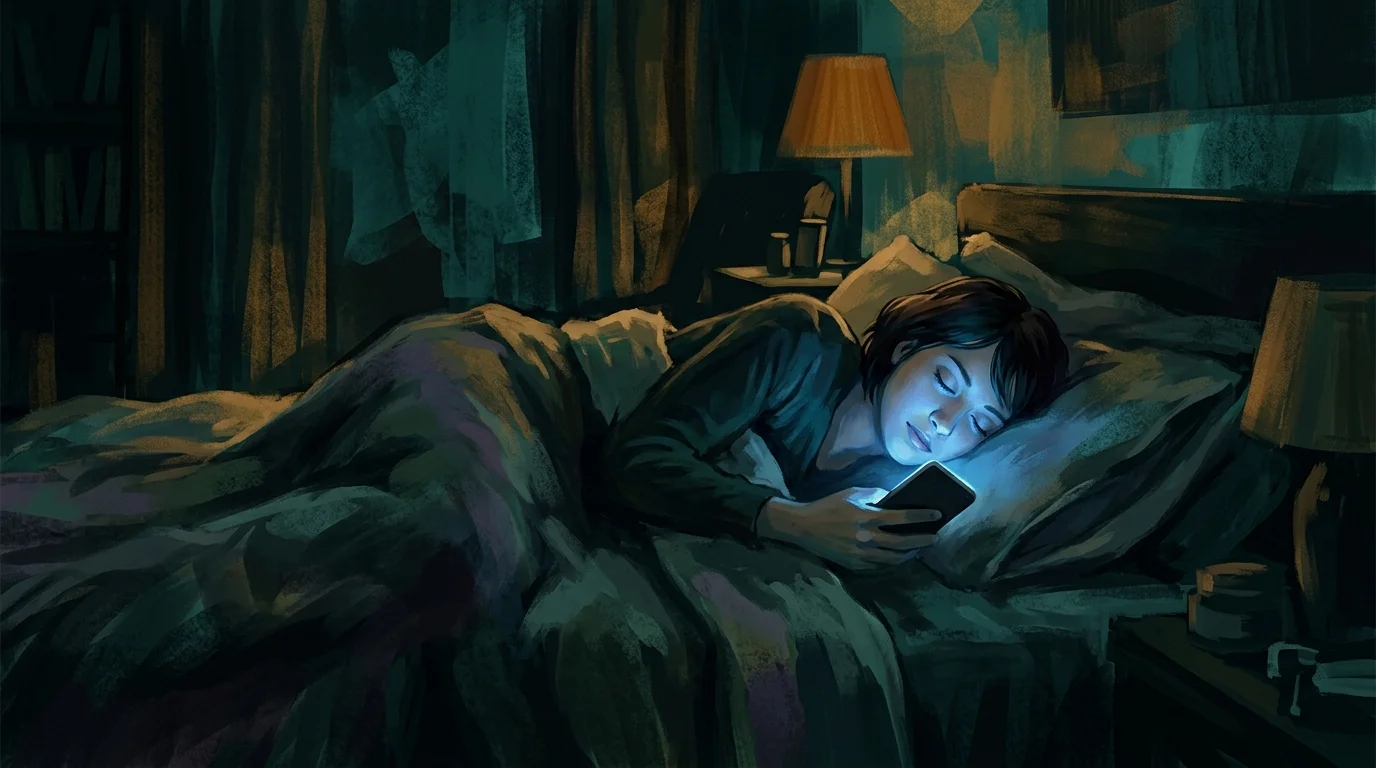
The cost of doomscrolling before bed doesn't show up in your Screen Time report. It shows up the next morning — in the quality of your thinking, the flatness of your mood, the way your body feels like it ran a low-grade background process all night and never fully shut down. You're not just losing minutes to the scroll. You're losing the biological repair your brain runs every night during deep sleep and REM: the memory consolidation, the emotional regulation, the cortisol reset that determines how reactive you'll be to everything that happens the next day. And most people are quietly skipping those processes, one TikTok at a time. The mechanism is well-documented — screen time before bed actively disrupts REM sleep architecture, not just your bedtime.
I was one of them. For close to two years, my bedtime routine was: get into bed, open Instagram "for a few minutes," lose forty-five minutes to Reels, switch to TikTok when Instagram got boring, emerge sometime after midnight having watched approximately one hundred pieces of content I couldn't name by morning. Then lie there, wired and weirdly anxious, waiting for sleep that felt far away.
Doomscrolling before bed means falling into an involuntary scroll of social media or short-form content during the hour or two before sleep — specifically during the biological window when your brain is preparing its overnight maintenance cycle. It's not just a time problem. The light from your screen suppresses melatonin, the hormone that signals your body to sleep, while the emotional stimulation of the content keeps your nervous system aroused long after you put the phone down. The result: delayed sleep onset, compressed deep sleep, fragmented REM. You're technically in bed for eight hours. But the repair work doesn't happen.
Why Bedtime Scrolling Hits Your Brain Differently
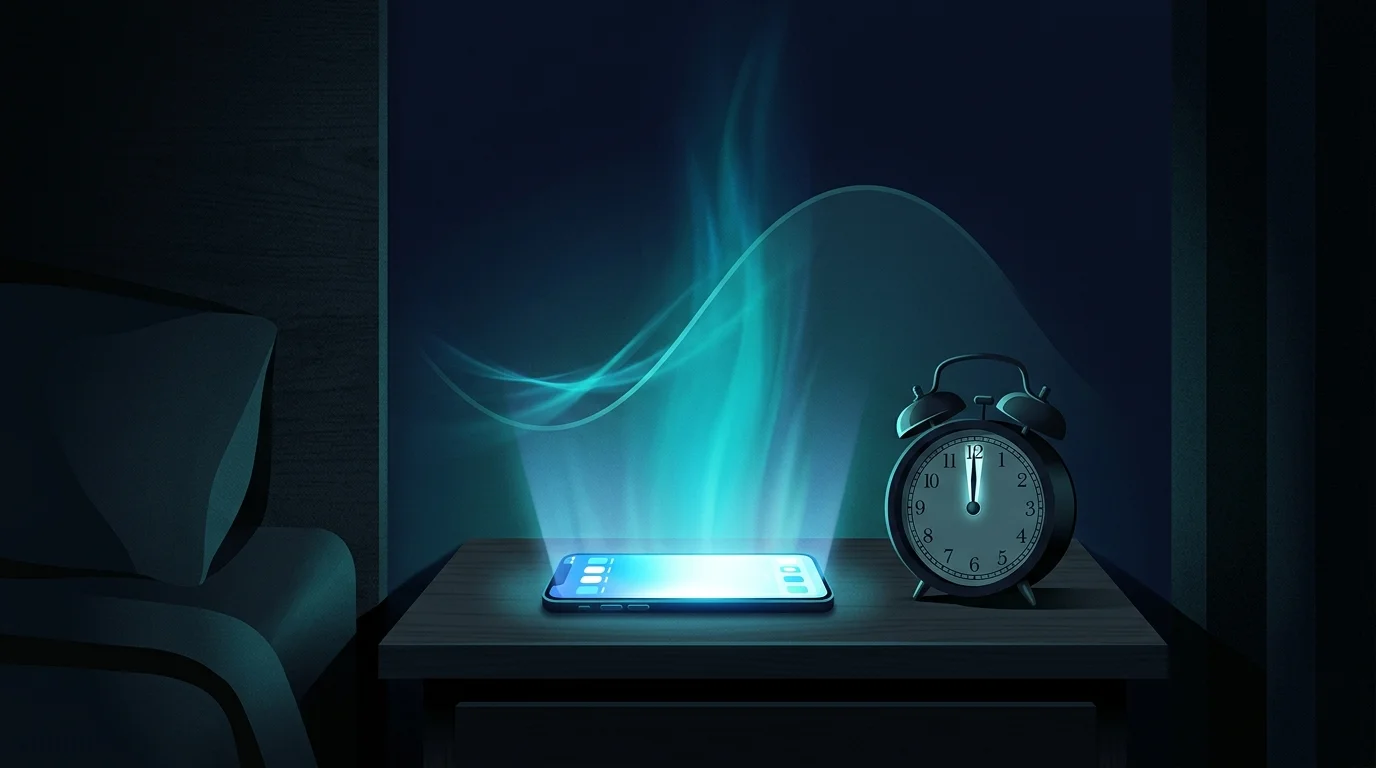
Scrolling at 11pm isn't the same as scrolling at 2pm. The timing matters in a way most people don't fully understand, because the hour before sleep isn't just another hour — it's a biological transition zone that your nervous system is actively managing.
Here's what's actually happening. As evening approaches, your brain begins releasing melatonin — a hormone sometimes called the "darkness signal" — which tells your body that nighttime is coming and it's time to begin winding down. The problem is that the blue light emitted by smartphone screens disrupts this process directly at the molecular level. Research from Harvard found that blue light suppresses melatonin for roughly twice as long as other light wavelengths and shifts circadian rhythms by up to three hours — meaning your body clock can be pushed three hours later simply by looking at a screen before bed. You feel tired, but your biology hasn't caught up. Sleep becomes a door that won't open when you push it.
That's the light problem. Then there's the content problem, which is arguably worse.
Social media algorithms don't serve you calming content at night. They serve you whatever kept you watching longest in the past — which tends to be emotionally activating: funny, outrageous, dramatic, surprising. Each piece of content triggers a small response in your nervous system, a micro-arousal, and these stack. By the time you put the phone down, you're not in a state of wind-down. You're in a state of low-grade stimulation, the exact opposite of what sleep requires. Your brain can't begin the first sleep cycle properly when it's processing a residue of forty stimulating videos. This is the core mechanism of doomscrolling — but at night, the consequences compound in ways daytime scrolling doesn't.
The downstream effect lands on REM sleep, the cycle stage where emotional memory processing happens. Sleep Foundation researchers note that light-disrupted sleep tends to reduce REM duration most significantly — which means the stage of sleep most responsible for emotional regulation and next-day mood is the first thing compressed when screens delay your sleep onset. You can sleep eight hours and still wake up emotionally flat, easily irritated, slower to find language. That's not tiredness. That's skipped REM. And it's entirely caused by what you were doing an hour before you closed your eyes.
I didn't understand any of this at the time. I just knew I was tired in a way that sleep didn't fix. And I'd been blaming it on everything except the obvious.
The Pattern I Finally Named
The realization came sideways. I was already a few weeks into trying to reduce my overall screen time, and I'd made progress during the day — I'd moved my phone charger out of the bedroom, set up a dedicated slot for email, stopped taking the phone into the bathroom. My daily average had dropped from nearly eight hours to around five. But I wasn't sleeping better. I was still waking up foggy, still crashing by 3pm, still reaching for the phone with a kind of low-grade desperation I didn't fully understand.
Then I looked at when the remaining screen time was happening.
Between 9pm and midnight. Every single night. The phone had left the bedroom, but I was using it on the couch until I fell asleep, then carrying it in half-conscious, and the damage was already done by then. I'd solved the morning problem and completely missed the one that mattered more — because the hours before sleep are not equivalent to other hours. They have an outsized effect on everything that follows.
The anxiety I'd been attributing to morning scroll habits was at least partially nocturnal in origin. My nervous system was going to bed charged and waking up still carrying yesterday's stimulation. That's not a small problem. That's a compounding deficit — each night worse than the last, each morning starting further in the hole.
The other thing I noticed: I didn't actually want to be scrolling. I'd pick up the phone looking for something specific — a feeling, maybe, or relief from a vague restlessness — and I wouldn't find it, but I'd keep looking anyway. This is the part nobody talks about. The dopamine loop doesn't deliver what you're seeking. It just makes you seek longer.
What Actually Changed My Nights
I want to be specific here, because the advice "put your phone away before bed" is useless without a mechanism. Knowing is not a mechanism. Wanting to is not a mechanism. What worked was understanding where the behavior actually lived and building structure around that specific point.
The Soft Cutoff at 9pm
I didn't ban myself from the phone in the evenings. I made opening social apps at night require a small conscious moment instead of being frictionless. The goal wasn't to stop entirely — it was to interrupt the automatic reach long enough for a choice to happen. Most of the time, when I paused, I realized I didn't actually want to scroll. I wanted to decompress, or I was bored, or my hands wanted something to do. Once I saw that clearly, I could give those things something better.
The 9pm cutoff wasn't a rule I kept perfectly. It was a friction point. Before 9pm, the phone was available with no ritual. After 9pm, I used Sip & Scroll — the same app I'd started using during the day — which prompts a sip of water and a quick selfie before any session with an addictive app begins. That small pause, maybe fifteen seconds, broke the automaticity. It sounds almost too small. It worked almost every time. The reflex reach would happen. The ritual would interrupt it. And somewhere in those fifteen seconds, the actual desire — or lack of it — would surface.
The hydration piece turned out to matter more than I expected. Drinking water before bed, even a small amount, meant my body had a physical sensation to anchor to. Something concrete happened. Something good for me. The scroll, when I chose to do it after that, felt different — less like falling and more like a decision.
The Replacement That Actually Stuck
Every guide about stopping bedtime scrolling tells you to "replace it with reading." I tried this. It works — but only if you've chosen the book in advance and it's already next to the bed, open, with a light within reach. The moment there's any friction between you and the replacement behavior, your brain defaults back to the phone. It's faster. It's easier. It's already in your hand.
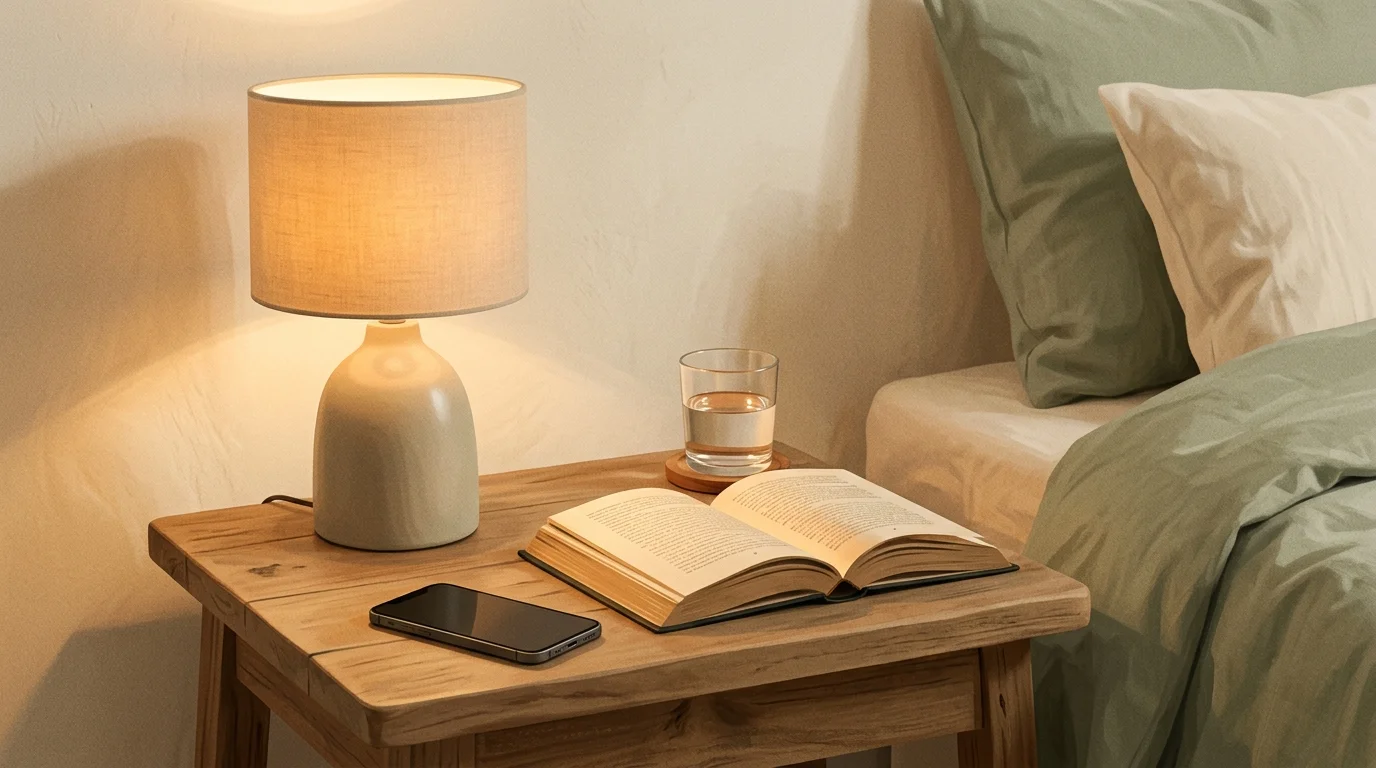
What worked for me was making the replacement require even less effort than the scroll: a physical book left open on the nightstand, already bookmarked, already in progress. No decision required. The alternative had to be more frictionless than the phone — or at minimum equally frictionless — for the replacement to compete.
The other discovery: I didn't need to read for long. Fifteen minutes of reading in dim light is neurologically more sleep-conducive than fifteen minutes of social media, by a significant margin. The book doesn't fight your melatonin. It doesn't feed your anxiety. And unlike a scroll, it has a natural stopping point — the end of a chapter, a good sentence, a moment where the eyes want to close.
Three Months Later
Sleep latency — the time it takes to fall asleep after getting into bed — dropped from somewhere around forty-five minutes to under fifteen. That's not an estimate. I started tracking it after the second week because I noticed I was falling asleep mid-page and wanted to understand whether it was actually happening consistently. It was.
The morning mood shift was harder to quantify but impossible to miss. The first hour of the day stopped feeling like recovery from the night before. I wasn't waking up ahead of my alarm but lying there dreading the start — the way I'd been doing for two years without understanding why. The dread, it turned out, was partly a sleep debt problem and partly a cortisol problem: ending the night with emotional stimulation meant my stress hormones were calibrated for low-grade threat before I'd even closed my eyes.
The thing that surprised me most: I didn't miss the late-night scroll. I thought I would. I expected the hours between 9pm and midnight to feel empty, the way time feels when you first take away a habit before you've built anything to replace it. But the hours felt longer — not empty-longer, but fuller-longer. I was reading, thinking, occasionally just lying there in the quiet. And the quiet, which used to feel like an absence, started feeling like the thing I'd been trying to find at the bottom of the feed all along.
You cannot willpower your way through a system that is specifically engineered to override willpower. The algorithms running your social feeds are designed by behavioral scientists whose full-time job is keeping you looking. They have billions of data points on what keeps you scrolling. You have one exhausted brain at midnight trying to make a good decision.
That's not a fight you win by trying harder. It's a fight you restructure around — by adding friction at the moment before the reflex fires, by giving your biology something to work with instead of working against it. Sip & Scroll was the structural piece that made the difference for me at night: not a wall, not a lockout, just a fifteen-second pause that gave my brain enough time to catch up to what my hand was already doing. A sip of water. A selfie. And then a choice — scroll, or don't — that was actually mine to make.
Ready to reclaim your nights?
Add gentle friction before bedtime scrolling. A sip of water, a selfie, and a real choice.
Download Sip & Scroll