Multitasking Is the Skill Holding You Back
The neuroscience of why the brain can't do two things at once — and how the myth of multitasking is quietly cutting your output by 40%.

Here is what multitasking actually costs. Not in theory — in measured output. Research consistently finds that constant task-switching reduces effective productivity by up to 40 percent, increases error rates substantially, and leaves you with more work at the end of the day than you had at the start — despite feeling busy the entire time.
This cost doesn't appear on your task list. It shows up as a project that takes twice as long as it should. As revisions that reveal errors you didn't notice making. As a late afternoon that somehow produced less than the morning, and a workday that stretched past its intended end while delivering less than its intended output. The productivity loss from multitasking is invisible on any given switch and undeniable over any given day.
Multitasking is the attempt to perform two or more cognitively demanding tasks simultaneously. It's widely understood to be effective — "good at multitasking" is a job-listing cliché, a self-described skill on résumés, a badge worn with pride in busy offices. The neuroscience is unambiguous: it is not a skill. The brain cannot execute two cognitive tasks simultaneously. What it can do is switch between them — fast enough to create the sensation of parallel processing, slow enough to pay a measurable cost on every switch.
What the Brain Is Actually Doing
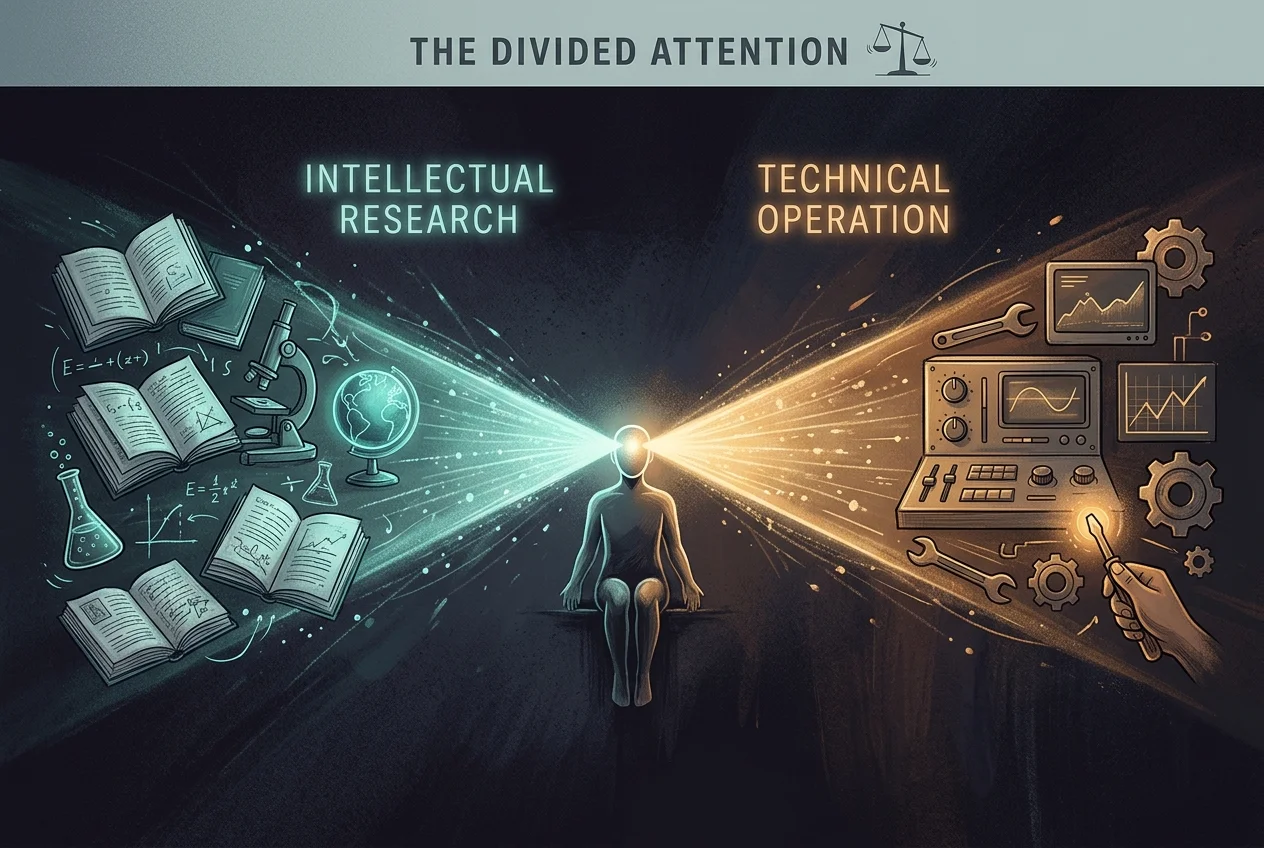
The brain's executive control system — housed primarily in the prefrontal cortex — manages conscious attention. When you focus on a task, this system loads a set of rules: what to prioritize, what to filter out, what decisions to make. When you switch to a different task, it has to unload those rules and load a new set. That transition — called a task-set reconfiguration — takes time and consumes cognitive resources, even when it feels instantaneous.
What researchers have found is that the brain activates four distinct regions during every task switch: the prefrontal cortex shifts attention, the posterior parietal lobe updates the active task rules, the anterior cingulate gyrus monitors for errors (more of them after a switch), and the premotor cortex prepares the new response pattern. All of this happens in the background, burning through the brain's available supply of glucose and neurotransmitters — the same resources that support sustained attention and working memory.
You cannot perceive this happening. The switches feel free. But accumulate enough of them across a day — and most people make hundreds — and you arrive at late afternoon significantly more depleted than the task list would suggest. This is cognitive drain that doesn't announce itself as drain. It announces itself as the inability to focus on the thing you're trying to focus on, right now, for the third time this hour.
Attention Residue: Why the Switch Never Fully Completes
Even when you've switched tasks, part of your attention hasn't. Researcher Sophie Leroy coined the term attention residue to describe the phenomenon: when you pivot from one task to another while the first is unfinished, a portion of your working attention stays back — processing the prior task, monitoring for it, waiting for an opportunity to return. You're on the new task in body, but not entirely in mind.
This is why context switching has a cost that outlasts the switch itself. The moment you stop working on one task to respond to an email or check a notification, you haven't cleanly transitioned — you've fractured. And the new task inherits a brain that is already partially occupied, working at reduced capacity on the fraction of attention that actually arrived.
Leroy's research shows that attention residue is strongest when the first task was unfinished — which is almost always the case in a multitasking workday. You switch away from a half-written document to answer a message, then switch back to the document, but the reply you sent is still being processed in the background. The document gets 70 percent of you. Sometimes less. And the "getting back on track" time — the reorientation, re-reading, rebuilding context — is its own additional overhead, paid on every return.
The Digital Multitasking Problem

The multitasking problem is not new — humans have always struggled with competing demands on attention. What is new is the density of switching opportunities that modern devices create. A knowledge worker in 2026 has a phone, a laptop, multiple open browser tabs, an always-on messaging app, email running in the background, and a social media feed one tap away. The average person checks their phone over 90 times per day. Each check is a task switch, even if it produces nothing.
And the phone doesn't have to be in your hand to cost you. Research from the University of Texas at Austin found that the mere presence of a smartphone on your desk reduces available working memory and fluid intelligence — even when it's face-down and silent. The brain allocates a portion of its executive control resources to managing the impulse to reach for it, leaving less for the task in front of you.
What this means practically: your phone on your desk is a multitasking tax you're paying without picking it up. The apps and feeds designed to interrupt you are extracting attention overhead whether you respond to them or not. The presence of the device — the possibility of a switch — is itself a cognitive cost.
The Research on Error Rate and Output Quality
The 40% productivity figure is widely cited, but what it means at the task level is worth unpacking. Task-switching doesn't just slow you down — it changes the quality of what you produce. When the brain is switching contexts, it is more likely to miss details, apply the wrong rule to the wrong task, and skip the kind of slow, deliberate review that catches errors before they leave your desk.
The specific mechanism is this: working memory — the mental workspace that holds the details of what you're currently doing — is limited and easily disrupted. When you switch away from a task, working memory begins to lose the detail-load of that task almost immediately. When you return, you have to reload: re-read, re-establish context, recalculate where you were. This reloading is imperfect. Details that were in working memory ten minutes ago are less sharp now. Some are missing entirely.
The result is work that reads as less thorough, less considered, and less complete than the same work done without switching. Not because the work was done carelessly — because the brain's cognitive architecture makes precision and switching fundamentally incompatible. You cannot be thorough and constantly interrupted at the same time. One of them will give way.
Single-Tasking as the Structural Alternative
The antidote to multitasking is not better time management. It's not a productivity app. It's not even discipline — because discipline deployed against an environment designed to trigger constant switching is a losing fight. The antidote is architecture: a working environment structured to reduce the number of available switches, not the number of switches you choose to take.
What that looks like in practice:
- One task per work session. Not "clear my to-do list" — one specific deliverable per timed block. Specificity reduces the activation cost of starting and the temptation to wander.
- Phone in another room. Not silenced. Not face-down. Out of the room entirely. The cognitive overhead of managing the impulse to check is eliminated when there's nothing to check.
- Tabs closed. Every open tab is a pending task switch. Close everything unrelated to the current work. Browser extensions that limit tab counts are one implementation of this.
- Inbox closed during work sessions. Email treated as scheduled work — checked at designated windows — rather than a live feed running in the background.
- Structured intervals. Time-bounded focus sessions like the Pomodoro technique give attention a container with a defined end, reducing the temptation to switch by making the commitment feel manageable rather than open-ended.
The goal of all of this is the same: reduce the number of task switches across the day, because each switch carries overhead that compounds. Ten switches instead of forty is not a modest improvement — it's a fundamentally different cognitive experience. Your output becomes cleaner, your focus arrives faster at the start of each session, and the afternoon doesn't arrive as a wall of depletion.
This is the same principle that applies to how phones and social media interact with your attention. Every notification is a triggered task switch. Every time TikTok or Instagram fires and pulls you away from what you were doing, you've paid the switching tax — the re-entry cost, the attention residue, the working memory reset. You cannot out-discipline a device that's making dozens of bids for your attention per hour. You need friction: a brief pause between the impulse and the action, long enough for the executive control system to register that a switch is about to happen. That's exactly the architecture of Sip & Scroll — a sip of water and a quick selfie before the app opens, turning a reflexive switch into a deliberate one. The tax doesn't disappear. But you get to decide whether you're paying it.
Stop paying the switching tax.
Sip & Scroll adds a brief pause before addictive apps open — turning a reflexive task switch into a deliberate choice. One sip of water, one selfie, then 45 minutes of intentional access.
Download Sip & Scroll