AI Brain Rot: Why AI Slop Is the New Doomscrolling
The content flooding your feed isn't made by humans anymore — and your attention span is paying the price.
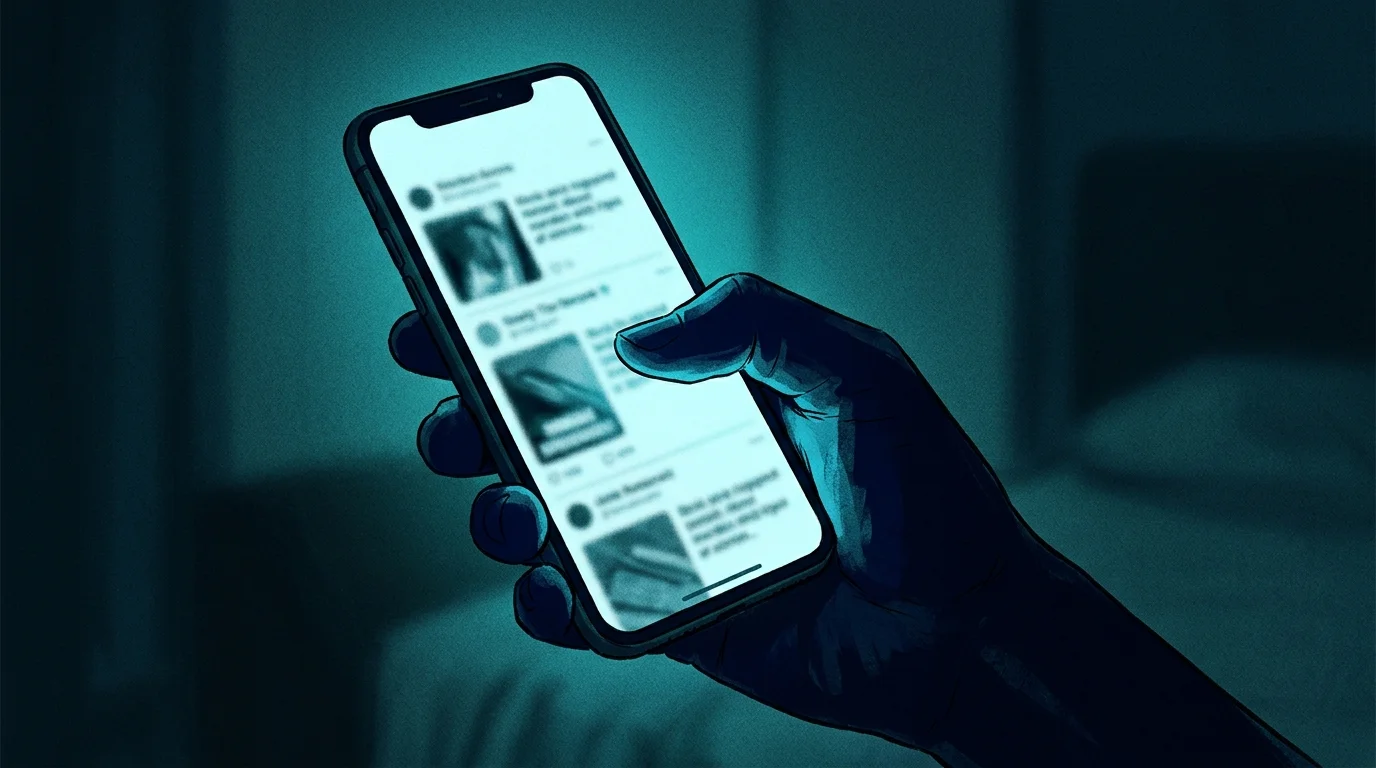
Something felt off about the video. The motion was slightly wrong — the way the person's hand moved as they demonstrated the "life hack," the way their voice didn't quite match the lip sync, the background that looked like a photograph someone had asked a computer to imagine. You watched it anyway. Then the next one. Then the next one after that. Thirty minutes later you couldn't remember a single thing you'd seen, and you felt a particular kind of hollow — not the hollow of wasted time, but the hollow of having consumed something that contained no actual nutrition at all.
Your feed is increasingly made of AI. Not partially, not occasionally — predominantly. AI-generated images, AI-written captions, AI-voiced narration over stock footage, AI-remixed clips of other videos that were themselves AI-generated. The scroll that used to offer occasional human authenticity — real people, genuine reactions, actual creativity — now delivers something the internet has started calling "AI slop": industrial-scale content optimized entirely for algorithmic engagement, with no actual human on the other side of it.
This is AI brain rot. The term builds on the broader concept of doomscrolling, but the mechanism is different and arguably more damaging. AI brain rot is the cognitive degradation that results from consuming large volumes of low-quality, machine-generated content — content that hijacks your attention circuits without delivering the genuine stimulation your brain actually needs. Oxford named "brain rot" its 2024 Word of the Year, with usage up 230% in a single year — and that was before the current wave of AI content generation fully hit its stride.
What "AI Slop" Actually Is

The Reuters Institute at Oxford describes AI slop as content that "quietly conquers the internet" — flooding platforms by sheer volume rather than value, gaming recommendation algorithms by hitting engagement signals without any corresponding substance. It's the difference between a meal and empty calories: the format is the same, the satiation is zero.
AI slop isn't just text articles. It's the "story time" videos on TikTok with AI-generated visuals and synthetic voiceovers. It's the Instagram carousels of "motivational quotes" designed by a prompt, not a person. It's YouTube Shorts that are remixed and re-captioned versions of other clips, assembled by an automation pipeline that produces a hundred variations a day. The humans who "make" this content often aren't making it at all — they're operating a machine that makes it for them, then collecting the ad revenue or affiliate clicks that result.
The volume is the point. One human creator can produce, at most, a few videos a week. One AI pipeline can produce thousands of variations daily, each slightly tweaked to hit the algorithmic signals that generate impressions. Your feed can't tell the difference. More importantly, in the moment of scrolling, you often can't tell the difference — and that's exactly what makes it dangerous.
Why AI Content Hits Your Brain Differently
Human content — even bad human content — carries a signal. A person made a decision somewhere in the creation process. They chose an angle, a punchline, an image that meant something to them. That signal, however faint, gives your brain something to process. It's the difference between interacting with a living system and staring at a screensaver.
AI slop delivers stimulation without signal. The visual novelty is there — the motion, the color contrast, the audio hook in the first second designed to stop your thumb. But once your brain looks for meaning underneath the surface, it finds nothing. No perspective. No coherent narrative arc. No genuine emotion behind the face on screen. Your pattern-recognition systems engage, find no pattern worth encoding, and return empty-handed — but the scroll loop has already pulled you to the next clip. Ness Labs analyzed a MIT study that captures this precisely: 0% of participants who used AI assistance could accurately recall their own essays afterward, compared to 89% in the group who wrote without it — suggesting that when cognition is offloaded to a system that skips the effortful encoding, the memory simply doesn't form.
A 2025 peer-reviewed review on brain rot in the digital era found that excessive consumption of low-quality short-form content is associated with impaired attention, reduced working memory, and emotional desensitization — the brain equivalent of turning down the volume on your own reactions because the signal-to-noise ratio has become too poor to justify full engagement. You start feeling less. Not because you're depressed, but because your brain has learned that the content doesn't warrant the energy of a full emotional response.
This is categorically different from the attention fragmentation caused by short-form video alone. That mechanism — rapid-fire novelty desensitizing your dopamine system — is already damaging. AI slop layers a second mechanism on top: content that engages your attention circuits without ever satisfying them. You keep watching because the algorithmic signals say "this should be worth watching" and your brain keeps coming up short. The result is something closer to compulsion than enjoyment — scrolling not because you're getting something from it, but because you haven't gotten anything yet.
Oxford Noticed Before Most People Did
When Oxford University Press selects a Word of the Year, it's tracking actual language data — how often a term appears in published text, how quickly its usage is growing, whether it's spreading across demographics or confined to a subculture. "Brain rot" earned the 2026 title with a 230% usage increase in a single year — a rate that signals not a trend but a tipping point.
The official Oxford definition is worth reading carefully: "the supposed deterioration of a person's mental or intellectual state, especially viewed as the result of overconsumption of material (now particularly online content) considered to be trivial or unchallenging."
The word "supposed" is doing real work there. Oxford isn't clinically confirming neurological damage — it's documenting that a significant enough portion of the population perceives this deterioration in themselves to have generated widespread linguistic uptake. People are noticing something. They're describing it to each other, building shared vocabulary around it, and doing so with enough consistency that it lands in a dictionary.
National Geographic reports that researchers studying Gen Z cognitive patterns have found that excessive short-form video consumption is directly associated with diminished cognitive functions — not as a future risk, but as a measurable present reality in a cohort that has never known a world without algorithmic feeds. They grew up scrolling, and the cognitive signatures are showing up in the data.
The Algorithm's Slop Machine Gets Faster Every Month

Here's what makes AI brain rot structurally different from every previous iteration of the attention economy problem: the supply side has become essentially unlimited.
Human content creation has natural limits. Creators get tired. They run out of ideas. They take breaks. The platforms could always serve more content than any individual creator could produce, but the gap was bounded. AI removes that bound entirely. The volume of content that can be generated, optimized for platform-specific engagement signals, and published in a single day is no longer constrained by human capacity. It is constrained only by compute costs, which continue to fall.
This matters because the feed's job — from the platform's perspective — is not to show you good content. It is to keep you on the platform. AI slop serves that goal better than human content in several ways: it's cheaper to produce, infinitely scalable, and can be A/B tested at machine speed to identify which specific visual elements, audio hooks, or topic combinations maximize watch time for your specific demographic profile. The content isn't built to be good. It's built to be sticky. Those are not the same thing.
The result is feeds that are increasingly hostile to your actual interests — not maliciously, but structurally. The optimization target is your continued presence on the platform, and AI-generated content is the most efficient available tool for achieving that target. Your attention is the product. AI slop is the factory output. And it's not limited to TikTok — Reddit addiction is rising as the same mechanics spread to platforms that feel more legitimate.
You Can't Out-Scroll the Machine — But You Can Add Friction
The solution to AI brain rot is the same as the solution to every previous attention economy problem, because the underlying mechanism is the same: you cannot out-willpower a system that has been engineered to defeat your willpower at scale. Trying to mentally filter AI content from human content in real time, clip by clip, is not a viable strategy — the detection challenge is already too difficult and getting harder, and your cognitive resources are finite.
What works is architectural. The goal isn't to identify and skip AI slop one at a time. The goal is to reduce the total volume of passive, algorithmic feed consumption — replacing it with intentional content choices you made before the feed's engagement loops could activate.
A structured dopamine detox can help recalibrate your baseline after a period of heavy AI slop exposure — getting your brain back to a state where content that actually contains something feels genuinely engaging again. But the maintenance layer is what holds: adding friction before you open the feed, consistently, so that each session is a conscious decision rather than a reflex. When you have to pause — even for five seconds — your prefrontal cortex gets to show up before the algorithm does. That's the gap where your own judgment lives.
This is exactly the architecture Sip & Scroll was built for. Before TikTok loads, before Instagram's Reels tab opens, before the YouTube Shorts autoplay begins — you pause, sip water, take a quick selfie. Eight seconds of physical action. Enough to interrupt the automatic behavior that leads you forty minutes deep into a feed of content you neither chose nor remember. You're not locked out. You're just required to decide. And that decision — made consciously, once, at the door — changes the entire character of the session that follows.
The machines are getting better at producing slop. They will continue to get better. Your attention isn't going to become more resilient through passive exposure — it will degrade. The only sustainable response is to make the feed's first request a conscious one rather than an automatic one. Build the friction. Protect the gap. Your brain is still the most sophisticated thing in the room — it just needs a moment to remember that.
How to Protect Your Attention from AI Slop Specifically
The standard digital wellness advice — reduce screen time, be more intentional, take breaks — was designed before AI content generation reached its current scale. It still applies, but it misses something specific to the AI slop problem: you can no longer rely on content quality as a cue that it's worth your continued attention.
Human-created content occasionally delivered something — a genuinely funny moment, a perspective that shifted something, information you didn't have before. That intermittent quality signal is what kept people watching despite low average quality. AI slop eliminates the genuine signal while preserving the format and behavioral cues. Your engagement reflexes (the pause before swipe, the rewatch, the share impulse) get triggered by content that never actually delivers anything. The loop stays warm without ever paying out. That's the specific exhaustion that follows a long AI slop session: engagement without reward.
The concrete protective measures follow from this mechanism. First, reduce your reliance on algorithmic discovery for anything requiring genuine attention. Algorithmic feeds are optimized for what keeps you watching, not what's worth watching. For content that actually matters — educational material, news, creative work — navigate directly to sources you've chosen rather than letting an algorithm surface options. The digital minimalism approach of curating inputs deliberately rather than consuming whatever the feed serves is specifically protective against AI slop because it puts selection authority back with you instead of an engagement-optimization engine.
Second, use your reaction as a signal. After a feed session, notice the quality of what you feel: genuinely entertained, informed, or connected — versus flat, restless, and vaguely hollow. The hollow is the slop signal. That feeling is your brain reporting that the content-to-signal ratio was poor. Notice it without judgment, and let it inform whether you open the feed again in the next hour. This is what the zombie scrolling pattern looks like from the inside: the hollow accumulates without you ever identifying the moment it started.
Third — and this is the structural layer that actually changes the behavior — add friction before the feed opens. Not because you're undisciplined, but because the AI content machine has gotten better faster than your attention defenses have. The feed loads in under a second. Your judgment about whether opening it is a good idea takes three to five seconds to formulate. The default architecture ensures the feed wins that race every time. Add a pause — physical, brief, non-negotiable — and your judgment gets to show up first.
The Difference Between AI Slop and AI-Assisted Content
The framing of "AI content = bad" is too blunt to be useful, and intellectual honesty requires acknowledging the distinction. Many quality publications use AI for research, fact-checking, and draft generation before human editors shape the final piece. AI slop is not "content where AI was involved." AI slop is content where no human made editorial decisions — where the optimization target was platform engagement metrics rather than genuine value to a reader.
The practical test is intention: did a human make editorial decisions about what would be genuinely useful or meaningful? If yes, AI's role in production is irrelevant. If no — if content was generated, published, and optimized purely by automated pipelines responding to engagement signals — that's slop regardless of how polished it looks. The surface quality of AI-generated content has become sophisticated enough that this distinction can't always be made visually. It can only be made at the level of the platform's or creator's business model. What are they optimizing for? If the answer is engagement volume, assume slop until proven otherwise.
This matters because the response to AI slop isn't "distrust all content." It's "distrust content that you arrived at passively, via an algorithm, without choosing it." The distinction between chosen content and surfaced content is one of the clearest lines you can draw in your own media consumption — and it maps almost perfectly onto the line between content that's worth your attention and content that's using it.
Frequently Asked Questions
What is AI brain rot?
AI brain rot is the cognitive degradation that results from consuming large volumes of AI-generated "slop" — low-quality, machine-produced content optimized for algorithmic engagement rather than genuine value. It builds on the broader concept of brain rot (Oxford's 2024 Word of the Year) but is specifically driven by AI content's combination of industrial-scale volume, engagement optimization, and absence of authentic human signal. Your attention circuits stay engaged without ever being satisfied.
What is AI slop?
AI slop is mass-produced, low-quality content generated by AI tools and published at scale with minimal human oversight — AI-generated images, synthetic voiceovers over stock footage, auto-captioned remix clips, and articles written purely to capture search traffic. The Reuters Institute at Oxford describes it as content that "quietly conquers the internet" by volume rather than value, gaming recommendation algorithms without delivering genuine substance to the viewer.
Is AI-generated content worse for your brain than regular social media?
Growing research and clinical observation suggest yes, for a specific reason: AI slop triggers your engagement reflexes — visual novelty, audio hooks, swipe-inducing format — without delivering the genuine signal (perspective, emotion, originality) that makes content worth processing. Your brain keeps searching for meaning that isn't there, producing the specific hollow exhaustion that follows a long AI slop session rather than the satisfaction that follows genuinely engaging content.
How do I stop consuming AI slop?
The most effective approach is architectural rather than willpower-based. Reduce algorithmic discovery for anything requiring genuine attention — navigate directly to sources you've chosen. Use your post-session feeling (flat and hollow vs. genuinely engaged) as a signal about content quality. A structured dopamine detox can recalibrate your baseline after heavy AI slop exposure. And add physical friction before opening social feeds — even a five-second pause gives your prefrontal cortex time to participate in the decision before the algorithm does.
Why did Oxford name "brain rot" Word of the Year?
Oxford tracked a 230% usage increase for "brain rot" in 2024, reflecting widespread public awareness of cognitive effects from online content consumption. The official definition — "the supposed deterioration of a person's mental or intellectual state, especially viewed as the result of overconsumption of material considered to be trivial or unchallenging" — resonated across generations. Peer-reviewed research on social media's effects on brain structure increasingly supports what Oxford was documenting at the cultural level.
Stop feeding the slop machine.
Add a sip of water between you and the feed. Eight seconds to decide — instead of forty minutes you don't remember.
Download Sip & Scroll Free