I Replaced My Smartphone with a Dumb Phone for 30 Days
Here's what happened to my attention, sleep, and sanity — and what it revealed about the real problem.
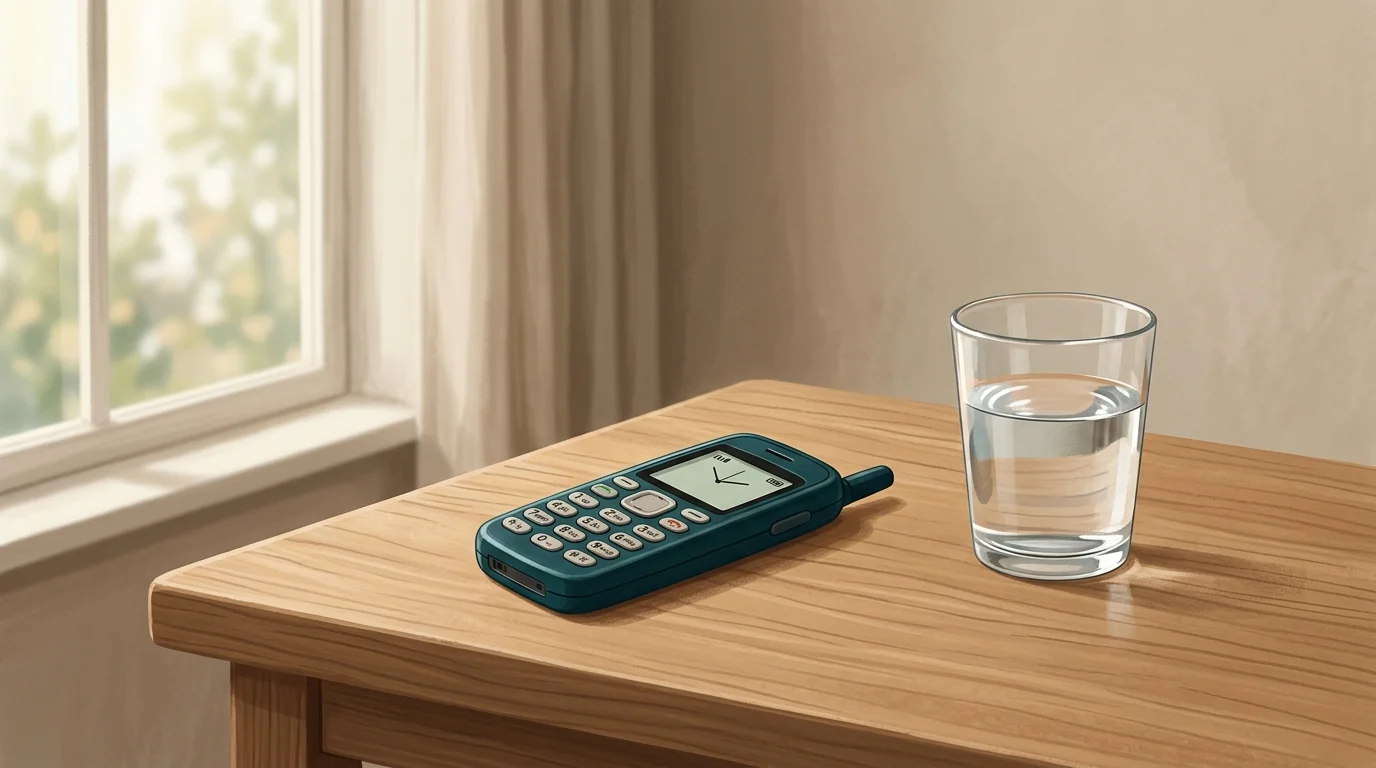
"I should just get a dumb phone." You've said it to yourself. Probably more than once — on a Sunday night after losing three hours to a scroll spiral you don't fully remember entering, or on a morning when your hand found the phone before your eyes were fully open. The idea arrives with a particular clarity: a clean break, no algorithms, no notification engineering, just calls and texts and the open silence of an uninterrupted mind.
The appeal is not irrational. There are real people — not luddites, not people who live off the grid — who've made this switch and describe meaningful changes in their attention and anxiety afterward. The dumb phone experiment has become its own corner of digital wellness culture: a planned thirty-day trial of trading your smartphone for a basic device, to see what's left when you strip the feed away. And it's no longer niche — the flip phone trend is going mainstream in 2026, with younger adults driving demand for feature phones and minimalist devices.
A dumb phone experiment is exactly what it sounds like: you replace your smartphone with a basic phone — one that makes calls, sends texts, and little else — for a fixed period, usually thirty days. The goal isn't to quit technology forever. It's to interrupt the behavioral loop long enough to see what's underneath it, and to find out which smartphone behaviors you actually want to keep once you have the choice back.
Here's the honest account of what that thirty days actually looks like.
What the Dumb Phone Experiment Actually Looks Like
The specifics matter, because "dumb phone" covers a wide range. At the most minimal end: a $20 feature phone with a physical number keypad, calls and texts only, battery life measured in days. In the middle: purpose-built minimalist phones like the Light Phone or the Punkt MP02 — designed specifically for this experiment, with optional navigation and music but no social media, no browser, no app store. Some people don't buy a new device at all; they strip their smartphone down using a launcher app that removes every icon except Phone and Messages.
What you're giving up is the feed. That's the thing. Not the device itself — the infinite scroll. No TikTok, no Instagram, no YouTube Shorts, no Reddit rabbit holes, no news app with its anxious refresh cycle. The social graphs, the group chats full of memes, the browser history of three-minute detours — all of it, gone.
What you keep: calls, texts, a basic camera, navigation if your device allows it. Some people keep music — or replace their phone entirely with a dedicated MP3 player to get the audio experience without the feed. Some remove even that. The specifics of what you keep and what you lose shape the experience significantly, but the core variable is always the same: does the feed go away? If yes, you're running the experiment. If not, you're just using your phone less — which is a different thing.
The experience breaks into distinct phases. And if you've read anything about dopamine detox or smartphone withdrawal, you already have a rough map of what those phases feel like — though the dumb phone version is more structurally enforced. (If a full 30-day switch feels like too large a leap, a 7-day digital detox with your current phone covers much of the same psychological territory with less logistical friction.)
Week One: The Phantom Limb Phase
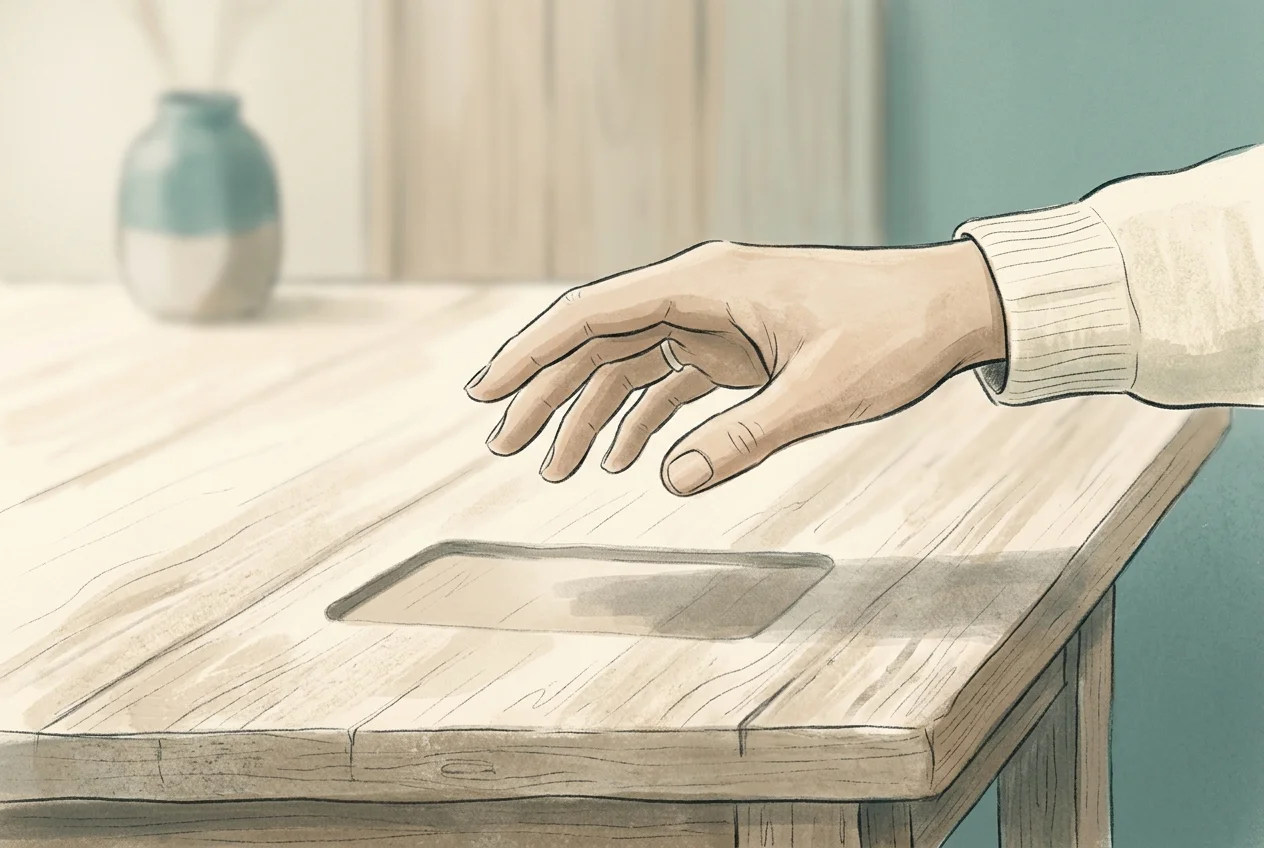
The first thing you notice is the reaching. Your hand goes for the phone in line at the coffee shop, in the pause between conversations, in the three seconds before sleep — and finds nothing to do. The phone is there. You can pick it up. But there's no feed waiting, no badge, no pull. Just a blank screen that reflects your face back at you.
That moment — reaching and finding emptiness — is the most informative moment of the entire experiment. It shows you exactly how often the phone was being used not as a tool, but as an escape from the ambient discomfort of existing without stimulation. Most people are surprised by the frequency. Not once an hour. More like every eight to twelve minutes — the research-backed average for smartphone checks, which people consistently underestimate by more than half.
Neuroscientists call the underlying condition boredom intolerance — the brain's difficulty holding a stimulus-free state after it's been recalibrated toward constant input. When you've spent months or years feeding your brain an algorithmically optimized content drip, ordinary reality starts to feel flat by comparison, the way your eyes take a moment to readjust after being in a very bright room. The first week of the experiment is essentially the process of discovering exactly how recalibrated your threshold has become.
This is also when what researchers call phantom phone syndrome peaks — nomophobia's quieter sibling, the sensation that your phone is vibrating when it isn't, the reach for a pocket that's empty. It's the nervous system searching for a stimulus that's no longer available. Most people experience it most intensely between days three and seven. By day ten, it starts to recede.
Sleep changes first. Without a smartphone in the bedroom — without the blue light, the notification anxiety, the late-night scroll that runs right up to lights out — the cortisol pattern begins to normalize. You might not register it as "dramatically better sleep" in week one. It's subtler than that. The morning feels less pre-loaded. Less like you woke up inside a problem.
Week Two: When Things Start to Shift
Around day ten to fourteen, something changes in the texture of the day. The reaching is still there, but less insistent. The boredom is still heavier than it used to be — it doesn't vanish — but it's become something you can sit inside rather than something you need to escape immediately.
The attention changes are real, and they're subtle. Not "I can now focus for four hours straight" — more like the mind stops fragmenting quite as aggressively. Tasks that used to get interrupted by the itch to check something can be held for longer. Not perfectly, not without effort. But longer. A conversation can be just a conversation, without the half-present feeling of keeping one mental tab open on whatever might be waiting in the feed.
What's happening underneath is your brain's dopamine system recalibrating — resetting toward a baseline where ordinary experiences register as meaningful again, rather than as pale imitations of what's available on the feed. It's the same process as a dopamine detox, but with structural enforcement: there's no device to reach for when the discomfort peaks, so the recalibration actually sticks instead of getting interrupted by one weak moment.
The unexpected difficulty in week two: the practical frictions become harder to ignore. Two-factor authentication is the obstacle that catches most people — every account that uses it needs either an authenticator app, a backup method, or a hardware key. Banking apps. Medical portals. Work systems. The smartphone has quietly become load-bearing infrastructure for modern life in ways that don't surface until you try to remove it. Navigation too: maps has become so automatic that many people have lost the habit of planning where they're going before they leave. These aren't showstoppers. They're friction that requires planning, which is itself a change in how you relate to your phone.
Week Three and Four: What Actually Changed (And What Didn't)
By week three, the experiment stops being about the phone and starts being about you.
What changed: presence, mostly. Being in a conversation without half a mental tab open on what might be waiting. Walking somewhere without the automatic narration of an Instagram Story. Eating meals that just ended instead of becoming content. These aren't dramatic transformations — they're the recovery of an ordinary attentiveness that had quietly been eroding for years without your noticing it go.
Boredom changed too. By week four, the heavy, uncomfortable quality of the first week had thinned into something more bearable — occasionally even interesting. Empty time started to behave the way empty time used to: generating thoughts you didn't know you were having, surfacing things you'd been meaning to think about, letting the background processing your brain does constantly actually complete. This is what people in screen time reduction communities mean when they describe boredom as the space where creativity lives. They're describing week four. Not week one.
What didn't change: the underlying appetite for stimulation. It's still there. It just finds other channels — food, television, compulsive book-finishing, meandering conversations that feel oddly similar to swiping. The dumb phone experiment changes the surface the habit runs on. It doesn't cure the behavioral architecture underneath. The hardware swap removes the most potent delivery mechanism. What remains is the nervous system itself, looking for input, as it always has.
This is where most honest accounts of the experiment converge: it works best as a reset, not a solution. Thirty days without a smartphone recalibrates your sensitivity and gives you real data about your own patterns. What you do with that data when you return to a smartphone — or whether you return at all — is where the actual decision lives.
The Verdict: Was It Worth It?

The honest answer — drawn from hundreds of documented accounts across communities like r/nosurf and r/digitalminimalism — is: yes, for the reset. For most people, not permanently.
The consistent findings: week one is harder than anticipated. Attention improves measurably by week two. Sleep improves within days. The discovery of boredom as an experience rather than a problem — as something to move through rather than immediately neutralize — is genuinely valuable and doesn't go away when the experiment ends. These are real gains. They're not small.
People who keep the dumb phone long-term tend to share certain characteristics: they've restructured their professional and social lives significantly to accommodate it, they've pre-solved the 2FA and authentication problem with deliberate systems, and they've accepted that they're trading specific conveniences for something they value more — attention, presence, the reclamation of a certain quality of time. They're not wrong. It's a legitimate trade if the terms work for your life.
For most people, thirty days reveals what they actually needed to know: which app behaviors were genuinely useful, which were automatic, and which they'd been defending more out of habit than intention. Most people return to a smartphone at the end of the experiment. But they return differently — with more clarity about what they're picking up and why.
Have you ever noticed how different it feels to choose to open an app versus just finding yourself inside one? The experiment makes that distinction impossible to miss. And once you've seen it, you can't unsee it.
The Alternative That Doesn't Require Buying New Hardware
If the dumb phone experiment is a factory reset, friction-based tools are the targeted patch.
What the thirty days without a smartphone teaches you is that the problem isn't the device — it's the access architecture. Unlimited, frictionless, instant access to an infinite feed is the behavioral design choice that makes ordinary restraint nearly impossible. The dumb phone removes that access entirely. It works. It's also a meaningful disruption to the rest of your daily infrastructure.
What friction-based tools do is surgically alter the access architecture without requiring you to trade in your phone, your 2FA app, or your maps. Sip & Scroll adds a single intentional pause before TikTok, Instagram, YouTube Shorts, or whatever app pulls hardest — a sip of water and a quick selfie, then forty-five minutes of completely unblocked access. That pause interrupts the automatic chain at exactly the right moment: after the reach, before the feed opens. Just enough lag for your brain to register a choice rather than a reflex.
The thirty-day experiment shows you why that pause matters. The access architecture is the problem — not your willpower, not the device itself. Sip & Scroll changes the architecture without changing the hardware. You get the attentiveness without the disruption. You get to keep your maps.
You don't have to go dumb to use your phone more mindfully. You need the right amount of friction in the right place. The experiment shows you why. What you put there is up to you.
Add the pause. Keep the phone.
Sip & Scroll adds a sip of water and selfie before your highest-use apps — then 45 minutes of unblocked access. The architecture fix without the hardware swap.
Download Sip & Scroll Free