Why "Quiet Quitting" Is Actually Just Boundary Setting
The debate has the costs backwards. The withdrawal isn't the problem — the overwork that preceded it was.
The "quiet quitting" trend hasn't cost workers a thing. The cost was already paid — in every email answered at 10pm, every weekend mentally contaminated by work that followed you home in the phone in your pocket, every vacation half-spent glancing at Slack. The quitting isn't quiet. The payment was.
This is the framing the entire debate has missed. "Quiet quitting" isn't an act of withdrawal. It's the moment a person stops subsidizing their employer with free labor and starts working the hours they're actually paid to work. And somehow, we've built a cultural conversation that treats this as a moral failing.
Quiet quitting is not quitting. It means doing your job — fully, competently, professionally — without also performing the theater of unlimited availability that knowledge-work culture has come to expect. You answer emails during business hours. You do your work. You don't volunteer unpaid overtime, check Slack at midnight, or respond to messages that arrive after the workday is over. In most of the developed world, this would simply be called "having a job."
What the Term Actually Reveals
The phrase "quiet quitting" was popularized on TikTok in 2022, but the phenomenon it describes is far older. Gallup calls it "not engaged" — and according to their research, quiet quitters make up at least 50% of the U.S. workforce. Half the country is doing this. Not because half the country is lazy. Because the baseline expectation has drifted well above what most job descriptions actually say.
When "showing up fully" means being mentally available at all hours, when "going above and beyond" becomes the minimum to avoid being labeled disengaged, the definition of normal has quietly shifted. Quiet quitting is just people noticing that shift and choosing not to follow it.
The real revelation embedded in the term isn't that employees are checked out. It's that the culture required extraordinary, uncompensated labor to look ordinary.
We Normalized the Abnormal
Think about what the "engaged" employee actually does in 2026 compared to someone doing the same job 30 years ago. They carry a device that beeps when their boss has a thought at 9pm. They respond to Slack messages on days off. They attend virtual meetings scheduled during lunch because the calendar had an opening. They field "quick questions" from the bathroom.
The smartphone didn't create always-on work culture — but it made it frictionless. Before email was in your pocket, work had to wait for a desktop. The physical separation between home and office was also a temporal one. When the device follows you into the bedroom, the dinner table, the vacation — work is never fully off.
The World Health Organization classified burnout in 2019 as an occupational phenomenon — a syndrome resulting from "chronic workplace stress that has not been successfully managed." The three dimensions WHO identifies are energy depletion, mental distance from work, and reduced professional effectiveness. All three are accelerated by a culture that treats availability as loyalty.
Quiet quitting is often the body's first signal that this loop is unsustainable. Not a moral failure. A warning light.
Boundaries Are Infrastructure, Not Laziness
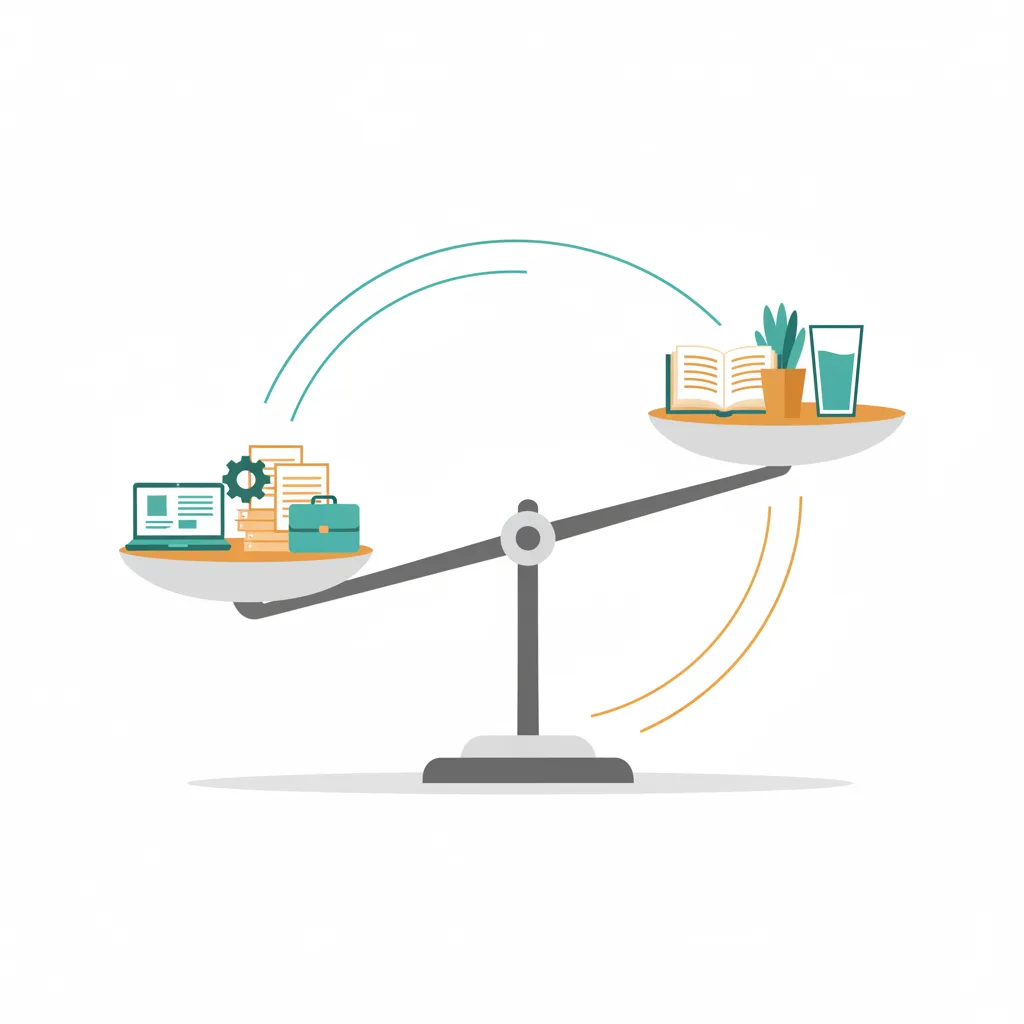
The word "boundary" has become loaded — it can sound therapeutic, even precious. But in psychological terms, a boundary is simply a limit that determines what you will and won't accept, then stated clearly and calmly. It's not a wall. It's a specification. It's you telling your environment: here is where I end and where the job begins.
Healthy boundaries aren't about doing less. They're about doing what you agreed to do — with the attention it deserves — and then actually stopping so your brain can recover. Recovery is when the consolidation happens: when the learning sets, when creativity refills, when the prefrontal cortex recharges enough to make good decisions again the next morning.
The employee who answers emails until midnight is not more productive than the person who stops at 6pm. Cognitive performance research consistently shows that overwork degrades output quality faster than it adds hours. You're not doing more work. You're doing the same work, worse, for longer — and you're spending your personal time as the cost.
Yet overwork is self-reinforcing: if everyone answers emails at midnight, the person who doesn't appears disengaged. The culture punishes the boundary, which is why individual willpower alone doesn't fix it. Structural change is required.
The Phone Is the Main Breach in the Wall
Here's where this becomes a screen time problem as much as a workplace one.
The phone is the primary vector through which always-on culture enters your personal life. Work Slack is two icons from Instagram. The email notification arrives at 9pm on the same device you use to unwind. The boundary between "work mode" and "rest mode" doesn't exist architecturally — it only holds if you enforce it deliberately, against a device engineered to keep you engaged.
This is the same dynamic that drives compulsive social media use and morning anxiety — the phone sits in your pocket, every quiet moment is an invitation to check something, and the neural reflex to reach for it fires before conscious thought catches up. Whether you're opening Instagram or opening work email, the pathway is identical: low stimulation → reach for phone → temporary relief → repeat.
The right-to-disconnect laws taking hold in Europe recognize this explicitly. They're not just regulating work hours — they're acknowledging that expecting individual willpower to resist an architectural problem doesn't work. Some countries now restrict after-hours work communication at the system level, because the boundary has to live somewhere other than in each employee's personal discipline.
That's the same logic behind digital minimalism: you don't out-willpower a system engineered to override your prefrontal cortex. You change the architecture.
Practically, this might look like keeping work apps off your personal phone entirely, using a separate device for anything job-related, or adopting the phone foyer method — leaving your phone in a designated spot when you arrive home so its presence doesn't contaminate the space. Physical distance between you and the device creates temporal distance between you and the work.
App-level friction does the same thing, more granularly. Sip & Scroll adds a brief pause — a sip of water and a quick selfie — before any app opens. That pause won't stop you from opening your phone. But it will surface the question you stopped asking: Am I opening this with intention, or out of reflex? For someone trying to enforce the boundary between work hours and personal time, that two-second pause might be exactly when you realize it's 10pm and the Slack notification can wait until morning.
You don't have to call it quiet quitting. Call it finishing work at the time you're paid to finish. Call it recovering so you can actually perform tomorrow. Call it not letting a pocket-sized computer dissolve the line between your job and your life.
The boundaries that protect your evenings are the same ones that protect your sleep, your attention, and your ability to show up with something left in reserve. That's not withdrawal. That's the architecture of a sustainable working life.
This article is part of our series on digital culture and screen time trends. For the full picture, see our guide: The Impact of Infinite Scroll on Gen Z Mental Health.
Build your boundary with a sip.
Sip & Scroll adds gentle friction before addictive apps open — so your phone use stays intentional, not reflexive.
Download Sip & Scroll — Free