Is Deleting Social Media Worth It? What You Actually Lose
There are real costs to quitting — and most social media detox articles won't tell you what they are. Here's the honest version.
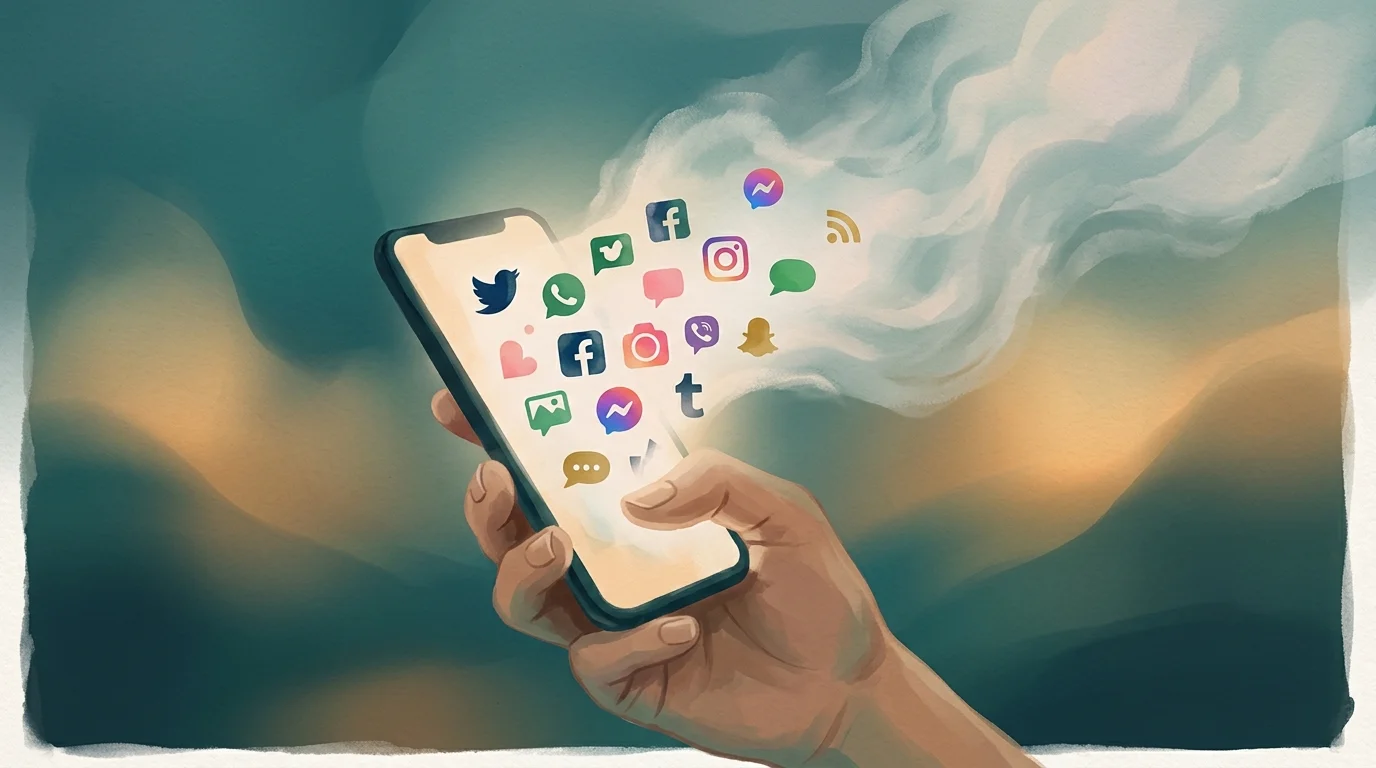
Suppose you deleted every social media app on your phone tonight — Instagram, TikTok, X, Reddit, all of it. Imagine waking up tomorrow with none of it there. No feed. No notifications. No group chats built inside the apps. Just the quiet.
Now imagine six months later. What's different? The optimistic version of this thought experiment is easy to picture: better sleep, sharper focus, more time for things that actually matter. The less-examined version is what's missing — the things you quietly depended on social media for that you didn't fully notice until they were gone.
Deleting social media is worth it for most people who do it deliberately — but the tradeoffs are real, and pretending otherwise makes the decision harder, not easier. The goal here is an honest accounting: what the research says you gain, what it says you lose, and how to make the calculation for your actual life rather than an idealized version of it.
What the Research Actually Says You Gain

The evidence on what happens when people reduce or eliminate social media is more consistent than you might expect. A review of 18 experimental studies by social psychologist Jonathan Haidt found that 12 of 18 — 67% — showed mental health improvements when participants cut back on social media. The improvements were concentrated in anxiety, depression, loneliness, and sleep quality.
The mechanism isn't mysterious. Social media is architecturally designed to trigger social comparison — to surface what others are doing, achieving, and experiencing at a rate and volume that human social environments never produced before. Your brain evolved for a social group of roughly 150 people. Instagram gives you access to 500 million. The result is a continuous low-grade appraisal process — measuring yourself against an endless parade of curated highlight reels — that your nervous system was never built to run at this scale.
Remove that input, and the comparison engine quiets. Sleep improves because the cortisol-spiking news cycle and the anxious late-night scroll no longer happen — and because the blue light from the device isn't suppressing melatonin an hour before bed. Attention span lengthens, slowly, as the brain's reward system recalibrates away from the popcorn brain pattern that constant short-form content produces. The recovery isn't instant — researchers estimate 4–8 weeks for meaningful attention restoration — but it happens.
Free time materializes. The average person spends 2–3 hours daily on social media. That time doesn't disappear when you quit — it reappears, unscheduled and available, often for the first time in years. What you do with it is yours to choose.
What You Actually Lose (The Honest List)
This is the part most detox articles skip. Quitting social media has real costs, and acknowledging them isn't an argument against quitting — it's preparation for doing it successfully.
Passive social connection. Social media creates ambient awareness of your network — you know, without effort, that your college roommate had a baby, that a former colleague just started a new job, that someone you haven't spoken to in a year is dealing with something hard. This low-cost, low-commitment connection has genuine value. You can replace it with phone calls and direct messages, but that requires converting passive awareness into active effort, which most people do for their close relationships and don't do for the rest. The rest will drift. For many people, this turns out to be okay — but it's real, and it's worth acknowledging.
Event discovery. A meaningful fraction of social events — parties, local concerts, community gatherings, professional meetups — get organized on or promoted through social media. If you leave, you miss the channel. The workaround is direct communication, email newsletters, and telling your closest friends to keep you in the loop. This works, but requires you to explicitly rebuild what social media did automatically.
Professional visibility. Depending on your field, social media may be where your professional identity lives. Designers on Instagram, developers on LinkedIn, writers on X, researchers on Bluesky — these platforms are where opportunities surface and where reputations compound. Quitting entirely may mean opting out of an ecosystem that shapes hiring, collaboration, and professional community in your industry. This is a real cost, not a rationalization for staying.
The information current. Social media is how many people learn that something is happening — a news story, a cultural moment, a local crisis. The alternative is actively seeking out news through RSS feeds, newsletters, or traditional media, all of which require more intentionality. The cost isn't being uninformed — it's being on a slight delay, and having to build new habits for the information you actually need. Pew Research found that 72% of US adults use at least one social media platform, and for a significant share, it's their primary news source. Leaving means finding a replacement, not just accepting a gap.
The Decision That Actually Matters
Most people approach the "should I quit?" question as binary — stay or leave, all or nothing. This framing is the thing that makes the decision feel impossible, because both options carry costs that feel unbearable when you hold them together. It's worth noting that even platforms designed for authenticity haven't solved this — as the BeReal vs Instagram comparison shows, the problem isn't curation tools, it's the audience itself.
The more useful question is: does my specific use of social media, as it actually happens, cost more than it gives me? Not the idealized version of your use. The real version — the 11pm scroll you didn't intend, the comparison spiral after checking an ex's profile, the hour that disappeared on a Sunday afternoon. What does that version cost? And what does it give?
For some people, the answer to that honest accounting is: quit. The costs of staying are concrete and daily; the costs of leaving are mostly about logistics that can be solved. If you've tried a social media detox and found the clarity on the other side compelling, or if your use consistently leaves you feeling worse rather than better, full deletion may genuinely be the right call.
For others, the answer is: change the relationship. The problem isn't that social media exists — it's that the access to it is frictionless, reflexive, and unconditional. You open it in every idle moment not because you decided to, but because your thumb knows the way. Dopamine research on variable-ratio reinforcement shows that intermittent, unpredictable rewards — the core mechanic of every social feed — are the most powerful drivers of compulsive behavior in the brain's reward system. The feed is designed to be opened without a reason.
The structural fix for that isn't necessarily deletion. It's friction. A pause. Something that forces a conscious choice to happen before the reflex fires. Sloww's treatment of Cal Newport's digital minimalism framework frames the goal precisely: a tool earns its place only when its benefits clearly outweigh its costs in your specific life — and that calculation has to be made deliberately, not by default.
The Middle Path: Intentional Access
What most people who successfully reduce social media use without quitting entirely have in common is a behavioral intervention at the moment of access — something that interrupts the automatic open and requires a moment of deliberate choice.
This is exactly what Sip & Scroll is built to do. Before you can open TikTok, Instagram, or YouTube Shorts, it pauses you with a small ritual: take a sip of water, snap a quick selfie to verify it. Then you get 45 minutes of intentional, unblocked access. The two seconds of friction is enough for your prefrontal cortex to register that something is happening — to ask whether you actually want this right now, or whether your thumb just got there first. After the 45-minute session, it resets. Another sip if you want to continue, or the choice to stop.
You don't lose the information. You don't lose the connection. You lose the reflex. And losing the reflex — the mindless open, the twenty-minute disappearance, the session you didn't intend — turns out to be most of what people are actually trying to get rid of when they consider quitting.
Whether you delete the apps or install a friction layer, the decision is the same: you're choosing to stop letting the feed decide when you show up to it. The architecture has always been designed to make you available on its terms. You're allowed to change that. You don't have to go cold turkey to do it. You just need to put something between the impulse and the scroll.
This article is part of our series on personal screen time journeys. For the full picture, see our guide: My Journey from 8 Hours of Screen Time to Just 2.
Keep the access. Lose the reflex.
Sip & Scroll adds one small ritual before Instagram and TikTok — enough friction to make scrolling a choice, not a habit.
Download Sip & Scroll Free