Do You Have Phone Addiction? The Signs Are Subtler Than You Think
Most people picture obvious extremes when they imagine phone addiction. The reality is quieter — and harder to dismiss.
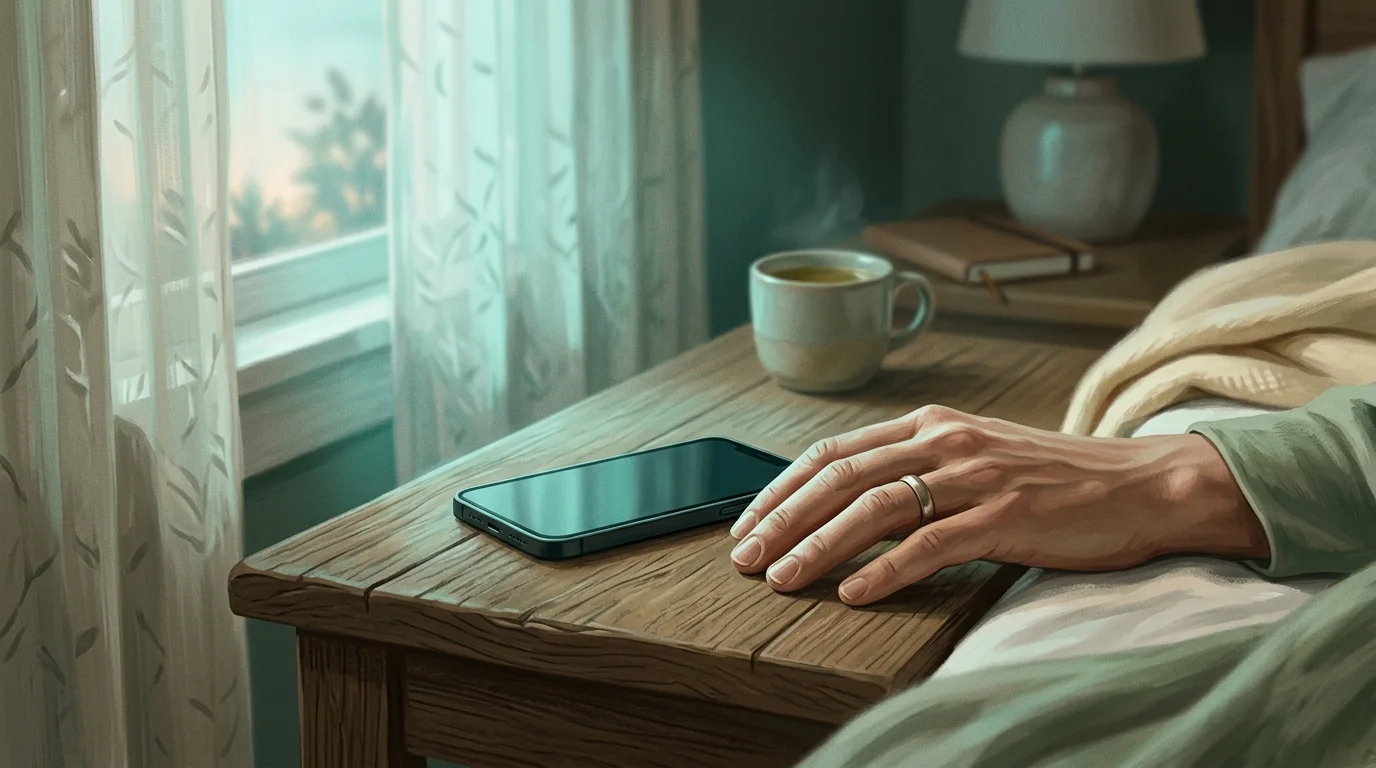
Suppose someone told you that you were addicted to your phone. Your first instinct would probably be to laugh it off. You're not that person — the one scrolling at the dinner table, or checking their phone mid-conversation while someone's still talking, or reaching for it at a stoplight the moment traffic slows. You know people like that. You're not like them.
But notice what happens in the next quiet moment — a pause in a meeting, a few seconds waiting for the elevator, the first thirty seconds after waking up. Notice where your hand goes. Notice whether you actually decided to check your phone, or whether it was already in your hand before the thought fully formed.
That gap — between intention and behavior — is where phone addiction lives. Not in the dramatic cases. In the automatic ones.
Phone addiction, more formally called problematic smartphone use, is a behavioral pattern in which compulsive phone use continues despite negative consequences — to your focus, your relationships, your sleep, your sense of time. It's driven by the same neurological mechanism behind gambling addiction: dopamine doesn't fire when you get a reward, it fires in anticipation of a possible reward. Every scroll is a pull of the lever. Most pulls are nothing. But you never know which one will pay off — and that uncertainty is precisely what keeps you pulling.
The Obvious Signs (And Why They're Not Enough)
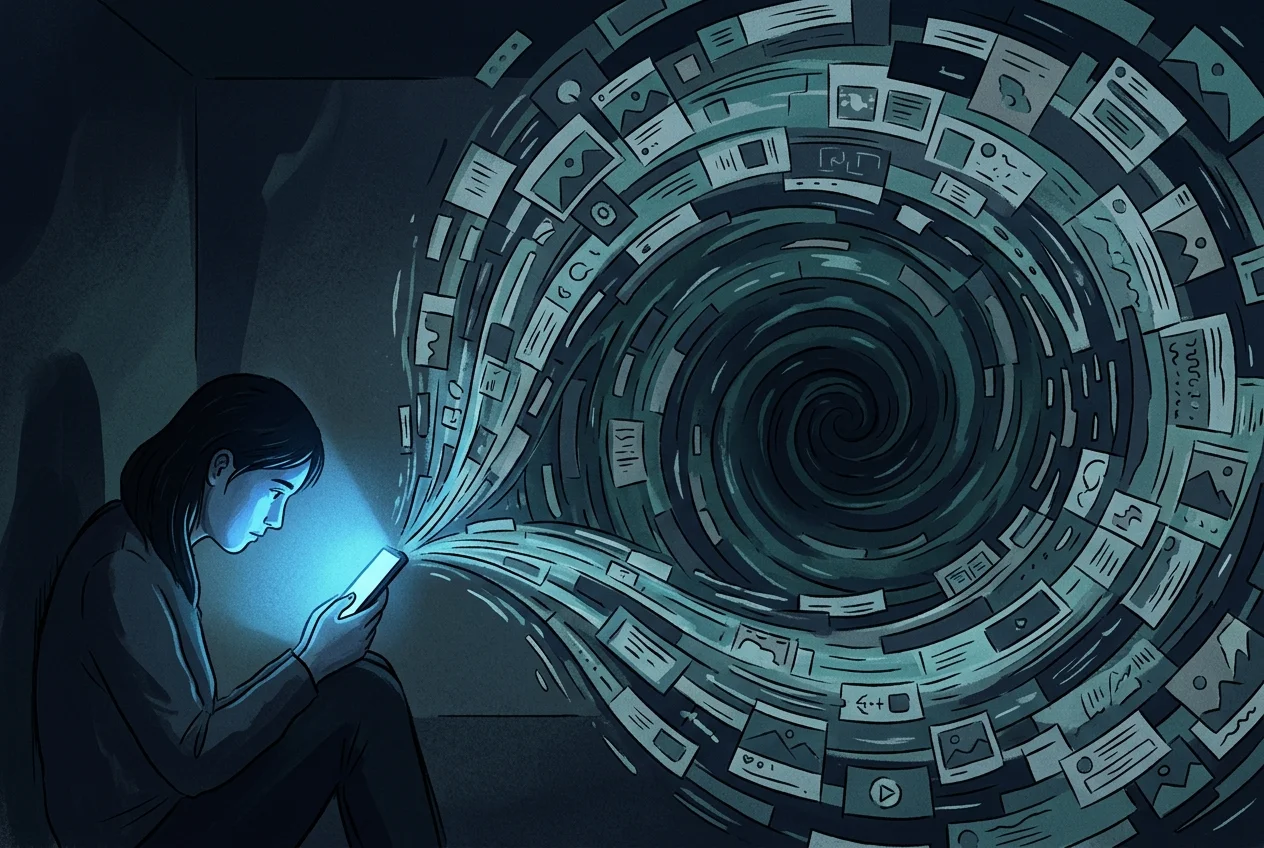
There are signs of phone addiction that show up in every listicle — and they're real, just incomplete. You probably already know them: using your phone more than you intend to, feeling anxious when the battery drops below 20%, checking it first thing in the morning and last thing at night, losing two hours to an app you opened for thirty seconds.
Pew Research found that 35% of teens use social media "almost constantly" — a number that has only grown since the survey was published. But the same dynamic applies to adults: a 2026 study of smartphone behavior found that the average person checks their phone 96 times a day, once every ten minutes of waking life, often without any specific intent.
These visible behaviors are the ones people point to when they decide they don't have a problem. "I'm not that bad." The more diagnostic question is what happens when the behavior is interrupted. Do you feel relief, or do you feel a pull — a low-grade discomfort, a vague itch that doesn't go away until you check? That pull is the signal. The frequency of use is just the noise.
The Subtle Signs That Actually Matter
The subtler signs of phone addiction are the ones that don't make the listicles, because they don't look like addiction from the outside. They look like personality traits, or modern life, or just being tired. But they point to the same underlying disruption.
You can't tolerate unstructured boredom anymore. Not the pleasant empty-afternoon kind — the brief, ordinary kind. Waiting two minutes for a coffee. Sitting at a red light. Standing in a line. The moment there's no external stimulus, the pull to reach for the phone is immediate. This isn't laziness or impatience. It's your brain's reward circuitry recalibrating to expect continuous stimulation. Sitting with ten seconds of quiet feels physically uncomfortable because your nervous system has learned to avoid that state.
Your mood tracks your feed. You came to Instagram to kill five minutes and left feeling vaguely worse — more anxious, more dissatisfied, less motivated — without being able to say exactly why. Or the opposite: a string of dopamine hits leaves you buzzed but hollow. When your emotional baseline becomes dependent on what an algorithm shows you, that's not social media use. That's a dependency.
You lose time in chunks you can't account for. Not the occasional scroll — the kind where you look up and it's been forty minutes and you have no clear memory of what you saw. This is zombie scrolling: a dissociated, almost trance-like state where the content isn't even registering. You're not enjoying it. You're just continuing. The absence of enjoyment doesn't stop you. That's the diagnostic part.
You reach for it when you feel something. Stressed, bored, lonely, excited, sad — the phone has become the default response to any emotional state. This is what researchers call emotion regulation via device use: you're using the phone not for content, but to manage an internal state. It works in the short term. Over time, it crowds out every other coping mechanism you might have developed, leaving the phone as the only tool in the kit.
You feel low-grade anxiety without it. Nomophobia — the fear of being without your phone — gets mocked as a millennial joke, but the underlying experience is real and measurable. If leaving your phone at home produces genuine distress rather than mild inconvenience, or if you find yourself constantly checking your pocket to make sure it's there, your nervous system has incorporated the device as something close to a safety object.
What's Actually Happening in Your Brain

Understanding the neurological mechanism doesn't make the behavior feel less frustrating — but it does make it feel less like a character flaw. And that reframe matters, because shame is not a useful treatment for addiction.
Research on the brain health consequences of digital technology shows consistent changes in attention systems, memory consolidation, and impulse control in heavy smartphone users. The prefrontal cortex — the region responsible for planning, impulse inhibition, and recognizing long-term consequences — is exactly the region that gets overridden by the reward-seeking circuits that social media is designed to activate. Your rational brain knows you should stop. The circuitry that controls stopping has been outgunned.
The mechanism is variable-ratio reinforcement — the same structure that makes slot machines the most addictive form of gambling ever designed. You don't get rewarded every time you check your phone. Sometimes the feed is boring. Sometimes it's gold. You never know which pull will pay off, so the brain learns to fire dopamine not on reward but on anticipation. Every scroll becomes a micro-bet. The uncertainty itself becomes the hook. Social media engineers know this. The infinite scroll, the pull-to-refresh, the like counter — these are not features. They are reward mechanics.
There's also a well-replicated finding about proximity: merely having a smartphone on your desk — even face-down, even silent, even switched off — measurably reduces available working memory and fluid intelligence, because part of your brain is continuously monitoring for it. The device doesn't need to be in your hand to cost you cognitive capacity. It just needs to be in the room.
Heavy Use vs. Addiction: Where's the Line?
Not everyone who uses their phone a lot is addicted to it. The distinction is control and consequence.
Heavy use is intentional — you use your phone frequently, but you can put it down when context demands it. You might spend two hours a day on social media and still feel like that was your choice, in service of something you wanted (connection, entertainment, information). The use fits your values, even if the volume is high.
Addiction is compulsion. You reach for the phone when you didn't plan to. You continue past the point where it stopped feeling good. You've tried to cut back and found the pull returning within minutes, along with a subtle restlessness that doesn't go away until you give in. The behavior is running you, rather than the other way around.
The clearest diagnostic question: what happens when you try to stop? If putting your phone in a drawer for an evening produces mild inconvenience, you have heavy use. If it produces anxiety, irritability, and a recurring pull that keeps drawing your attention back to the drawer — that's a dependency. It doesn't require a clinical label to be worth taking seriously. The lived experience is the signal. The question is whether you want to act on it.
For people with ADHD, this line is particularly blurry. The same dopamine-seeking circuitry that makes phones irresistible also underlies the ADHD brain's constant search for novelty. ADHD and phone addiction interact in ways that make the pull significantly stronger — and the standard advice to "just use it less" even less useful.
What Actually Helps (Structural Fixes, Not Willpower)
If you've recognized yourself in any of this, the worst thing you can do is try to out-willpower the behavior. Willpower is a finite resource deployed by the same prefrontal cortex that's already losing the battle. You cannot win a war of attrition against systems engineered by teams of behavioral scientists with billions of dollars and your entire behavioral history as their dataset.
What works is architecture — changing the environment so that the compulsive behavior requires deliberate effort rather than zero friction.
Physical distance is the most evidence-backed intervention. Phone in another room, not in your pocket. Charger in the kitchen, not the bedroom. If the device is not within arm's reach, the reflex loop breaks — there's a moment of recognition before the behavior that gives the prefrontal cortex time to register a choice. That moment is where change lives.
Friction before the addictive apps is the next layer. Not a hard block — those get deleted because they feel like punishment. A brief, intentional pause that interrupts the automatic open → scroll sequence. Treating phone addiction like any behavioral dependency means working with the brain's plasticity rather than against its momentum.
This is what Sip & Scroll is built around. When you set up an app like TikTok or Instagram inside Sip & Scroll, opening it prompts you to take a genuine sip of water and snap a quick selfie verifying it. The pause is about three seconds — enough to interrupt the reflex, register that you're making a choice, and give your prefrontal cortex a moment to participate. After that, you get up to 45 minutes of unblocked access. No punishment, no hard lockout, no shame. Just a pause that makes the choice conscious rather than automatic. And a sip of water, which your body probably needed anyway.
You don't have to keep running on autopilot. The fact that you're reading this suggests the autopilot is already costing you something. The fix isn't discipline. It's friction, applied precisely where the reflex fires — before the feed opens, not after you're already in it.
This article is part of our series on phone addiction and doomscrolling. For the full picture, see our guide: What is Doomscrolling?.
Turn the reflex into a ritual.
A sip of water before you scroll. Simple friction that gives your brain time to choose.
Download Sip & Scroll